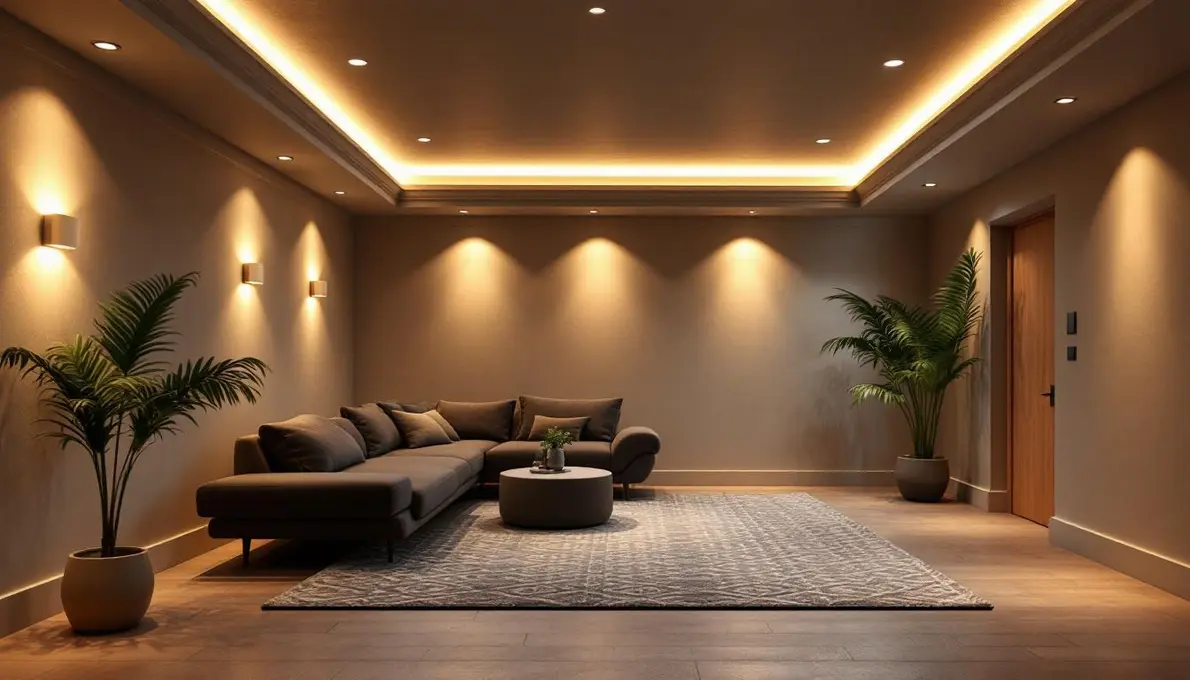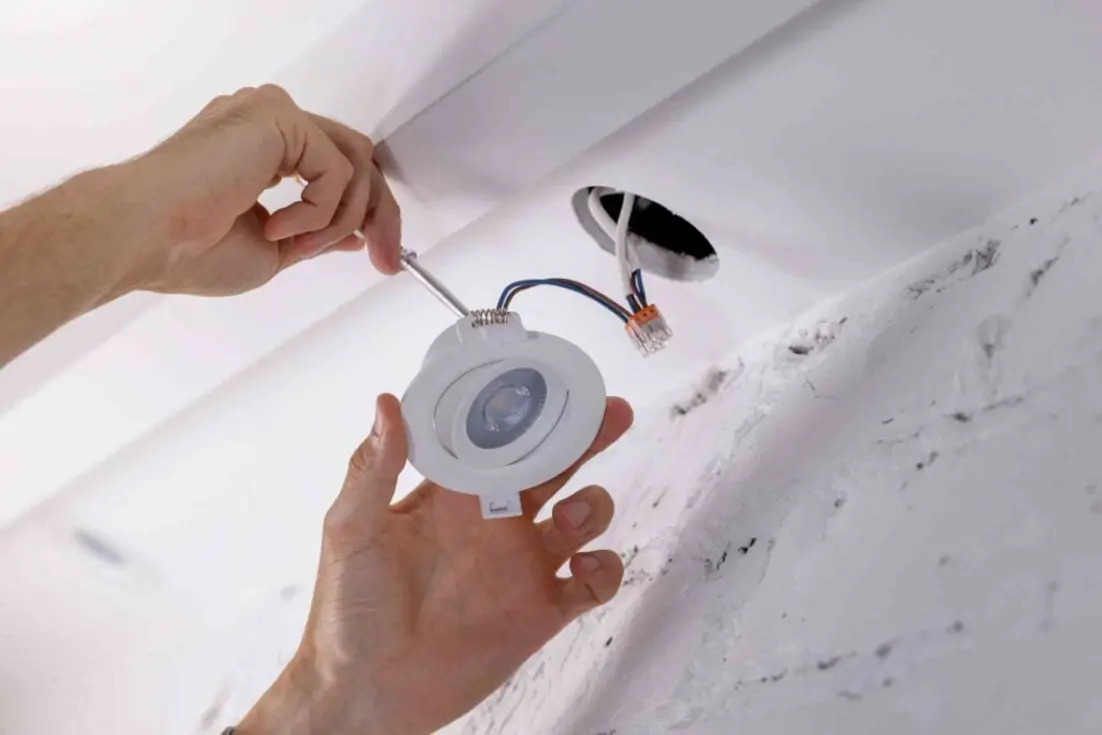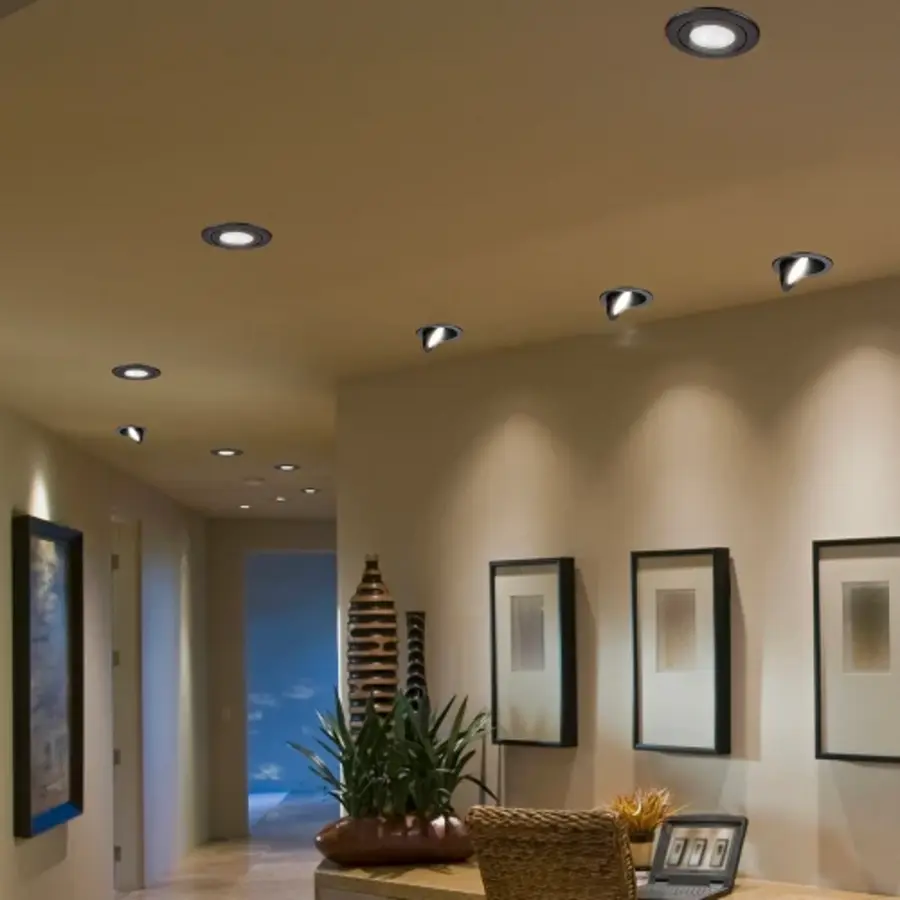
Warm dim gimbal recessed lights can solve two separate problems at once: they let you direct light toward a wall, artwork, cabinet front, or task area, and they make the light look warmer as it is dimmed. The difficult part is that many slim adjustable fixtures achieve their low-profile installation by placing the LED lens close to the ceiling plane. That can leave a bright source visible from across the room.
For a low-glare result, prioritize a regressed optical system over the thinnest possible fixture. Then confirm that the fixture is truly dim-to-warm, works with a compatible dimmer, has enough aiming range for the intended surface, and can physically fit around joists and other ceiling obstructions.
Start with the distinction: dim-to-warm is not selectable color temperature
A fixture described as "5 CCT selectable" may let an installer choose one fixed color temperature before installation, such as a warm, neutral, or cool setting. Once installed, it generally dims while staying near that selected color temperature.
A genuine dim-to-warm fixture changes color temperature as light output falls. At full output, it may begin at a relatively warm white; at lower levels, it shifts toward an amber, incandescent-like appearance. The exact starting and ending color temperatures vary by product, so read the photometric and dimming information rather than assuming all warm-dim products behave alike.
This matters in a bedroom or living room, where lower evening light levels often feel more comfortable when they are warmer. In a kitchen, dim-to-warm can be useful for late-night ambient lighting, but it does not replace dedicated task lighting where clear visibility is needed.
Make regression the first glare filter
Regression describes how far the light-emitting surface sits above the finished ceiling. A regressed gimbal recessed light places its lens and light engine inside a deeper opening, often with a dark or light-colored baffle around it. This geometry helps conceal the brightest part of the fixture when viewed from the side.
By contrast, many gimbal wafer lights have a nearly flush, exposed lens that pivots below or close to the ceiling. They can be practical where there is little ceiling depth, but the luminous surface may be visible from seating areas, hallways, or adjacent rooms.
When comparing adjustable warm dim recessed lighting, look at product photos from the side rather than only straight below. Ask these questions:
- Can you see the LED lens when standing several feet away?
- Does the gimbal sit inside a recessed housing or protrude below the ceiling?
- Is there a baffle, reflector, louver, or other shielding element around the light source?
- Does tilting the fixture expose more of the bright lens toward the normal viewing direction?
A fixture can be regressed when pointed straight down yet become visually harsh once aimed toward a wall. Check product images or documentation that show the gimbal at its likely operating angle.
Treat aiming and glare as linked decisions
A gimbal is most useful when it has a specific target. It may correct for a sloped ceiling, light a vertical surface, emphasize artwork, or place light closer to a counter edge. But every tilt changes where the brightest part of the fixture is visible.
Avoid aiming a gimbal toward the main seating position, bed, dining chair, or television-viewing area. Even if the beam is aimed at a wall, the lens can be uncomfortable if it faces a person seated across the room.
For wall washing, the fixture should usually be positioned and aimed to create an even field of light rather than a bright oval with a dark upper wall. The needed setback depends on ceiling height, beam spread, wall texture, and fixture optics. A lighting plan is more reliable than placing fixtures by a standard rule of thumb.
In kitchens, do not assume a tilted gimbal is the best way to light a work surface. A bright adjustable fixture aimed toward a counter can reflect in polished stone, glossy cabinets, appliance doors, or a nearby person’s line of sight. Under-cabinet lighting and carefully placed downlights often handle task illumination with less glare. See our guide to where to mount under-cabinet LED strips for the task-lighting side of that decision.
Compare aperture, beam angle, and light output together
A nominal 4-inch light is often a sensible scale for rooms with standard-height ceilings, but its apparent brightness depends on more than aperture size. A small opening can look discreet, yet a concentrated beam from a small bright source can still create glare.
Review these specifications as a group:
| Specification | What it affects | What to look for |
|---|---|---|
| Aperture size | Visual scale and source size | A size that suits the ceiling without assuming smaller always means lower glare |
| Beam angle | How concentrated or broad the beam is | A beam spread suited to the target surface and mounting distance |
| Lumens | Total light output | Enough usable light at the intended dimming level, not simply the highest output |
| Candela or photometric data | Intensity in particular directions | Useful evidence of beam control when available |
| Tilt and rotation range | Whether the light can reach its target | Enough adjustment without needing an extreme tilt |
| Regression depth | Source shielding | A visibly recessed lens or optic, especially for seated rooms |
A wide beam can be more forgiving for general light and wall washing. A narrower beam can be useful for art or architectural accents, but it requires more careful placement and aiming. If detailed photometric information is unavailable, that is a reason to be cautious about using the fixture for a glare-sensitive job.
Choose the dimming system before buying the fixtures
The warm shift and the lowest stable dimming level depend on the fixture's driver and the dimmer used with it. A product described as dimmable is not necessarily compatible with every wall dimmer, and a dimmer that works acceptably with one LED fixture may perform poorly with another.
Look for a current compatibility list from the fixture manufacturer. If possible, confirm the exact dimmer model rather than relying only on broad terms such as "LED compatible" or "TRIAC dimmable." Also check whether the documentation states a low-end dimming level or describes expected dimming performance.
Before committing to a whole room, it can be worthwhile to have the electrician test one fixture and the intended control. Watch for flicker, popping on or off near the low end, delayed startup, uneven dimming between fixtures, or a warm-dim shift that happens too abruptly.
If an existing recessed LED system flickers after a dimmer change, the issue may be dimmer-driver compatibility rather than the fixture's advertised dimming capability. Our guide to recessed LED lights that flicker on a standard switch explains the common symptoms and limits of homeowner troubleshooting.
Do not let a canless design override the optical decision
Canless lights are popular because the thin fixture body and separate junction box can fit in some tight ceiling spaces. But a canless fixture still needs a path for the junction box, wiring, spring clips, and any required clearances. Joists, ductwork, plumbing, insulation, ceiling framing, and existing electrical boxes can all affect the installation.
A thin gimbal wafer light may be the only realistic option in a constrained ceiling. If so, reduce glare through placement and aiming rather than assuming the fixture itself will conceal its source. Keep it out of direct sightlines, use more modest output where possible, and avoid placing it directly over a sofa, bed, or dining seat.
If ceiling depth permits, a deeper recessed adjustable fixture may provide better visual comfort than a wafer-style gimbal. It can also offer more deliberate optics, though this varies by product.
Do not rely on online listings alone for fit or safety information. Confirm the cutout size, junction-box dimensions, driver location, insulation contact listing, ceiling compatibility, and any local installation requirements with the manufacturer’s current documentation. For new wiring, altered circuits, or uncertain conditions above the ceiling, use a qualified electrician and verify current local rules.
Match the fixture type to the room
Living room
Prioritize source shielding and low-end dimming. Regressed adjustable fixtures can work well for lighting artwork, a fireplace wall, shelving, or textured architectural surfaces. Avoid using many tilted gimbals as the room's only ambient layer; a combination of indirect lighting, lamps, and controlled recessed lighting is usually more comfortable.
For lower ceilings, see low-glare recessed lights for 8-foot ceilings before choosing a high-output, wide-open gimbal.
Kitchen
Use gimbals selectively for vertical surfaces, open shelving, or a sloped-ceiling condition. Plan counter lighting separately. Aiming adjustable fixtures toward glossy finishes or directly into the cook’s working view can create reflected glare even when the ceiling appearance seems acceptable.
Bedroom
Warm dimming is especially valuable where lights are used at low levels before sleep. Keep fixtures away from the bed's direct view and avoid a layout that puts exposed lenses over pillows. A wall-focused gimbal can add useful visual depth, but bedside lamps and wall lighting may be better for reading.
Common selection mistakes
- Choosing a CCT-selectable fixture when the goal is an actual warm shift while dimming.
- Assuming a 4-inch opening guarantees a discreet appearance.
- Selecting the slimmest gimbal without checking whether the lens is exposed from normal sightlines.
- Using maximum output as the main comparison point instead of evaluating dimmed comfort and beam control.
- Tilting every fixture without a defined target.
- Buying fixtures before checking the dimmer compatibility list.
- Treating the nominal fixture size as the required ceiling cutout size.
- Ignoring obstructions above the ceiling until installation day.
A practical specification checklist
Before purchasing warm dim gimbal recessed lights, confirm the following for the exact model:
- It is described as dim-to-warm or warm-dim, not only CCT selectable.
- Its published color-temperature range at full and low dimming suits the room.
- The optic is regressed, shielded, or otherwise designed to limit direct view of the LED source.
- The gimbal can reach the intended wall, artwork, or ceiling-plane correction without extreme tilt.
- Beam angle and output suit the target rather than relying on a generic room-size claim.
- The manufacturer lists a compatible dimmer or control type.
- The fixture, driver, and junction box can fit around the actual joists and services above the ceiling.
- The installation documentation is appropriate for the ceiling location, and a qualified electrician has confirmed any applicable local requirements.
The best choice is usually not the thinnest adjustable light or the one with the most selectable settings. It is the fixture whose optics remain visually quiet from where people sit and walk, while its warm-dim behavior, aiming range, and installation format all match the room.
References
- DALS Lighting GBR04-DW-WH 4" Gimbal Recessed Dim to Warm | BuyRite Electric. (n.d.). https://buyriteelectric.com/products/dals-lighting-gbr04-dw-wh-4-gimbal-recessed-dim-to-warm-white-finish
- Looking for gimbal slim 4" LED lights with warm dim. (n.d.). https://www.reddit.com/r/Lighting/comments/1iluiy4/looking_for_gimbal_slim_4_led_lights_with_warm_dim
- 4 in - Gimbal - Recessed Lighting. (n.d.). https://www.homedepot.com/b/Lighting-Recessed-Lighting/4-in/Gimbal/N-5yc1vZc7niZ1z1zw83Z1z258m5
- Amazon.com: Oculux 3.5" LED Round Open Reflector Trim Spot 3000K with Warm Dim Light Engine in White : Everything Else. (n.d.). https://www.amazon.com/WAC-Lighting-R3BRA-FWD-WT-Adjustable-Flood-50/dp/B07HGSB5J3
- 4" Gimbal LED Recessed Lighting with Adjustable Lens | NuWatt. (n.d.). https://www.nuwattlighting.com/products/4-inch-black-gimbal-recessed-lighting
- HALO RA 4-Inch Recessed LED Trim Downlight with Adjustable Gimbal, Selectable Lumens and Color Temperatures, Dim-to-Warm - RA4LS9FSD2W1EWH - Amazon.com. (n.d.). https://www.amazon.com/HALO-Integrated-Recessed-Adjustable-Selectable/dp/B0CKFHNRY3
- Gimbal Recessed Lighting | NuWatt Lighting - USA Company. (n.d.). https://www.nuwattlighting.com/collections/canless-gimbal-recessed-lighting
- 4” Slim Recessed LED Floating Gimbal Downlight, 5 CCT 2700-5000K. (n.d.). https://www.maxximastyle.com/4-in-adjustable-slim-recessed-led-floating-gimbal-downlight-900-lumens-5-cct-color-selectable-2700k-5000k-mrl-s41255