Recessed LED lights flicker on a standard switch when the cause is not the dimmer. A standard on-off switch does not eliminate possible problems with an LED fixture's driver, a loose connection, an overloaded or unstable circuit, or an issue farther upstream in the home's electrical system.
The most useful first question is not which recessed-light brand to buy. It is whether the flicker is confined to one fixture, one switched group, one circuit, or several unrelated areas of the house. If several recessed LED groups flicker—even where ordinary switches are used—replacing one fixture may not solve anything because the problem may be shared wiring, supply voltage changes, or a connection that serves more than one light.
Start by mapping where and when the flicker happens
Before changing fixtures or switches, make a short record for a day or two. Note which lights flicker, which switch controls them, whether the lights share a breaker if you know that safely, and what else is running when it occurs.
Look for these patterns:
| Symptom pattern | More likely cause area | Appropriate next step |
|---|---|---|
| One recessed light flickers while nearby lights remain steady | Fixture, LED module, driver, trim connection, or local junction connection | Have the fixture and its connections inspected; try a known-compatible replacement only if the fixture design allows it. |
| All lights on one switch flicker together | Switch, splice, shared branch circuit, or supply to that lighting group | Check whether the pattern changes with other loads; arrange electrical inspection if it persists. |
| Flicker happens only on dimmers or at the low end of dimming | Dimmer-to-driver compatibility or dimmer setup | Verify the dimmer and fixture compatibility information. |
| Flicker appears when a vacuum, refrigerator, HVAC equipment, pump, or other motor load starts | Voltage drop, circuit loading, starting equipment, or a connection issue | Record the trigger and ask an electrician to assess the circuit and affected equipment. |
| Lights in multiple rooms or on different circuits flicker | Panel, feeder, service, neutral, or utility-side issue | Treat this as an electrical-system concern and contact a qualified electrician promptly. |
A phone video can help document the problem, especially if the flicker is intermittent. It may not accurately show every type of flicker because cameras and LEDs can interact in misleading ways, but it can still show an electrician whether multiple lights dip or pulse at the same time.
Why LED recessed lights can flicker without a dimmer
An LED does not operate directly like an incandescent filament. Most recessed LED fixtures use an electronic driver that converts incoming power into the controlled output the LEDs need. That driver may react visibly to poor connections, voltage variation, heat, or internal failure.
A failing or poor-quality driver
The driver is a common source of flicker in integrated recessed lights and wafer-style downlights. A driver can fail early, but persistent flicker across several fixtures does not automatically mean every driver is defective. Consider the driver first when one fixture behaves differently from identical lights on the same switch.
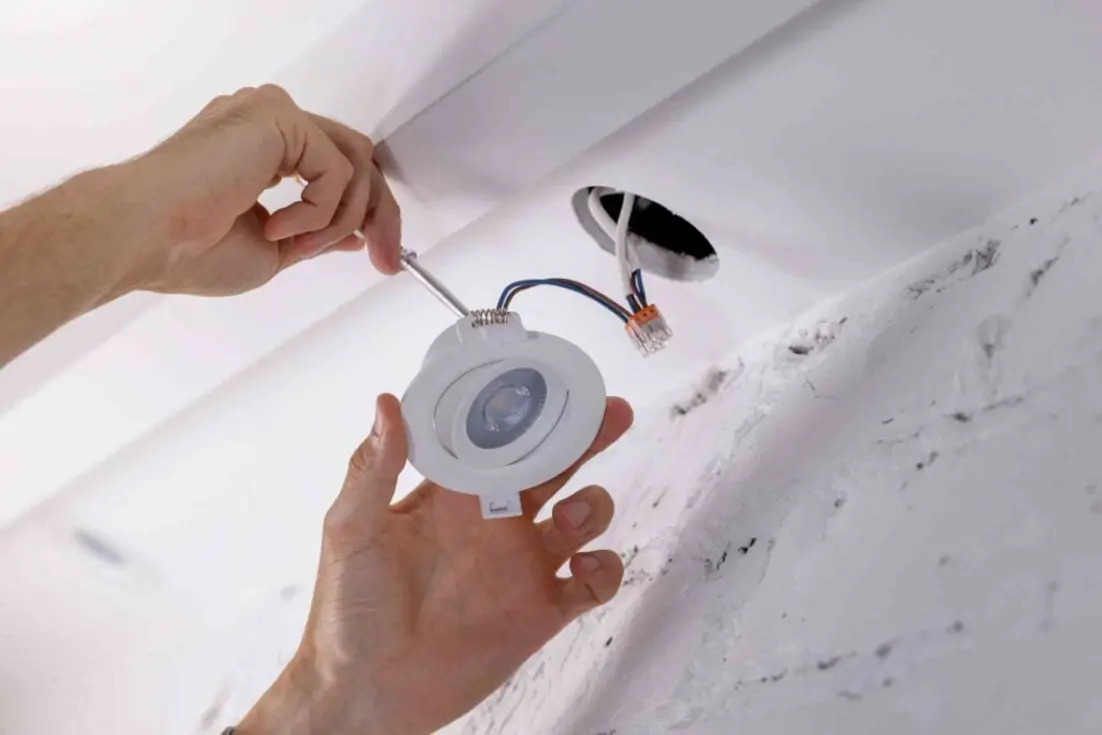
Some fixtures also have detachable LED modules or replaceable LED lamps. If an individual light flickers, confirm that the lamp or module is seated correctly and that the fixture is being used only with components the manufacturer identifies as compatible. Do not force, modify, or substitute parts inside an integrated fixture.
Loose or deteriorating connections
A loose connection can create intermittent flicker as current flow changes. The light may blink when a door closes, when the ceiling cavity warms up, or when another appliance turns on. It can also produce irregular dimming rather than a clean on-off cycle.
Connections may be located at the switch, within an accessible fixture junction box, at another junction point, in the electrical panel, or elsewhere on the circuit. Because these are mains-voltage connections and may be hidden in ceilings or walls, this is not a good place for trial-and-error work. A qualified electrician can inspect and test connections safely.
Heat around the fixture or driver
Recessed fixtures operate in a ceiling cavity where insulation, restricted airflow, or unsuitable installation conditions may affect heat management. Overheating can shorten driver life and may lead to cycling, dimming, or intermittent shutdown in some products.
If flicker begins only after lights have been on for a while, note how long it takes and whether it affects one fixture or a whole group. Do not remove insulation, enlarge openings, or alter housings based on guesswork. Recessed fixtures may have installation limitations related to insulation contact, air sealing, and fire safety that should be verified for the exact fixture and under current local requirements.
Circuit voltage changes and large loads
LED drivers can make small power disturbances more visible than older incandescent lamps did. A brief dip when a motor starts may be barely noticeable with a filament bulb but obvious with an LED downlight.
If recessed lights flicker when a vacuum turns on, that does not prove the vacuum is defective. It may indicate that the lighting and appliance are on the same circuit, that the circuit has a significant load, or that a connection or supply issue deserves testing. A similar pattern can happen with HVAC equipment, a refrigerator, a sump pump, a well pump, or other equipment with a high starting demand.
For a more focused explanation of this symptom, see why LED lights flicker when a vacuum turns on.
Problems beyond one circuit
Whole house recessed light flicker is different from a single bad downlight. If lights in several rooms pulse, brighten and dim together, or change when large appliances operate, the cause may be upstream of the individual lighting circuit.
Potential causes can include a problem at the panel, a feeder connection, a neutral connection, service equipment, or utility supply. These conditions need professional diagnosis. Do not open a service panel or attempt to tighten electrical connections yourself.
Why changing recessed LED brands may not fix it
Replacing one brand of recessed light with another is a reasonable test when the flicker is limited to one fixture or one product batch. It is much less conclusive when lights on different switches and in different areas flicker similarly.
A new fixture still receives power from the same branch circuit, switch box, panel, and service. If the incoming power to that location is unstable, or if a shared connection is poor, the replacement fixture may flicker too. In some cases, a different driver makes the issue look slightly better or worse without removing the underlying electrical problem.
This is why a symptom map matters. It prevents an expensive cycle of replacing lights when the evidence points to the circuit instead.
Check dimmed and non-dimmed lights separately
A dimmer can still be one cause even if some flickering lights are on ordinary switches. Treat dimmed and non-dimmed groups as separate clues.
For dimmed recessed lights, verify all of the following:
- The fixture or LED module is identified as dimmable.
- The dimmer is intended for LED lighting.
- The dimmer model is compatible with the fixture or driver, where the manufacturer provides a compatibility list.
- The dimmer is not being asked to control a load outside its intended range.
- Flicker is not limited to the lowest dimming settings.
Different LED drivers can respond differently to leading-edge and trailing-edge dimming methods. A dimmer labeled for LEDs is not necessarily ideal for every LED fixture. If the lights are stable at full output but flicker or drop out near the bottom of the dimming range, compatibility is a stronger possibility.
Read more about that narrower problem in LED lights flicker after installing a dimmer.
Safe checks a homeowner can make
You can gather useful information without working on wiring:
- Identify the affected areas. Note whether the lights are on one switch, one room, one breaker, or several parts of the house.
- Compare full brightness with dimmed operation. If a dimmer is present, see whether flicker changes at different settings. Do not remove the switch cover or adjust internal wiring.
- Watch for load-related triggers. Note whether flicker coincides with a vacuum, microwave, laundry equipment, heating or cooling equipment, or a pump.
- Check whether the problem changes over time. Flicker that starts after fixtures warm up can point in a different direction than flicker that happens immediately.
- Inspect only what is externally visible. Look for damaged trims, a fixture hanging loose, discoloration, unusual buzzing, or a burning odor. Do not touch exposed conductors or open junction boxes.
- Record urgent symptoms. Repeated breaker trips, hot switch plates, buzzing from a panel, burning smells, sparks, or lights that brighten unusually should be reported promptly to an electrician.
Do not add capacitors or improvised line devices
It can be tempting to search for a capacitor, resistor, bypass device, or other add-on intended to “smooth” flicker. Do not add components to a lighting circuit unless they are specifically designed for the installed control and fixture system and are installed by someone qualified to do so.
An improvised line capacitor does not diagnose the source of the problem. It can conceal a connection or supply issue, create new compatibility problems, and introduce safety concerns. A listed accessory may sometimes be appropriate for a particular dimmer and LED load, but only after the fixture and control documentation support that approach.
When to call an electrician
Arrange an electrician's assessment rather than continuing to swap fixtures when any of these apply:
- Recessed lights flicker on standard switches as well as LED-rated dimmers.
- The flicker occurs in multiple rooms or appears on different circuits.
- Lights react strongly when another appliance starts or stops.
- The problem is getting worse, is intermittent and unpredictable, or affects more than lighting.
- You notice buzzing, heat, odor, discoloration, sparks, breaker trips, or unusual brightening and dimming.
- Replacing one fixture did not change a broader pattern.
Tell the electrician which rooms are affected, whether dimmers are involved, what equipment seems to trigger the flicker, and whether the issue is limited to certain times of day. That information can shorten the diagnostic process.
A practical bottom line
Recessed LED lights flicker without dimmer involvement because LEDs and their drivers can reveal problems that originate in the fixture, its connections, the branch circuit, or the electrical service. A single flickering light often points toward a local fixture or driver issue. Flicker shared by several lights, switches, or rooms deserves a circuit-level investigation.
If flicker is causing headaches, do not assume it is something you simply have to tolerate. Use the pattern of the problem to separate a product-level issue from a house-level electrical issue, then have persistent or widespread symptoms checked by a qualified electrician.
References
- Recessed LED lights are flickering. Looking for some advice - Reddit. (n.d.). https://www.reddit.com/r/AskElectricians/comments/14tt8a7/recessed_led_lights_are_flickering_looking_for
- What causes recess lights on a dimmer switch to flicker on and off?. (n.d.). https://www.facebook.com/groups/237138492156724/posts/405305312006707
- Methods for reducing LED recessed light flicker? : r/AskElectricians. (n.d.). https://www.reddit.com/r/AskElectricians/comments/17pj4qz/methods_for_reducing_led_recessed_light_flicker
- 6 Reasons Your Recessed Lights Are Flickering. (n.d.). https://pompanomistersparky.com/why-are-recessed-lights-flickering
- Recessed Lights Flicker with Dimmer? Expert Troubleshooting Guide. (n.d.). https://www.justanswer.com/electrical/d31m8-20-recessed-lights-installed-one-dimmer.html
- How to Fix Flickering Led Recessed Lights | 5 Easy Steps (2025). (n.d.). https://brightlighthub.com/how-to-fix-flickering-led-recessed-lights
- Lutron Dimmer switch causing recessed lights to flicker | DIY Home Improvement Forum. (n.d.). https://www.diychatroom.com/threads/lutron-dimmer-switch-causing-recessed-lights-to-flicker.767082
- Why do LED lights flicker on low dimmer settings?. (n.d.). https://diy.stackexchange.com/questions/182910/why-do-led-lights-flicker-on-low-dimmer-settings