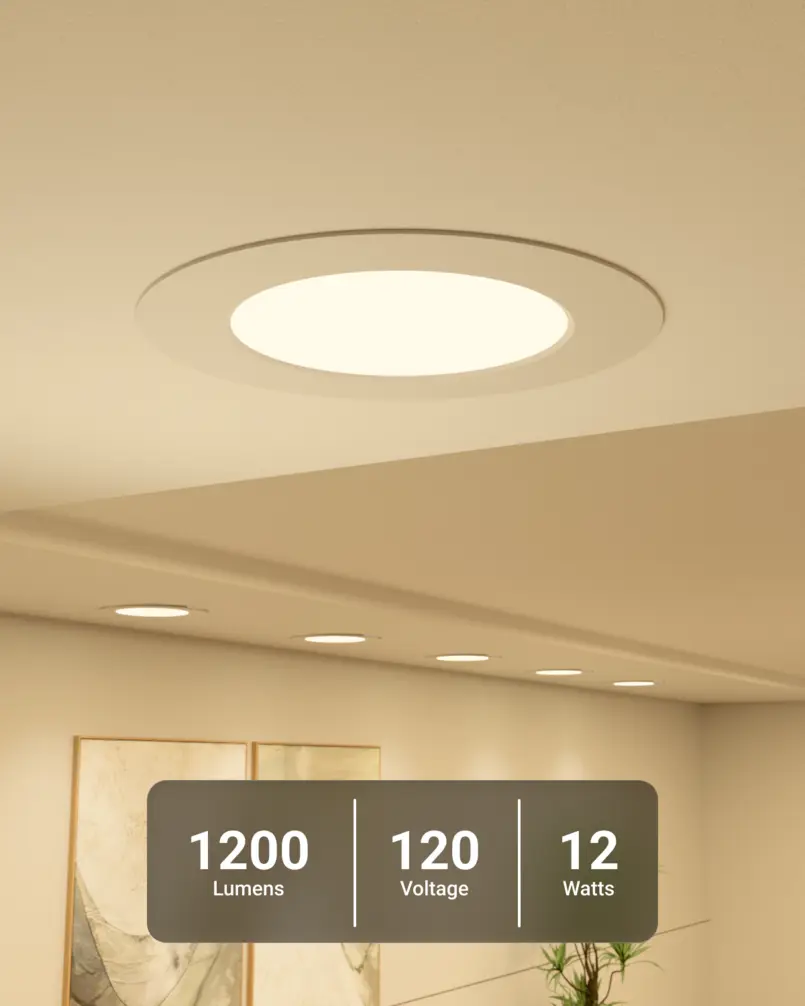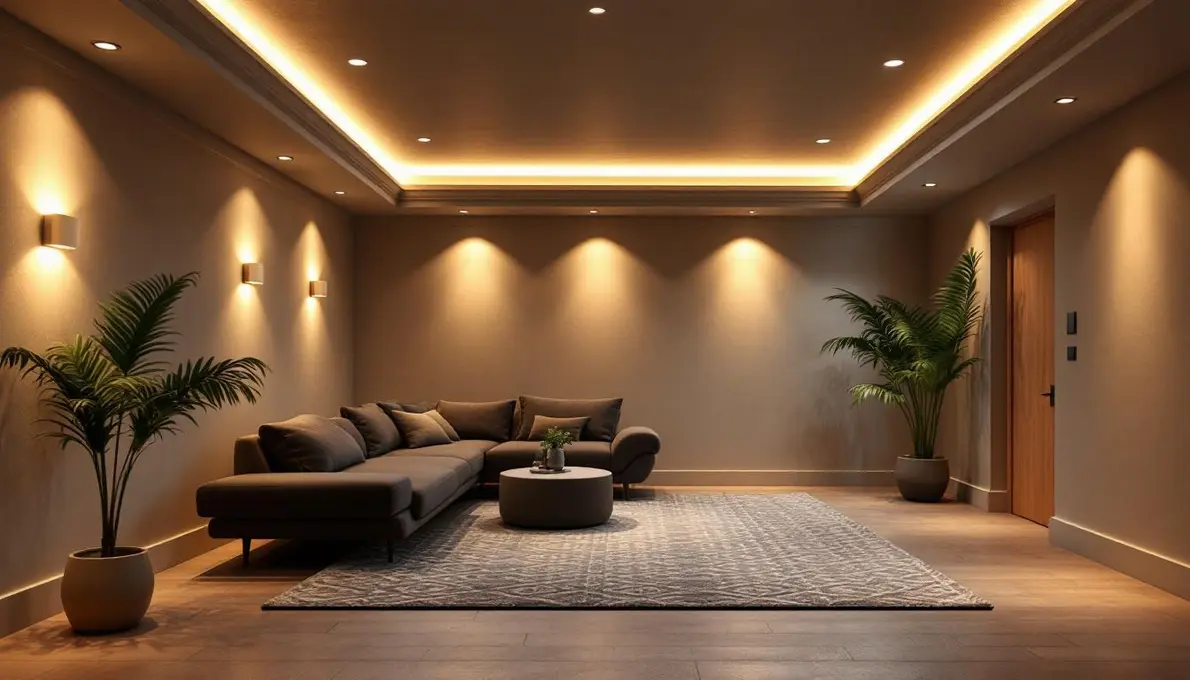
For low glare recessed lights for 8 foot ceilings, prioritize a fixture with a deeply regressed light source, a dark or matte interior aperture, and a dimmer-compatible light engine. The important change is usually not simply moving from a 4-inch opening to a smaller opening. It is making the bright LED surface harder to see when you are sitting, standing, or walking through the room.
A shallow wafer light or flat LED retrofit can make a low ceiling feel visually busier because its luminous surface sits nearly flush with the ceiling plane. A conventional baffle trim can help somewhat, but it may still leave the LED lamp or module clearly visible. If your current 4-inch baffle lights feel harsh, a purpose-designed regressed downlight is usually the more meaningful upgrade.
Why recessed lights can glare on an 8-foot ceiling
Glare is not just a question of total brightness. It occurs when a bright source appears in a direct line of sight or creates a sharp contrast against darker surroundings. With an 8-foot ceiling, recessed lights are closer to seated eye level than they are in a room with a taller ceiling. That makes the angle of the light source especially important.
A bright, shallow LED disk can be visible from across the room, particularly when it is placed over seating, in a circulation path, or near the edge of the ceiling. A white ceiling can make the fixture itself look less noticeable when switched off, but it does little to hide an exposed luminous surface when the light is on.
The goal is not necessarily to eliminate downlights. It is to reduce direct views of the brightest element while using enough fixtures, or other light sources, to avoid relying on a few intense ceiling lights.
Choose optical depth before choosing diameter
When comparing fixtures, look first at the position of the LED relative to the finished ceiling surface.
Flat wafer and thin canless lights
Wafer-style lights are useful when ceiling depth is limited. Their remote junction boxes and slim profiles can simplify installation in difficult joist bays. But many have a broad illuminated lens positioned nearly flush with the ceiling. That design can be efficient and visually clean when off, yet it is often the least comfortable choice for someone already sensitive to recessed light glare.
Some wafers are marketed as regressed or low-glare. Do not assume that description means every shallow fixture will perform alike. Look at product photos and drawings: the emitting surface should sit meaningfully above the ceiling plane, rather than appearing as a bright disk at the opening.
Standard baffle trims
A baffle trim uses ridges or a textured interior to reduce reflected brightness within the opening. It can soften the appearance of a conventional recessed fixture compared with a smooth, reflective trim. However, the baffle itself is not a complete glare solution.
If the lamp, LED module, or diffuser sits near the bottom of the trim, the source may remain visible from much of the room. Replacing a shallow white trim with a black baffle can reduce apparent brightness at the opening, but it will not create the shielding provided by a genuinely deeper fixture.
Deep recessed and regressed downlights
Deep recessed LED lights place the optical source farther above the ceiling. Regessed recessed lighting describes this same useful principle: the aperture is visible, but the brightest component is set back within a chamber.
This geometry lets the edge of the ceiling opening block some direct views of the source. A dark interior, often black or deep charcoal, can further reduce reflections inside the aperture. The result is typically a quieter-looking ceiling and more comfortable light from common sightlines.
For an 8-foot ceiling, look for a fixture described with terms such as deep regressed, deep aperture, anti-glare optic, louvered, or optical chamber. Read the specification details and inspect the side-view image. Marketing language matters less than whether the luminous surface is visibly recessed.
A smaller aperture can help, but it is not the main cure
A 4-inch opening often looks less dominant than a 6-inch opening in a residential ceiling. A smaller source can also be less distracting when viewed from a distance. But a small, high-output LED set flush with the ceiling can still be uncomfortable to look at.
Conversely, a somewhat larger fixture with a deep optical chamber may be calmer than a smaller, shallow one. Aperture size should support the room layout and visual scale, while source depth handles much of the glare control.
For a typical living room with an 8-foot ceiling, a 4-inch regressed downlight is often a reasonable starting point. Consider a smaller aperture when the ceiling has many fixtures and you want them to recede visually. Avoid assuming that downsizing alone will make a bright, exposed LED comfortable.
Select output and beam distribution together
An overly bright downlight creates discomfort even when its source is well shielded. In a low room, it is usually better to distribute ambient light across several modest-output fixtures than to depend on a few intense points of light.
Compare the fixture's lumen output, beam distribution, and dimming behavior rather than choosing based on wattage or opening size alone. A broad beam can spread light more evenly, but it may also place light on faces, screens, and reflective surfaces. A narrower beam can create stronger pools of light and more visible contrast if fixtures are not carefully located.
In a living room, downlights should generally support the room rather than do all the work. Add floor lamps, table lamps, wall lighting, or other indirect light where possible. These sources brighten vertical surfaces and the lower part of the room, allowing the recessed lights to be dimmed to a more comfortable level.
Use adjustable recessed lights selectively
Adjustable recessed lights can be useful for artwork, shelving, a fireplace wall, or another defined feature. They can direct light away from the center of the room and toward a surface that needs emphasis.
They are not automatically low glare. A directional fixture aimed toward the room can place a bright source at an unfavorable angle, and an exposed adjustable mechanism may be more conspicuous than a fixed downlight. Choose adjustable recessed lights with a recessed, shielded optic, then aim them at a wall or object rather than into normal sightlines.
Avoid using adjustable fixtures as general ambient lighting directly over sofas or chairs. A fixed regressed downlight is usually the simpler option for broad room illumination.
Check these specifications before buying
Use this checklist when comparing fixtures:
- Source setback: Choose an LED module that sits above the ceiling plane, not directly at it.
- Aperture finish: Dark, matte interiors usually reduce reflections and make the opening less visually bright.
- Optic description: Look for a deep aperture, regressed optic, glare-control louver, or similar physical shielding feature.
- Lumen output: Choose output that works as part of a layered lighting plan, not as the room's only source of light.
- Dimming range: Confirm compatibility with the planned dimmer and check whether the fixture is known to dim smoothly at low levels. See our guide to <a href="/guides/recessed-led-lights-that-dim-low/">recessed LEDs that dim low</a> for more on this issue.
- Color temperature: In living rooms, a warmer appearance is often more relaxed than a cooler one, especially in evening use. Evaluate samples in the actual room if possible.
- Color rendering: A higher color-rendering specification can help furnishings, artwork, and skin tones appear more natural, though it does not by itself reduce glare.
- Installation depth: Verify that the fixture will fit the ceiling cavity and work around joists, ducts, insulation, and other obstructions.
Placement matters as much as fixture choice
Even a well-shielded fixture can be distracting if it is directly above a seat where occupants regularly look up or if it creates a bright reflection in a television, framed art, glossy table, or window.
Place ambient downlights to light useful parts of the room, including walls and circulation areas, rather than arranging them as an even grid by default. A modest amount of light on walls can make the room feel brighter without pushing ceiling light output too high. For planning guidance, see <a href="/guides/recessed-lighting-layout/">how to plan a recessed lighting layout</a>.
Before cutting new openings, mark potential locations with painter's tape and stand, sit, and recline where the room is normally used. This simple check can reveal fixtures that would land directly in common sightlines.
When replacement is worthwhile
If the existing 4-inch baffle lights are shallow and their bright LED surfaces are easy to see, changing to deep recessed or regressed fixtures is likely to make a noticeable difference. Swapping only to a smaller shallow wafer, or selecting another flat retrofit disk, is less likely to solve the problem.
If replacing fixtures is impractical, reduce discomfort by lowering the dimmer setting, adding lamps for evening use, and reconsidering which existing downlights need to operate at the same time. A room that relies less on overhead light is often more comfortable, especially with an 8-foot ceiling.
For any fixture replacement, confirm compatibility with the existing housing, ceiling construction, insulation conditions, and control system. If wiring, junction-box access, or ceiling modifications are involved, verify current local requirements and use a qualified electrician when needed.
References
- What recessed lighting options maximize brightness and headroom for ceilings under eight feet? | Home Improvement Answers - Toolstash. (n.d.). https://toolstash.com/answers/what-recessed-lighting-options-maximize-brightness-and-headroom-for-ceilings-under-eight-feet
- I like smaller can lights for an 8' ceiling. They feel less bulky .... (n.d.). https://www.instagram.com/reel/DTLHw2bjmYO
- Recessed Lighting Tips for Your Home Addition. (n.d.). https://www.justanswer.com/general/tuf5o-recessed-led-lighting-vaulted-ceiling.html
- Where to Place Recessed Lights: The Rule of Thumb for .... (n.d.). https://amicolight.com/blogs/news/where-to-place-recessed-lights-the-rule-of-thumb-for-every-room
- Led 4 Inch Recessed Lights: The Role in Designing Low-Glare Lighting - PacLights. (n.d.). https://www.paclights.com/explore/led-4-inch-recessed-lights-the-role-in-designing-low-glare-lighting
- low glare lighting. (n.d.). https://shine.lighting/tags/low-glare-lighting
- Avoiding Glare From Residential Downlights. (n.d.). https://forums.mikeholt.com/threads/avoiding-glare-from-residential-downlights.2551188
- Installed this HD 4" baffle recessed lights but too much glare. (n.d.). https://www.reddit.com/r/Lighting/comments/1nt4pzs/installed_this_hd_4_baffle_recessed_lights_but