A 6 inch retrofit LED recessed light can be made less glaring, but simply choosing a dimmer or a frosted lens often creates a second problem: not enough light where it is needed, darker walls, or sharp shadows on counters and faces. The most effective solution is usually a combination of a deeper-regressed trim, sensible lumen output, adequate fixture spacing, and supplemental light for tasks.
Start by addressing the visible brightness of the fixture rather than only reducing its total output. A retrofit with its LED and lens set close to the ceiling plane can look intensely bright when viewed from across the room. A deeper baffle or regressed aperture conceals the light-emitting surface at more viewing angles, while a broader, well-planned distribution helps prevent the room from becoming patchy.
Why reducing glare can create shadows
Glare and shadows are related, but they are not opposites. Glare occurs when a bright source is directly visible or creates uncomfortable contrast in the field of view. Shadows become objectionable when the light reaching a surface is too directional, too sparse, or coming from the wrong position.
A common unsuccessful fix is to replace bright shallow trims with lower-output lights while leaving the same layout. The direct glare may improve, but the remaining fixtures may be too far apart to light the floor, walls, work surfaces, and people evenly. The room then feels dim between fixtures, while each pool of light can still look conspicuous.
Another problem is relying on recessed lights for every purpose. Ceiling downlights are useful ambient lighting, but they are not always good task lights. In a kitchen, for example, a downlight behind a person can cast that person's shadow onto the counter. In a bathroom, overhead-only light can deepen shadows under the eyes and chin. Lower-glare recessed lighting improves comfort, but it cannot correct every shadow created by the room layout.
Choose a deeply regressed retrofit trim
For most homeowners trying to reduce 6 inch retrofit LED recessed light glare, the most important specification is the position of the light source relative to the ceiling.
Look for descriptions such as:
- Deep regressed lens or aperture
- Deep baffle
- Anti-glare trim
- Recessed light engine
- Higher cutoff angle
- Dark or matte inner baffle
A shallow retrofit has a lens that sits nearly flush with the trim. It may distribute a wide wash of light, but the bright lens remains visible from much of the room. A regressed retrofit places the lens or LED module farther above the ceiling plane. The trim and baffle shade the source from side views.
Manufacturers often describe this effect in terms of cutoff angle: the angle at which the bright source becomes hidden from view. A deeper aperture generally improves this visual shielding. As Maxxima explains in its overview of anti-glare downlights, these designs control the angles at which the brightest parts of the fixture are visible rather than merely reducing output.
A dark inner baffle can further reduce reflected brightness inside the opening. Black is common, though a very dark baffle creates a more pronounced ceiling dot when the lights are off. White baffles are visually quieter in a white ceiling but may reflect more light toward the viewer. Neither finish is automatically better; the recess depth and lens position matter more.
Check the actual product profile
Terms such as “low glare” are not standardized performance ratings. Product photos can also be misleading because a lens may appear deeply recessed in a studio image but sit much closer to the ceiling in person.
When comparing retrofit trims, look for a side-view drawing, cut sheet, or installation image showing the distance between the ceiling plane and the luminous surface. If this information is unavailable, consider the claim unverified rather than assuming the trim will provide meaningful shielding.
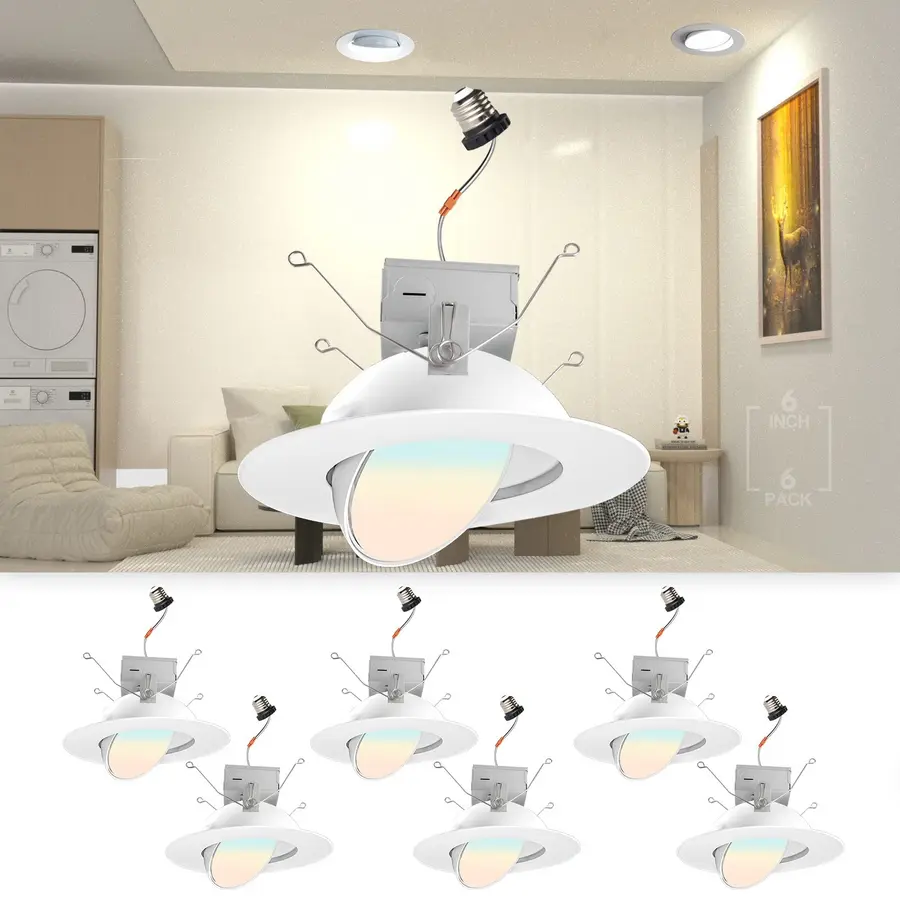
Also confirm that the trim is intended for an existing 6 inch housing. Retrofit modules use different mounting arrangements, including torsion springs, clips, and socket adapters. A trim may fit the opening yet not secure correctly in the existing housing.
Do not solve glare by under-lighting the room
A lower-lumen retrofit can be appropriate, especially in a small room with many fixtures or a low ceiling. But reduced output should not be the only glare-control strategy.
Use output reduction when the room is genuinely overlit. Signs include needing to keep the dimmer far below its upper range, bright pools on the floor, or uncomfortable brightness even when you are not looking directly at a fixture. If the room already has dark corners and poorly lit walls, changing to much lower-output trims will usually make the unevenness more apparent.
Instead, aim for comfortable light from more than one direction. This may mean retaining sufficient ceiling light while adding or improving:
- Under-cabinet lighting for kitchen counters
- A vanity light or side lighting near bathroom mirrors
- Floor and table lamps in living rooms
- Desk lighting in a home office
- Wall lighting or lamps near seating, reading, and dressing areas
Task and wall lighting allow recessed lights to operate at a lower, more comfortable level without leaving important surfaces dark. For kitchen-specific placement issues, see our guide to kitchen recessed light placement for countertops.
Match beam spread and spacing to the room
A deeper aperture can narrow the apparent distribution of light, depending on the optical design. This is not necessarily a flaw. It simply means the existing layout must still provide enough overlap between fixtures.
If fixtures are widely spaced, a narrow-beam or strongly shielded retrofit can create bright circles separated by dim areas. Walls may become noticeably darker, and the ceiling can look spotted. If fixtures are close together, the same trim may provide a comfortable, even result.
Before replacing every trim, test one or two in representative locations. Evaluate them at night from the places where people sit, cook, work, watch television, or enter the room. Then look for these outcomes:
| What you see | Likely cause | Better response |
|---|---|---|
| Bright source visible from a sofa or bed | Shallow lens or insufficient shielding | Choose a deeper regressed trim or reposition seating if practical |
| Dark bands between pools of light | Fixtures are too far apart for the distribution | Use a broader distribution, add another lighting layer, or reconsider the layout |
| Dark counters below wall cabinets | Ceiling light is blocked by the user or cabinets | Add under-cabinet task lighting |
| Dark walls despite bright floor areas | Downlights are aimed mostly downward | Add wall-oriented lighting or use a broader, more suitable optical distribution |
| Faces look shadowed | Lighting comes only from overhead | Add lighting around the mirror, desk, seating area, or other face-level zone |
Existing fixture locations are a real limitation with retrofit installations. A new trim can improve comfort, but it cannot move light into a part of the room that the original layout missed. If the layout itself is the problem, read our broader guide to recessed lighting layout.
Use dimming as a finishing control, not the main cure
A compatible dimmer is valuable because the right brightness changes through the day. However, dimming does not change the physical visibility of a bright lens. A flush, highly luminous trim may still be distracting even when dimmed.
Check both sides of compatibility:
- Confirm that the retrofit is listed by its manufacturer as dimmable.
- Check whether the dimmer manufacturer lists the LED load or fixture type as compatible.
- Set the dimmer's low-end and high-end trim adjustments, if available.
- Test for flicker, delayed startup, sudden jumps in brightness, dropout at the low end, and audible noise.
Good low-end dimming matters when glare is most noticeable in the evening. A fixture that only dims to a relatively bright level may leave the room feeling overlit after dark. A fixture that dims smoothly but shifts warmer as it dims can feel more relaxed in bedrooms and living rooms, though the color change should suit the rest of the lighting in the room.
If your current recessed lights flicker or stop dimming smoothly, review why recessed LED lights flicker on a standard switch and how to choose recessed LEDs that dim low.
Consider ceiling height and sightlines
Low ceilings make glare harder to avoid because the fixtures are physically closer to eye level and more often within the normal field of view. In an 8-foot room, a shallow lens over a sofa, dining table, or bed can be more distracting than the same trim in a taller space.
Pay particular attention to fixtures near:
- Seating areas where people look upward while reclining
- Television walls, where bright ceiling reflections can be distracting
- Dining tables, where occupants see fixtures across the table
- Hallways and stair approaches, where a fixture may be directly ahead at eye level
- Bathroom mirrors, where bright overhead sources can reflect in the mirror
In these positions, a deep regressed trim can be more important than maximum lumen output. Our guide to low-glare recessed lights for 8-foot ceilings covers the particular challenges of shorter rooms.
When a retrofit trim is not enough
A deep retrofit can substantially improve a shallow, glaring installation, but it cannot solve every visual-comfort problem. Consider a more involved redesign when:
- Existing fixture spacing leaves persistent dark areas after a trim change.
- The room depends entirely on recessed lights for ambient, task, and decorative lighting.
- The ceiling openings are poorly placed over seating, screens, or work surfaces.
- The existing housings do not accept the desired trim securely or as intended.
- You need directional aiming, wall washing, or precise task lighting that a fixed retrofit cannot provide.
At that point, the answer may be a different lighting layer, relocated fixtures during renovation, or a purpose-designed recessed fixture rather than another retrofit trim. Verify compatibility with the existing housing and consult a qualified electrician for changes involving wiring, housings, ceiling construction, or local electrical requirements.
A practical selection checklist
Before buying replacement 6 inch retrofit LED recessed lights, confirm the following:
- The lens or LED is visibly recessed, not nearly flush with the ceiling.
- The trim uses a baffle or other shielding feature that limits direct views of the source.
- The lumen output suits the room without requiring the dimmer to stay near its minimum setting.
- The optical distribution will overlap adequately with the current fixture spacing.
- The product is compatible with the existing 6 inch housing and mounting method.
- The fixture and dimmer are compatible, including acceptable low-end performance.
- The room has separate task or wall lighting where shadows matter.
The best result is rarely the lowest-output recessed light or the deepest-looking trim alone. It is a coordinated balance: shield the source from view, keep enough overlapping light for the room, dim it smoothly when needed, and use other fixtures to light the tasks that ceiling downlights cannot handle well.
References
- Baffit 6" Glare-free Retrofit LED Recessed Light - 15W Dimmable .... (n.d.). https://torchstar.us/collections/living-room-lighting/products/torchstar-spiraligh-recessed-light-6-inch-15w-5cct
- Halo RL 5/6 inch LED recessed Can light Trim, 5CCT, dimmable, 900/1200 lm | recessed baffle retrofit can light trim, low glare, wet-rated for showers and outdoor use, Dims to 5% + dim to warm - Amazon.com. (n.d.). https://www.amazon.com/HALO-inch-recessed-Light-dimmable/dp/B0C7QSXJCT
- 6 Inch Led Retrofit. (n.d.). https://www.amazon.com/6-inch-led-retrofit/s?k=6+inch+led+retrofit
- Best 6” LED Retrofit Downlights? : r/Lighting. (n.d.). https://www.reddit.com/r/Lighting/comments/1jb84vs/best_6_led_retrofit_downlights
- Maxxima 5" & 6" Retrofit Recessed Anti-Glare LED Downlight, White Trim .... (n.d.). https://www.youtube.com/watch?v=velGsaHoLEM
- Best 6" retrofit downlight? : r/Lighting. (n.d.). https://www.reddit.com/r/Lighting/comments/1luv3fe/best_6_retrofit_downlight
- Anti-glare Downlights - Canless Recessed Lights. (n.d.). https://www.maxximastyle.com/recessed-lighting/led-anti-glare-downlights
- How To Install LED Recessed Lighting Retrofit - Usual House. (n.d.). https://www.usualhouse.com/how-to-install-led-recessed-lighting-retrofit