A sunny-looking corner is worth keeping for plants only if it supplies usable light where the plants will actually sit鈥攏ot merely at the window itself. To assess light for indoor plants, identify the window direction, watch for direct sun over a full day, note what blocks the sky, and check how quickly the light falls away from the glass. Then match plants to that observed condition rather than relying on a room listing that calls the space 鈥渟unny.鈥?
A grow light is most useful when a plant鈥檚 intended position lacks enough direct sun or bright indirect daylight for the type of plant, especially in winter. It is not automatically necessary beside every window. A well-exposed corner may support many foliage plants without supplemental lighting, while a high-light flowering or fruiting plant may still need help.
Start with the window, not the room label
Window orientation gives a useful first estimate of the light pattern, but it is only a starting point. In the Northern Hemisphere, North Carolina Cooperative Extension describes the usual patterns this way:
| Window direction | Typical daylight pattern | What can change it |
|---|---|---|
| North-facing | Mostly indirect light; generally the lowest natural-light level | Open sky, a large window, pale interiors, nearby reflected light |
| East-facing | Direct morning sun, then indirect light | Trees, neighboring buildings, blinds, and the plant鈥檚 distance from glass |
| South-facing | The longest and often strongest exposure over the day | Exterior overhangs, tall buildings, seasonal sun angle, window treatments |
| West-facing | Bright daylight and direct afternoon or evening sun | Heat buildup, glare, neighboring structures, and strong summer sun |
This pattern assumes a Northern Hemisphere location. If you live in the Southern Hemisphere, reverse north and south in the table.
Orientation does not tell you whether a particular corner works. A south-facing window facing a close building can be dimmer than an unobstructed east-facing window. A corner several feet to the side of the window can receive far less light than the sill. Treat orientation as a hypothesis to test, not a verdict.
Do a one-day daylight audit
Choose a day when you can check the area several times. A mix of sun and clouds is useful, but repeat the check on another day if conditions were unusually dark or bright.
1. Mark the actual plant positions
Before evaluating the corner, decide where pots could realistically live. Mark a few locations with tape or place an empty pot there:
- directly in front of the window;
- beside the window, where the corner turns away from it;
- on a shelf or stand at the intended height;
- farther into the room, if that is where the plant would be safest from a pet.
This matters because daylight drops quickly as a plant moves away from a window. The University of Maryland Extension notes that light intensity decreases rapidly with increasing distance from the source. A corner can look broadly bright to your eyes while the lower shelf where a plant sits is comparatively dim.
2. Check for direct sun at several times
Look at each marked position in the morning, around midday, and later in the afternoon. Record whether sunlight physically reaches the leaves or the placeholder pot, and for roughly how long.
Direct light means the sun is touching the foliage through the window glass. It is not the same as a bright room. If direct sun reaches the spot, note its timing:
- Morning direct sun is common near east-facing windows and is often gentler than late-day sun.
- Midday direct sun can be intense near an unobstructed south-facing window.
- Afternoon direct sun from west-facing windows can be particularly hot and bright.
A phone note is enough: 鈥?:30鈥?1:00 a.m. direct sun on stand; bright, no direct sun after.鈥?Exact precision is less useful than an honest pattern over time.
3. Use shadows to distinguish direct from bright indirect light
Shadows are a practical visual check. When direct sun reaches a plant, its leaves usually cast crisp, clearly edged shadows. In bright indirect light, the space is well illuminated and the plant may see a broad area of sky, but the shadow edges are soft. In weak light, shadows may be faint or absent.
This distinction is especially helpful in apartment corners because sunlight often lands on the floor or wall but misses the shelf where the plants are located. Judge the light at leaf level, not elsewhere in the room.
Assess the view beyond the glass
For window light for houseplants, the view outward has a major effect on the result. Stand at plant height and look toward the window. How much open sky can the plant 鈥渟ee鈥?
Nearby apartments, balconies above, deep exterior recesses, street trees, tinted film, insect screens, curtains, and partially closed blinds can all reduce light. House Plant Journal recommends assessing two separate conditions at each location: the duration of direct sun and the strength of indirect light when the sun is not directly hitting the plant. Its practical principle is that plants benefit when they can see as much sky as possible.
Also look indoors. A tall chair, bookcase, or a cluster of larger plants may shade smaller pots. If the corner is intended as a shared pet-and-plant zone, a pet bed, gate, or climbing furniture can dictate where plants must sit. Audit the final likely locations, not an idealized arrangement that will not last.
Check the conditions that change through the year
One bright afternoon does not establish year-round suitability. Window light changes with season, weather, and the sun鈥檚 path. The University of Maryland Extension identifies season, cloud cover, screening, window cleanliness, curtains, nearby trees, and surrounding buildings as factors that affect indoor light intensity.
Make a short seasonal note for the corner:
- Summer: Does direct sun become harsh enough to overheat leaves or fade furnishings? Do leafy trees block much of the window?
- Winter: Does lower sun enter more deeply, or are daylight hours simply too short for plants that need high light?
- Spring and fall: Are there temporary shifts in direct sun that change placement needs?
For a new setup, observe for at least several days before giving up valuable floor area. Then revisit the audit at a different season. You do not need to rebuild the whole plant corner each time; moving a pot closer to the glass or adjusting a sheer curtain may be enough.
Match the corner to plant needs
Once you know the pattern, assign plants based on the light you measured.
Direct-sun positions
Reserve the closest, sun-receiving position for plants that genuinely tolerate or prefer direct sunlight. Even then, introduce a plant gradually if it came from lower light. A sudden move into intense sun can scorch foliage.
Watch for overheating at west-facing glass, particularly when leaves touch the window or sit in a poorly ventilated pocket. Strong light and excessive leaf temperature are separate problems.
Bright indirect positions
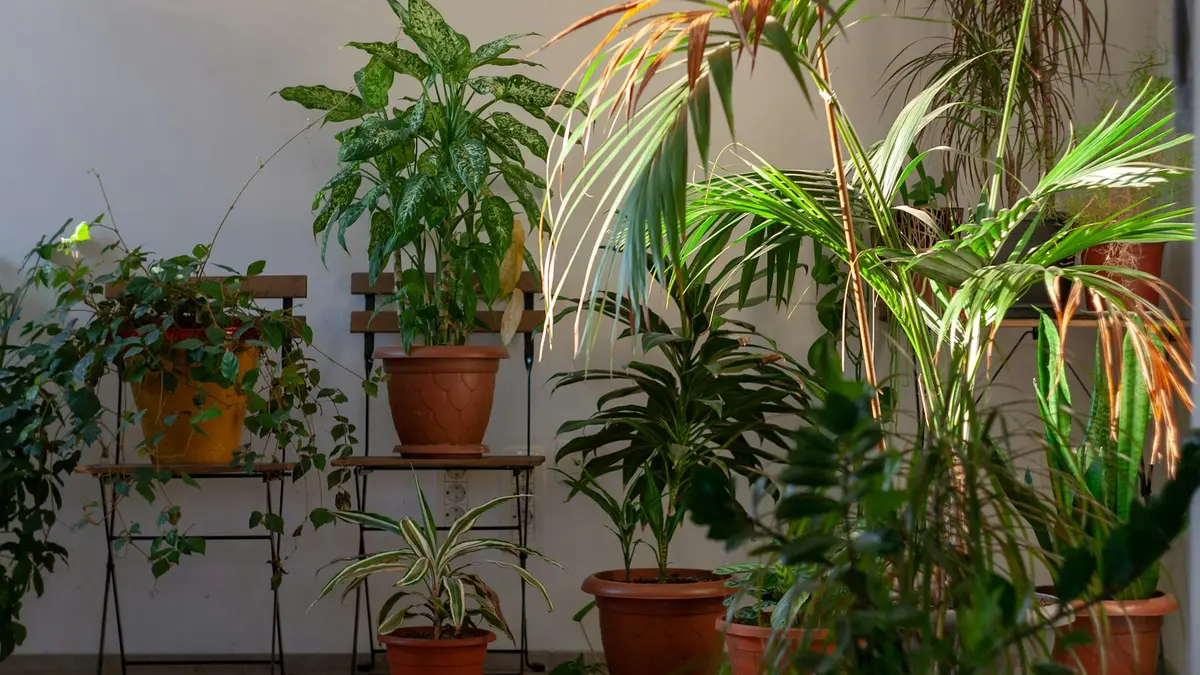
A location with a clear sky view, strong ambient daylight, and no sun directly on leaves can be an excellent home for many common foliage houseplants. These are often the most useful spaces in an apartment plant corner: bright enough for reliable growth, with less risk of sun scorch than a direct-sun sill.
Keep plants near the window rather than assuming a bright wall across the room is equivalent. If a plant starts stretching toward the glass, producing smaller new leaves, or growing slowly during the brighter season, move it closer before assuming it needs a lamp.
Low-light positions
鈥淟ow light鈥?does not mean no light. It means a plant can tolerate lower available light, usually with slower growth and less frequent watering needs. A dim interior corner may be suitable for a tolerant plant, but it is not a productive place for plants selected for large leaves, flowers, or fruit.
How to measure indoor plant light without overcomplicating it
A daylight audit and plant response are usually more useful than a single number. If you want a measurement, use it as a comparison tool: take readings at the plant鈥檚 leaf position, at the same times on different days, and in several candidate locations.
Light meters may report different units, and phone apps can vary in accuracy. Do not treat one reading as a universal pass/fail score. Indoor plants respond to intensity, duration, and light quality together, as the University of Maryland Extension explains. A moderately bright spot with a long, consistent daylight period may suit a plant better than a short burst of sun followed by a dark day.
The most useful record is simple:
- Direct sun: none, morning, midday, or afternoon; include approximate duration.
- Indirect light: weak, moderate, or bright based on sky view and shadows.
- Distance and direction from the window.
- Obstructions: building, tree canopy, blind, screen, overhang, or furniture.
- Season and weather when observed.
When to use grow lights for houseplants
Consider supplemental plant lighting when the corner is the right place for the household but the daylight is not enough for the plants you want to grow. This is common in winter, at shaded windows, in corners set back from the glass, and for plants with higher light demands.
A grow light is warranted when one or more of these are true:
- The corner receives little or no direct sun and has a restricted view of the sky.
- A plant that should grow actively produces thin, elongated stems or increasingly small leaves.
- A flowering or fruiting plant does not get enough light to perform as expected.
- The only pet-safe placement is farther from the window than the plant can tolerate.
- Winter conditions are substantially dimmer than the plant鈥檚 needs.
Supplemental lighting should be planned around the plant, not used as general decorative illumination. Put the fixture close enough and aim it so light reaches the foliage, then use a timer for a consistent schedule. The Iowa State University Extension and Outreach emphasizes the same three planning variables: light quality, intensity, and duration.
Avoid judging a grow light by wattage alone. Watts describe electrical energy use, not the amount of useful light reaching the plant. Review the manufacturer鈥檚 coverage and placement guidance, and account for the fixture鈥檚 distance from the foliage.
Decide whether the corner earns its space
The loss of open floor space is justified when the corner has a clear role: it gives suitable plants a stable place near good daylight, fits daily living, and can be kept safe for pets. It is less compelling when plants must sit far from the window, the view is heavily obstructed, or the setup needs a large supplemental-light installation just to keep low-demand plants alive.
A practical compromise is to keep the floor mostly open and use a narrow stand, wall-mounted shelf, or window-adjacent surface for a small collection. Start with plants matched to the observed light. Add a supplemental fixture only if plant behavior and a repeatable daylight audit show that natural light is insufficient.
Common assessment mistakes
Calling the whole room 鈥渂right鈥?
Plants experience light at their leaves. A bright living room can still have a low-light corner several feet from the window.
Checking only at noon
A west-facing window may look ordinary at noon and receive powerful direct light later. An east-facing window can offer its best light before the workday begins.
Ignoring obstructions
A close building, balcony, or mature tree can outweigh the usual expectation for a window direction.
Treating plant labels as precise instructions
Terms such as 鈥渕edium light鈥?and 鈥渂right indirect light鈥?are useful categories, not standardized measurements. Compare the label with the plant鈥檚 actual growth and adjust gradually.
Adding a grow light before changing placement
Moving a plant closer to an unobstructed window is often the first and simplest adjustment. Supplemental light is most effective when it solves a clear shortfall rather than compensating for an avoidable placement problem.
References
- Bright Indirect Light 鈥淩equirements鈥?by Plant Type 鈥?House Plant Journal. (n.d.). https://www.houseplantjournal.com/bright-indirect-light-requirements-by-plant
- Light Considerations for Indoor Plants - Richmond County Center | N.C. Cooperative Extension. (n.d.). https://richmond.ces.ncsu.edu/news/light-considerations-for-indoor-plants
- Lighting for Indoor Plants | University of Maryland Extension. (n.d.). https://extension.umd.edu/resource/lighting-indoor-plants
- Give Indoor Plants the Right Light | The Stanislaus Sprout. (n.d.). https://ucanr.edu/blog/stanislaus-sprout/article/give-indoor-plants-right-light
- The Sill | How to Choose a Houseplant Based on Your Light. (n.d.). https://www.thesill.com/blogs/care-miscellaneous/understanding-lighting-in-your-home-and-how-it-affects-your-plants
- Lighting Indoor Houseplants. (n.d.). https://extension.missouri.edu/publications/g6515
- Best Window Direction for Indoor Plants (North, South, East & West .... (n.d.). https://www.theshadygalwrites.com/window-location-growing-plants
- Important Considerations for Providing Supplemental Light to Indoor Plants | Yard and Garden. (n.d.). https://yardandgarden.extension.iastate.edu/how-to/growing-indoor-plants-under-supplemental-lights/important-considerations-providing-supplemental-light-indoor-plants