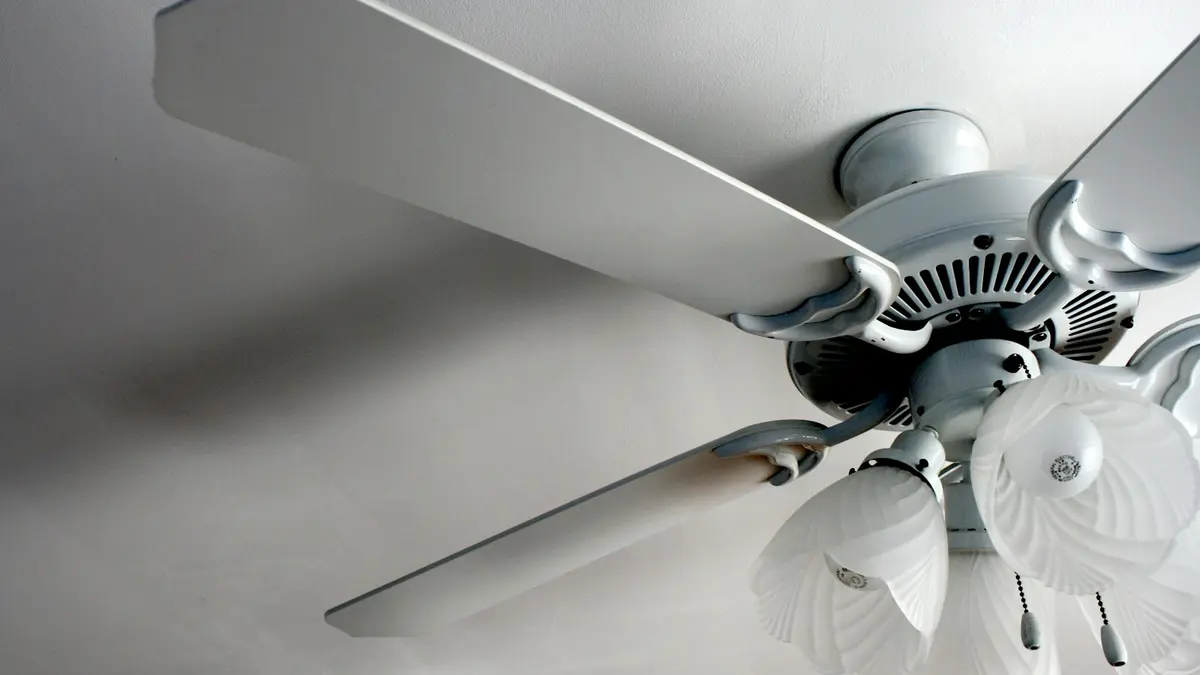
A ceiling fan for a low ceiling should keep its blades safely above head height while leaving enough space above the blades for the fan to move air. In many homes with an 8-foot finished ceiling, that points to a flush-mount or low-profile fan, often called a hugger fan. But “flush mount” is not enough information on its own: two fans with the same mounting style can place their blades at very different heights.
Start with the finished floor-to-ceiling height, then compare it with the manufacturer’s blade height and total fan height. A fan may fit physically yet still be a poor choice if a deep light kit lowers the bottom too far, the blades sit too close to the ceiling, or its sweep is too large for the room.
The measurements that decide whether a fan will work
Take measurements after flooring is complete, especially if carpet, thick rugs, raised flooring, or a ceiling treatment changes the effective room height. Record these four dimensions before shopping.
1. Finished ceiling height
Measure from the finished floor to the finished ceiling directly below the intended outlet box. Do not assume every room with an “8-foot ceiling” is exactly 96 inches high; renovations and floor finishes can change the usable dimension.
The key safety check is the height of the blade plane above the floor. Guidance commonly used for residential fan planning is to keep blades at least 7 feet above the floor. Local rules, the fan instructions, and conditions in your home may require additional considerations, so verify the installation with a qualified electrician or installer when there is little margin.
A 7-foot ceiling will usually not provide enough height for a conventional ceiling fan while maintaining suitable blade clearance. With an 8-foot ceiling, a compact flush-mount model is often the practical starting point. A 9-foot ceiling gives more options, including some short-downrod fans.
2. Blade height, not just overall fan height
Product listings may show several dimensions, including overall height, housing height, and blade-to-ceiling distance. The dimension that matters most in a low room is the distance from the finished floor to the blades.
Ask the manufacturer or consult the specification sheet if the blade height is unclear. Do not estimate it from product photos. A shallow-looking motor housing does not necessarily mean a shallow fan: blade brackets, blade pitch, and a light kit can all alter the lowest point.
A simple check is:
Finished ceiling height − distance from ceiling to blade plane = blade height above floor
For example, if a room is 8 feet high and the fan blades sit 8 inches below the ceiling, the blades will be about 7 feet 4 inches above the floor. That may be workable, provided other clearances and installation requirements are satisfied.
3. Clearance above and around the blades
Low-profile fans necessarily sit closer to the ceiling than downrod-mounted fans. Still, the blades need room above them to draw and circulate air. Manufacturers commonly provide a minimum blade-to-ceiling dimension; compare that figure with the fan’s actual geometry rather than assuming every hugger design performs the same way.
As a general planning target, blades are often kept at least 6 to 8 inches below the ceiling. More space can support better airflow, but low ceilings limit that option. A flush-mount fan is therefore a compromise: it protects headroom, although it may not circulate air as effectively as a fan positioned lower in the room.
Also check blade-tip clearance from walls, tall cabinets, curtain rods, bunk beds, and other obstructions. A commonly used planning allowance is at least 18 inches from blade tips to walls or nearby objects. In a narrow room, the fan sweep may need to be smaller even when the floor area suggests a larger fan.
4. Lowest point of the complete fan
The lowest point may not be the blades. A bowl light, decorative pendant-style light kit, pull chain, or remote receiver cover can hang below them. This matters in a walkway, beside a bed, above a desk, or anywhere a tall person may stand beneath the fan.
Check dimensions for the exact configuration you plan to buy. If a fan is offered with an optional light kit, the listed height may apply to the fan without that kit.
Flush mount, low profile, or short downrod?
These terms are used inconsistently, so compare dimensions rather than labels.
| Mounting approach | When it usually suits | Main tradeoff |
|---|---|---|
| Flush mount or hugger | Low ceilings, often around 8 feet | Maximum headroom, but blades sit close to the ceiling |
| Low-profile fan | Low ceilings where a compact motor and shallow drop are needed | Dimensions vary widely between models |
| Short downrod | Rooms with a little more ceiling height | Better blade separation from the ceiling, but reduced headroom |
| Standard or longer downrod | Taller rooms | Usually unsuitable for a genuinely low ceiling |
A true flush mount places the motor close to the ceiling, with no visible downrod. It is usually the safest place to start when ceiling height is limited. However, a low-profile fan with a very short downrod can sometimes provide better airflow if its blade plane remains high enough above the floor.
Do not choose a fan simply because it is described as “flush mount.” Compare these specifications side by side:
- overall height from ceiling to lowest point;
- blade-to-ceiling distance;
- blade height above your finished floor;
- blade sweep or diameter;
- airflow rating, usually stated in cubic feet per minute (CFM);
- whether the listed dimensions include the light kit.
Choose blade sweep for the room, not just the ceiling height
A low ceiling does not automatically require a very small fan. Fan diameter should still suit the room’s footprint and available wall clearance.
For a compact bedroom or home office, a smaller sweep can be appropriate and may be easier to position away from walls and tall furniture. A larger living room may need a wider fan, multiple fans, or another air-movement strategy. One small hugger fan in the center of a broad open room may be safe but underpowered for the job.
Airflow ratings are useful for comparing fans of similar size and purpose. Higher CFM generally indicates more air movement, but it does not tell the whole story. Blade pitch, motor design, speed settings, room layout, and the fan’s position below the ceiling all influence how the room feels.
In a low room, prioritize a fan with enough airflow for the space over decorative blade count or a bulky light fixture. A well-designed compact fan can be more useful than a larger model that barely meets clearance limits.
Decide whether you need a light kit
A low profile ceiling fan without light is often the cleanest solution when the room already has adequate lighting. Removing the light kit can reduce the fan’s total drop, improve head clearance, and avoid placing a bright source directly overhead.
Choose a fan with an integrated light only when it serves a real lighting need. In a bedroom, living room, or home office, fan lighting alone is often not enough for comfortable reading, working, or balanced room lighting. Table lamps, floor lamps, wall lights, or recessed lighting can provide more flexible light with less glare.
If you do want a light kit, check:
- the added depth below the fan body;
- whether the light is dimmable with your intended control;
- whether the LEDs are integrated or use replaceable bulbs;
- whether the fan and light can be controlled separately;
- whether the color temperature will fit the room’s existing lighting.
For more on the maintenance tradeoff, see our guide to integrated LED vs. replaceable bulb fixtures.
Controls matter more in a low-ceiling room
Avoid relying on pull chains when the fan is installed close to the ceiling, particularly over a bed or furniture. A wall control or remote is usually more practical.
Before choosing a remote-controlled fan, decide how you want the wall switch to work. Some homeowners want the switch to remain on while the remote controls speed and light output; others prefer a dedicated wall control. Compatibility can depend on the fan’s receiver, existing wiring, and control type. Read the manufacturer’s instructions and review the options in our guide to ceiling fan remote vs. wall switch.
If separate light and fan control is important, confirm it before purchase. Some compact fans combine these functions in ways that limit control flexibility.
When a ceiling fan is not the right answer
A low-profile fan is not automatically the best cooling solution. Consider a pedestal fan, wall-mounted circulating fan, portable air conditioner, or improved window shading when:
- the ceiling is too low to preserve acceptable blade clearance;
- the only suitable location is above a high bunk bed, loft bed, or frequently used standing area;
- the room is too narrow for safe blade-tip clearance;
- the fan would be installed too close to a sloped ceiling, beam, or tall storage;
- the room needs stronger localized cooling than a small flush-mount fan can provide.
A fan on a sloped ceiling deserves separate attention. Many flush-mount fans are not intended for angled mounting, and an adapter may be needed for compatible downrod-mounted models. Confirm slope compatibility with the manufacturer rather than modifying the mounting arrangement.
A short buying checklist
Before ordering, confirm all of the following:
- The finished ceiling height at the planned location.
- The blade plane will sit at a suitable height above the floor.
- The blades have adequate clearance from the ceiling, walls, furniture, and doors.
- The stated overall height includes the exact light kit and accessories you plan to use.
- The blade sweep suits both the room size and its unobstructed space.
- The airflow rating and speed range fit the room’s cooling needs.
- The control method works with your preferred wall-switch and remote arrangement.
- The outlet box and support arrangement are suitable for the specific fan, as confirmed by a qualified installer where needed.
Common mistakes to avoid
The most common mistake is measuring only the ceiling height and selecting the thinnest-looking fan. Blade height and the fan’s lowest point are more useful measurements.
Another is treating a light kit as an afterthought. On a low ceiling, even a modest integrated light can use the headroom that made the fan feasible in the first place.
Finally, do not assume a ceiling electrical box can support any fan or that an existing light-fixture setup is ready for a fan installation. Fan support, wiring condition, switch compatibility, and any applicable local requirements should be verified before installation. If there is uncertainty, use a qualified electrician.
A suitable low-ceiling fan is one that clears people and surrounding objects first, then provides enough air movement for the room. For most 8-foot rooms, a compact flush-mount or hugger ceiling fan with a shallow profile—and no unnecessary light kit—is the most straightforward place to begin.
References
- Ceiling Fan Clearance: How Much Space Do You Need from the Ceiling?. (n.d.). https://parrotuncle.com/blogs/news/ceiling-fan-clearance-how-much-space-do-you-need-from-the-ceiling
- How Far Should a Flush Mount Ceiling Fan Be from the Ceiling?. (n.d.). https://vindusfans.com/it/blog-2/how-far-should-a-flush-mount-ceiling-fan-be-from-the-ceiling-ceiling-fan-height-mounting-guide
- Ceiling Fans: 7 Things You Need To Know - Carolina Lanterns. (n.d.). https://lanterns.carolinalanterns.com/2018/06/30/ceiling-fans
- Are Flush Mount Ceiling Fans Effective? - Complete Buyer’s Guide – City Lights SF. (n.d.). https://citylightssf.com/blogs/city-lights-insights/are-flush-mount-ceiling-fans-effective
- Ceiling Fans for Low Ceilings: Flush & Low-Profile Guide. (n.d.). https://www.lamps.com/pages/buying-guide/ceiling-fans-for-low-ceilings
- How to Measure a Ceiling Fan – Hunter Fan. (n.d.). https://www.hunterfan.com/pages/how-to-measure-a-ceiling-fan
- Ok I have a question for the experts, I have .... (n.d.). https://www.facebook.com/groups/woodworkingforbeginner/posts/3258560580965211
- Flush Mount vs Downrod Ceiling Fan: When to Use Each. (n.d.). https://ceilingfansizecalculator.com/guides/flush-mount-vs-downrod