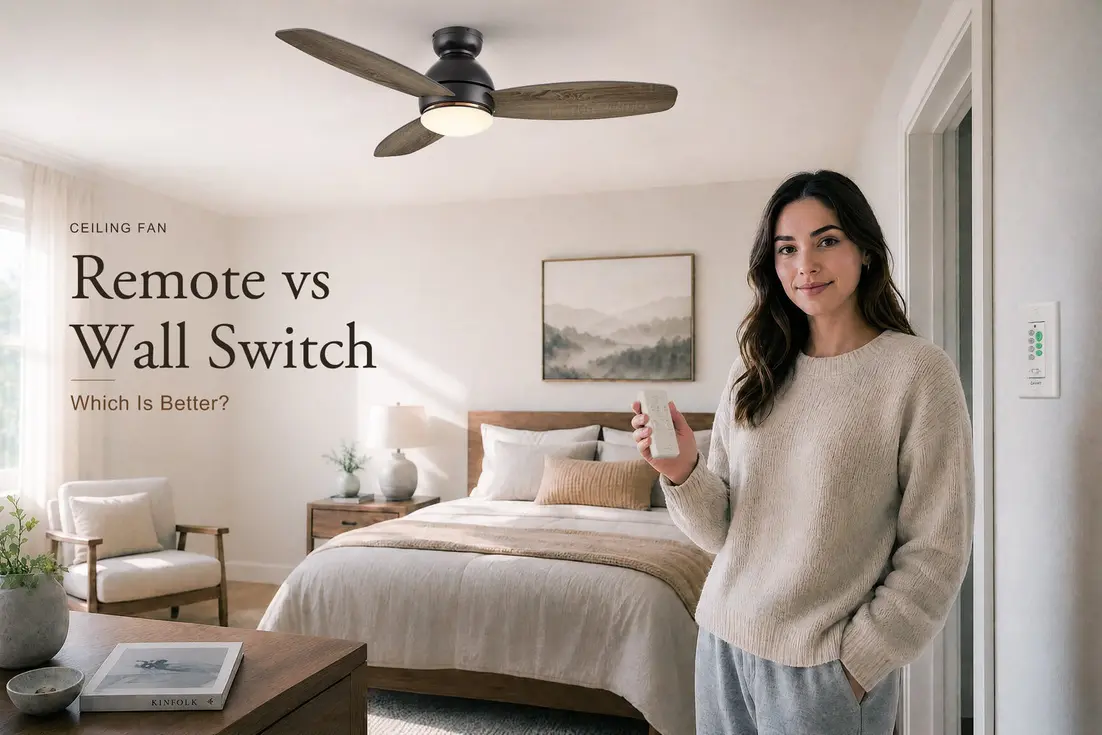
For most homes, the most dependable ceiling fan remote vs wall switch setup is not an either-or choice. A wall control gives everyone a predictable place to turn the fan and light on, while a remote can add speed, dimming, and comfort adjustments from a bed or sofa. If you are installing several fans, plan for each fan to have an independent identity and a practical wall-control strategy before buying the fans.
A remote-only fan can work well for one bedroom fan, especially where the fan is adjusted from bed. It becomes less convenient when several identical remotes collect in a living room, guests cannot find the right one, or power has been turned off at the wall. A wall control is usually the better baseline for shared rooms and for anyone who wants the fan to remain usable without hunting for a handset.
Start with the room, not the control technology
The right control arrangement depends on how many fans are present, who uses the room, and whether the light and fan need to work separately.
| Room situation | Usually the most practical setup | Why |
|---|---|---|
| One bedroom fan | Wall control plus remote, or a wall-mounted transmitter | Wall access is useful on entry; remote access is useful from bed. |
| One living-room fan | Dedicated wall control, optionally with remote or app control | Visitors can operate it without learning an app or locating a remote. |
| Two or more fans in one open room | Independently addressable fans with separate wall controls or clearly assigned controls | Prevents one control from unexpectedly operating every fan. |
| Fan on a two-entry room or stair-adjacent space | A system specifically designed for switching from more than one location | Not every remote receiver or wall control supports this arrangement. |
| Rental, guest room, or simple secondary space | Basic wall control or pull chains, if accessible | Fewer components can mean less confusion and less to misplace. |
The key question is not simply whether you prefer remotes. Ask: When someone walks into this room, can they turn on the light and set the fan to a usable state without finding a particular device?
The main ceiling fan control options
Pull chains
Pull chains are mechanically simple and remain useful on many traditional fans. One chain may control fan speed and direction settings, while another controls the light. They are most practical where the fan is low enough to reach safely and the room does not need frequent adjustment.
Their limitation is obvious in bedrooms, high ceilings, and large shared rooms: the control is at the fan, not where people enter or sit. A pull-chain fan can still be controlled by a wall switch that supplies power, but that switch may only turn the whole fan and light on or off at the last pull-chain setting.
Handheld remote controls
A ceiling fan remote normally communicates with a receiver housed in or near the fan canopy. Depending on the fan, it may control speed, light on/off, dimming, direction, timers, and comfort modes.
Remote control is convenient, but it has a few planning drawbacks:
- The remote can be misplaced or have a depleted battery.
- A remote-operated fan may not behave as expected after wall power is switched off and restored.
- A replacement remote is not always universal; it may need to be compatible with the installed receiver.
- The supplied wall switch may be intended only to provide constant power, not to regulate fan speed or dim the light.
For a single fan, these are manageable tradeoffs. For multiple ceiling fans, they can become a daily irritation unless controls are intentionally assigned.
Wall-mounted fan controls
A ceiling fan wall control may be a wired controller, a dedicated electronic control, or a wall-mounted transmitter that looks like a conventional switch. The distinction matters.
A wired wall control may rely on wiring between the switch box and fan, or it may work with a compatible receiver system. A wall-mounted transmitter sends a wireless command to the fan receiver and may not directly switch the fan's electrical supply. Both can offer a tidy, always-visible control point, but they are not interchangeable.
A dedicated fan wall control is usually easier to live with than a standard on/off switch when you want to select fan speeds or control the light independently. It can also avoid the problem of a handheld remote disappearing into a drawer.
Smart controls and app-based systems
Smart fan systems can offer app control, schedules, voice control, and sometimes integration with lighting scenes. These features can be useful in a bedroom or living room, particularly when the fan is part of a wider smart-home routine.
They should not be the only way to operate an essential room light. Wi-Fi changes, app updates, account issues, and unfamiliar guests can all make app-only control less pleasant than it sounds. Look for a system with a clear physical control at the wall or a reliable included remote.
Plan fan and light control separately
A ceiling fan light switch control can mean several different things. It might turn both the motor and light on together, control only the light, or communicate with a receiver that separately controls both functions.
Separate fan and light control is usually worth prioritizing in bedrooms and living rooms. It allows the light to be off while the fan runs overnight, or lets you use the fan light without creating unwanted air movement during a cool evening.
Do not assume a standard dimmer is compatible with a fan light or that a standard fan-speed controller is compatible with a remote-operated fan. The fan, receiver, light kit, and wall control must be listed by their manufacturers as compatible. An incompatible control can lead to flicker, humming, poor dimming, unreliable operation, or equipment damage.
If a room has two switches at the door, that does not automatically mean you have separate fan and light capability. What is possible depends on the existing wiring, the fan's design, and the selected control system. A qualified electrician can assess the available wiring and explain options without relying on guesswork.
Think carefully about two-location control
In bedrooms, hall-adjacent rooms, and larger living areas, it can be desirable to operate the fan or light from more than one doorway. This is often described as three-way switching, but fan controls do not all support it in the same way.
A conventional switching arrangement, a proprietary wall-control system, and a wireless accessory switch may each handle multi-location control differently. Some systems permit an additional control point; others do not. Some require their own companion accessory rather than another standard control.
If control from two locations matters, make it a purchase requirement. Ask the manufacturer whether the exact fan and wall-control combination supports it, then ask an electrician to verify what is practical for the home's existing electrical layout and current local requirements.
Remote control problems that are worth preventing
Many ceiling fan remote control problems are really setup or power problems rather than a failed fan. Common symptoms include a remote that works only sometimes, a light that does not respond, or a fan that starts at an unexpected speed after the wall switch is used.
Before assuming the fan is defective, safely check the basics:
- Replace the remote battery if applicable.
- Confirm that wall power has not been switched off.
- Check whether the remote and receiver require pairing or matching settings.
- Review the fan manual for its power-restoration behavior.
- Confirm that any wall-mounted controller is compatible with the fan's receiver.
- Check whether a light dimmer is approved for that specific fan light.
Do not open a fan canopy, alter connections, or bypass a receiver unless you are qualified to do that work. Ceiling fan installation and changes to fixed electrical wiring can involve support, grounding, box rating, and local electrical-rule considerations. Use a qualified electrician when a new circuit, switch change, wiring alteration, fan replacement, or persistent electrical fault is involved.
Choose fan lighting with future servicing in mind
Control planning and light-source planning are connected. A remote may dim an integrated LED module smoothly, but an integrated module is not serviced in the same way as a fixture with replaceable lamps.
Integrated LED fan lights
Integrated LED lighting can provide a compact fixture design and may offer remote-adjustable brightness or color temperature. The tradeoff is serviceability: when the LED board, driver, or related electronics fail, repair may require manufacturer-specific parts or replacement of a larger assembly.
Before choosing one, find out whether replacement light modules, drivers, and remotes are available for the model. Also check whether the light can be operated independently of the fan and whether it remembers its preferred brightness after power interruption.
Replaceable bulbs in ceiling fans
Replaceable bulbs in ceiling fans are often the simpler long-term choice. A failed lamp can usually be changed without sourcing a model-specific LED board. They also make it easier to alter light color or brightness later, provided the fan's light kit is designed for the selected lamps.
The limitations are mostly aesthetic and compatibility-related. Bulb shapes may be visible through glass shades, and some fan light kits have restrictions on lamp type or dimming. Use only lamps and dimming arrangements that the fan manufacturer approves.
For a fuller comparison of maintenance, repair, and light-source tradeoffs, see our guide to integrated LED vs. replaceable bulb fixtures.
A practical default plan
For a homeowner adding several fans in bedrooms and living areas, a strong default is:
- Choose fans with separate fan and light control.
- Give every fan a dedicated, clearly identified control assignment.
- Use a physical wall control at each normal room entry.
- Add handheld remotes or wall-mounted transmitters where seated or bedside adjustment is useful.
- Keep manufacturer pairing instructions and model information for future replacement remotes or service.
- Prefer independently controllable fans in rooms with more than one fan.
- Choose integrated LED only when you are comfortable with the likely parts-and-service model; choose replaceable lamps when straightforward future lamp replacement is a priority.
The best setup is usually the least confusing one: the light works from the wall, the fan can be adjusted where people use the room, and each fan responds only when you expect it to. Confirm compatibility before purchase, and involve a qualified electrician early if the plan requires new wall controls, separate fan and light switching, or control from more than one location.
References
- Safe and Efficient Ceiling Fan Installation for Any Room. (n.d.). https://www.efficientelectricphoenix.com/electrician-blog/safe-and-efficient-ceiling-fan-installation-for-any-room
- Shop Ceiling Fans With Light: Lighting Standards, What Engineers .... (n.d.). https://www.paclights.com/explore/shop-ceiling-fans-with-light-lighting-standards-what-engineers-should-know
- Ceiling Fan Buying Guide: The Overlooked Factor in Lighting .... (n.d.). https://www.paclights.com/explore/ceiling-fan-buying-guide-the-overlooked-factor-in-lighting-efficiency
- Ceiling Fan Made In America: The Do's and Don'ts in Lighting. (n.d.). https://www.paclights.com/explore/ceiling-fan-made-in-america-the-dos-and-donts-in-lighting
- Part 2. (n.d.). https://www.energy.gov/sites/default/files/2021-12/89303321DEM000059_AMC_Facility_Base_IDIQ_Fully_Executed_Cleansed_Part_4_1.pdf
- Lighting Fan: Lighting Codes and Regulations, How It Fits In. (n.d.). https://www.paclights.com/explore/lighting-fan-lighting-codes-and-regulations-how-it-fits-in
- New Federal Regulations For Ceiling Fans. (n.d.). https://www.energy.gov/sites/prod/files/2018/07/f54/Jan%202018%20ASHRAE%20Journal%20article%20-%20New%20Federal%20Regulations%20for%20Ceiling%20Fans.pdf
- Exterior Ceiling Fans With Lights: Compliance in ... - PacLights. (n.d.). https://www.paclights.com/explore/exterior-ceiling-fans-with-lights-compliance-in-lighting-what-engineers-must-do


