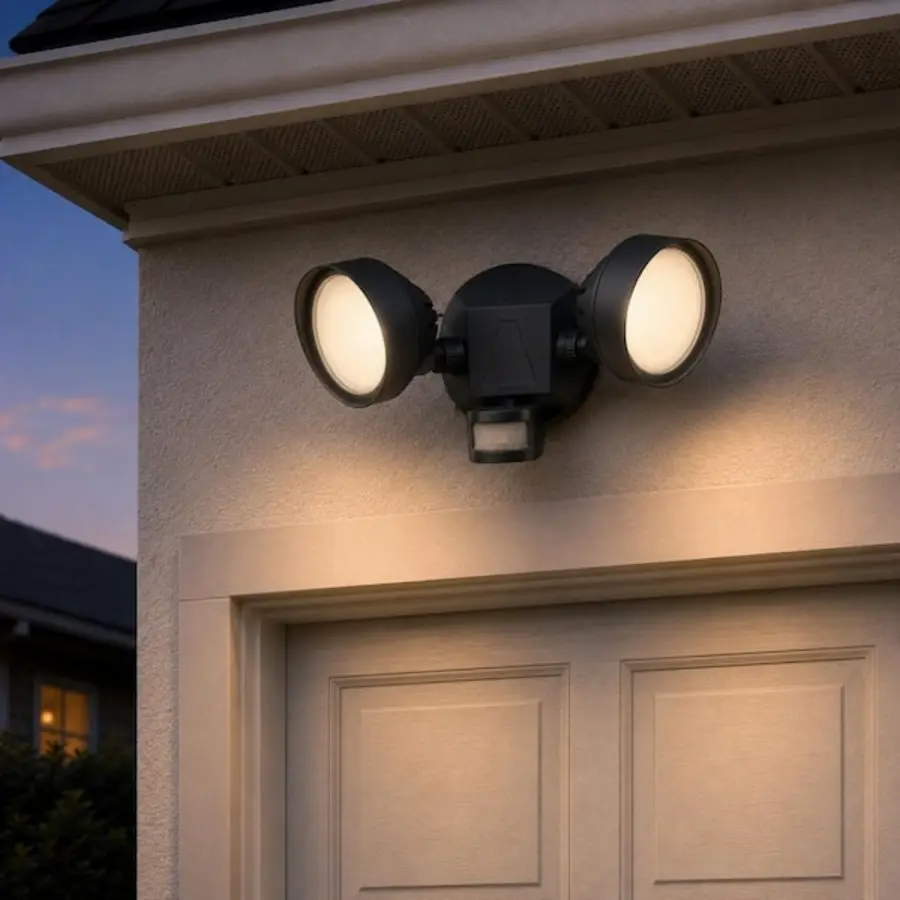
Solar vs wired flood lights comes down to one practical question: can the light still provide the amount of illumination you need on the nights when conditions are least favorable? A solar LED flood light can be a sensible solution for a sunny, low-use location where running cable would be disruptive. A wired outdoor flood light is usually the better choice for a driveway, entry, side yard, or other area that needs dependable brightness throughout the night and through darker winter weather.
Solar fixtures avoid the need to run mains wiring, but they depend on the day’s stored solar energy. Wired fixtures require a suitable electrical installation, yet their output is not limited by that day’s sun exposure. For core home security lighting, consistency is often more valuable than the convenience of a wire-free installation.
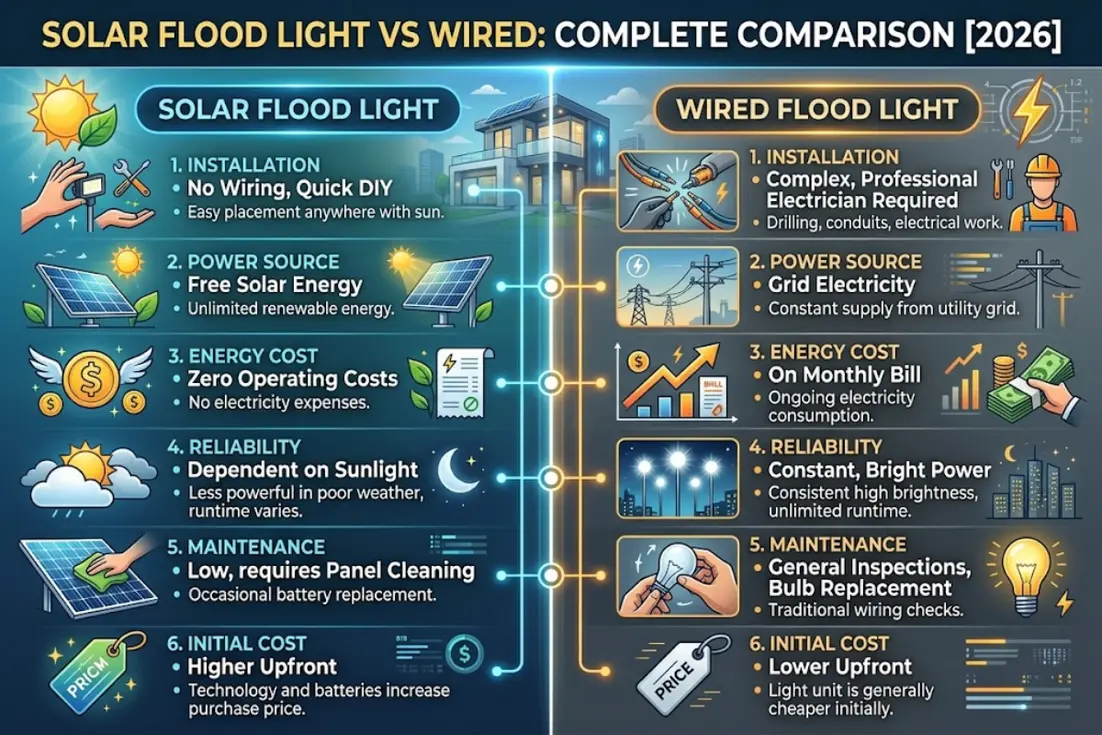
Solar vs wired flood lights at a glance
| Consideration | Solar LED flood light | Wired LED flood light |
|---|---|---|
| Power source | Solar panel charging a battery | Home electrical supply |
| Installation | Usually simpler; no trenching or branch-circuit extension | May require cable routing and professional electrical work |
| Nightly reliability | Depends on sunlight, battery condition, settings, and temperature | Generally consistent while power is available |
| Light output | Often best for localized or motion-activated use | Better suited to sustained, broader-area illumination |
| Winter and shade | Can have shorter runtime or lower output | Not affected by daylight availability |
| Ongoing cost | No direct electricity use, but battery replacement may eventually be needed | Uses electricity, with no solar battery to maintain |
| Best fit | Remote gates, sheds, bins, secondary paths, occasional-use areas | Driveways, entrances, side passages, patios, and primary security zones |
Neither type is automatically better. The appropriate outdoor security lighting power source depends on the site, how long the light must operate, and what happens if it does not operate one night.
The main difference: stored energy versus continuous power
A solar flood light is a small energy system rather than simply a lamp. Its panel collects daylight, its battery stores energy, and a controller manages charging and operation after dark. The fixture can only use the energy available in that system.
That makes solar performance highly site-dependent. A panel in open sun may charge well during long summer days. The same panel may receive substantially less useful energy in a winter month, after several cloudy days, or when leaves, dirt, snow, or a nearby roof shade it.
A wired fixture draws power as it operates. It does not need to ration a battery between dusk, motion events, and dawn. That is why wired flood lights are usually the more reliable choice when a light must remain available for long periods or needs to illuminate a large area consistently.
This does not mean solar lighting is ineffective. It means its use should match its energy limits. A motion-triggered solar light that operates briefly a few times each night asks much less from its battery than a bright fixture running from sunset until morning.
When a solar security light is a good choice
Solar security lights can work very well in the right location. Consider one when most of the following are true:
- The location receives clear, direct daylight for much of the day.
- The area is away from the house, making cable installation difficult or disruptive.
- The light is mainly needed when someone approaches, rather than continuously overnight.
- The area is secondary rather than your only illuminated entry or access route.
- You can mount the panel separately if the best light location is shaded.
- You are comfortable checking the panel and battery performance over time.
A detached shed, garden gate, refuse area, remote fence line, or occasional-use path can be good candidates. Motion sensing and low-level standby modes can help preserve stored energy, allowing the fixture to reserve brighter output for movement.
The panel location deserves at least as much attention as the fixture location. A light installed under a porch roof may have a clear view of the path but poor access to daylight. If the design has a separate panel, you may be able to place the panel in a sunnier area while aiming the light where it is needed. Keep in mind that the connecting lead also needs a protected, practical route.
When a wired outdoor flood light is the better choice
Choose a wired outdoor flood light when dependable operation matters more than the convenience of a wire-free installation. It is usually the stronger option for:
- A front or back entry used every day.
- A driveway where people arrive late or leave early.
- A side passage that needs regular, reliable visibility.
- A large patio, yard, or parking area needing sustained illumination.
- A heavily shaded site or a location with short, dim winters.
- A security camera area where usable light is needed consistently.
- A location where the light must work through several overcast days.
A hardwired fixture can still use a motion sensor, photocell, timer, or smart control. Being wired does not mean it must run at full brightness all night. In many homes, a motion sensor or scheduled control provides useful light while reducing unnecessary operation and spill into neighboring properties.
For guidance on control types and common setup issues, see our guide to <a href="/guides/hardwired-motion-sensor-flood-lights/">hardwired motion sensor flood lights</a>.
Brightness: do not compare only the headline lumen figure
Solar and wired fixtures may both display a lumen claim, but the number alone does not tell you whether they will perform similarly through the night. With solar lighting, the available brightness may change according to battery charge, operating mode, and how often motion has triggered the light.
Look instead at the lighting task:
- Entrance identification: You need enough light to recognize visitors, find locks, steps, and uneven surfaces.
- Driveway visibility: You need broad, even illumination with limited deep shadows around vehicles and walking routes.
- Deterrence and awareness: A motion-triggered increase in light may be more useful than continuous high output.
- Camera support: Avoid assuming any flood light will improve camera images. Very bright light close to a camera can create glare, reflections, or harsh contrast.
Aim flood lights toward useful surfaces and routes, not outward at eye level. A fixture that causes glare can make it harder for a person—or a camera—to see into a darker area beyond it. Placement is often more important than simply increasing output. Our guide on <a href="/guides/where-to-put-motion-sensor-lights/">where to put motion sensor lights</a> explains how to cover approach routes without aiming light directly into windows or neighboring property.
Runtime and weather: where solar limitations become most visible
Solar LED flood light reliability is usually strongest after bright days and weakest when demand is highest: during long, dark, cold, or overcast periods. Winter creates a double challenge because there are fewer hours for charging and more hours of darkness to cover.
Cold conditions can also reduce battery performance. Dirt, pollen, leaves, and snow on a panel reduce the sunlight that reaches it. A panel that is partly shaded at midday may collect much less energy than its appearance suggests.
Wired fixtures are not immune to weather-related problems. Water intrusion, damaged seals, corrosion, failed sensors, and electrical faults can affect any outdoor fixture. However, their nightly output does not depend on solar charging conditions.
Check that any fixture is intended for its outdoor location and exposure level. Product descriptions may use ingress-protection ratings, but those ratings should be interpreted carefully rather than treated as a complete guarantee of durability. See <a href="/guides/ip-ratings-for-lights/">our guide to IP ratings for lights</a> for a plain-language explanation of what they can and cannot tell you.
Motion sensing is especially important for solar fixtures
Motion control can make a solar light more practical because it reduces the total energy used overnight. Common modes include:
- Off until motion is detected.
- Low-level background light that brightens with motion.
- Bright light for a selected period after motion.
- Dusk-to-dawn operation at a reduced output.
For a solar light, the most energy-demanding choice is usually continuous, high-brightness dusk-to-dawn operation. That may work in favorable summer conditions but become less dependable after poor weather or in winter.
Set the motion detection zone carefully. If the sensor faces a busy sidewalk, road, swaying branches, or a frequently visited neighboring area, repeated activation can use battery capacity before you need the light. A sensor should cover the approach route—not every possible movement in the wider yard.
Installation and maintenance tradeoffs
Solar installation is often physically simpler because it does not require running a new electrical cable. You still need secure mounting, a panel position with good daylight exposure, and a way to route any separate panel cable without damage. Test the sensor before final mounting, because height and aim can significantly change what it detects.
Wired installation can be more involved, especially when power is not already available near the desired fixture location. Electrical work outdoors involves safety, equipment suitability, and current local requirements. Do not assume a nearby indoor circuit, existing box, or old fixture location is appropriate for a new flood light. Verify current local rules and use a qualified electrician where the work involves fixed wiring, uncertain existing conditions, or new cable runs.
Maintenance differs as well:
- Solar: Clean the panel periodically, keep it clear of seasonal debris, check mounting hardware, and expect the battery to have a finite service life.
- Wired: Clean the lens, inspect for physical damage or moisture, and investigate flicker, tripping, unusual heat, or intermittent operation rather than repeatedly resetting the fixture.
If an outdoor fixture appears dim until motion occurs, first determine whether it is operating in a deliberate standby mode rather than failing. Our article on <a href="/guides/outdoor-lights-dim-until-motion-detected/">outdoor lights that dim until motion is detected</a> covers that distinction.
A simple decision framework
Use these questions before choosing between solar security lights vs wired fixtures:
- Is this a primary security location? If it covers the main entrance, driveway, or a regularly used access route, favor wired lighting for dependable operation.
- Can the solar panel receive reliable daylight year-round? Consider winter shade, tree growth, roof shadows, and local weather patterns—not just a sunny installation day.
- Does the light need to stay bright for hours? If yes, wired is usually more suitable. Solar is more convincing for short, motion-triggered use.
- How disruptive would wiring be? A remote location may justify solar even if its performance is more limited.
- What happens if the light has a poor night after several cloudy days? If that would create a meaningful safety or security gap, use wired power or add another dependable light source.
- Can you manage glare and spill? Either power source can be badly placed. Choose a fixture and mounting position that lights your property without shining into windows, roads, or neighboring yards.
The practical bottom line
For dependable home security lighting near the house, a wired LED flood light is usually the better long-term choice. It can provide stable output regardless of the previous day’s weather and can support motion sensing, schedules, and all-night operation without drawing down a battery.
A solar LED flood light is most useful where wiring is impractical and the site has strong daylight exposure. Treat it as a focused, energy-limited solution: especially suitable for remote, occasional-use, or motion-activated lighting rather than the only light protecting a primary entrance.
The best approach is often mixed. Use wired lighting for the driveway, doors, and main routes, then use solar fixtures for secondary garden areas, gates, sheds, and other places where cable installation would be disproportionate to the lighting need.
References
- Solar vs Wired Landscape Flood Lights: What Lasts?. (n.d.). https://solargardenspotlights.com/solar-vs-wired-landscape-flood-lights
- do solar flood lights work - Outdoor Lighting Guide | SEEKINGLED. (n.d.). https://seekingled.com/do-solar-flood-lights-work
- LED floodlights vs. LED Solar Floodlights: Which is the Best Outdoor Lighting Choice? - AGC Lighting. (n.d.). https://www.agcled.com/blog/led-floodlights-vs-led-solar-floodlights-best-outdoor-lighting-choice.html
- What Are LED Solar Floodlights and Why Are They So Popular?. (n.d.). https://www.ledlightexpert.com/What-Are-LED-Solar-Floodlights-and-Why-Are-They-So-Popular_b_112.html
- Solar Security Lights vs Traditional Flood Lights: What Homeowners Should Choose | Outdoor Solar Outlet. (n.d.). https://outdoorsolaroutlet.com/blogs/news/solar-security-lights-vs-traditional-flood-lights-what-homeowners-should-choose
- Are solar LED flood lights actually worth it or should I go wired?. (n.d.). https://www.reddit.com/r/Lighting/comments/1r1utbh/are_solar_led_flood_lights_actually_worth_it_or
- Solar vs. Wired Outdoor Lighting Which Is Better for Your Home – 7Pandas USA Lighting Store. (n.d.). https://7pandas.com/blogs/news/solar-vs-wired-outdoor-lighting-which-is-better-for-your-home
- Solar Flood Lights: Buyer's Guide to Specs and Sizing – LinkSolar. (n.d.). https://linksolar.net/blogs/guide/solar-flood-lights-buyers-guide