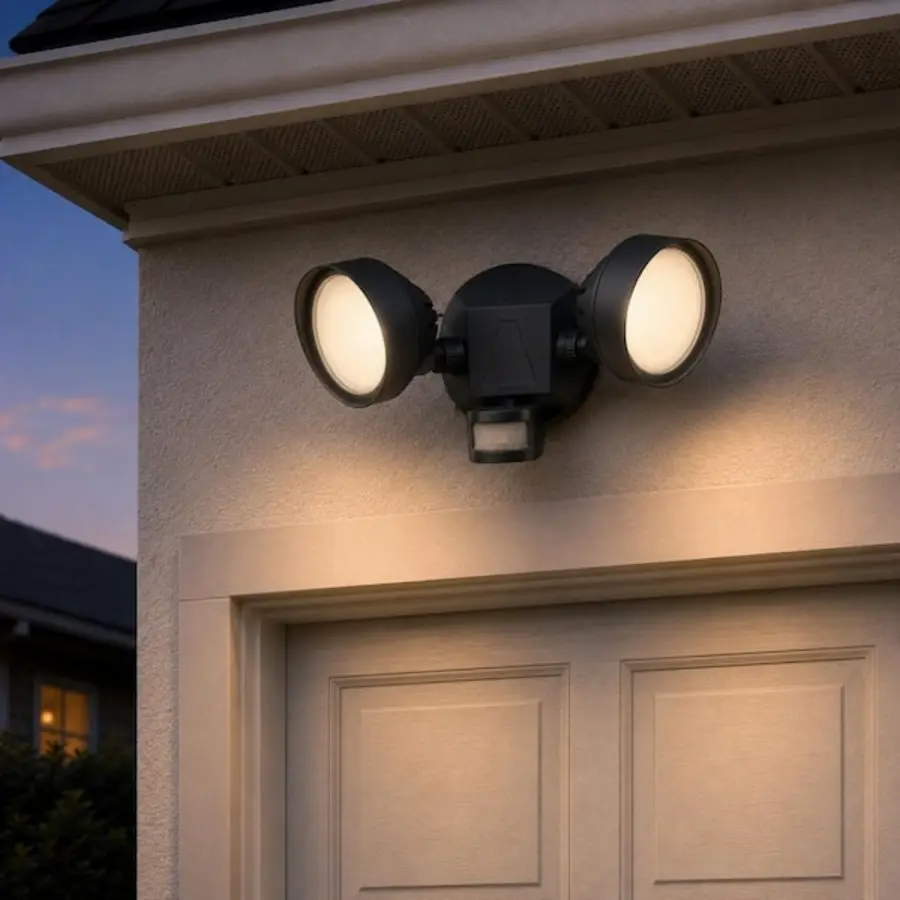
Hardwired motion sensor flood lights work best when they are selected as controlled area lights, not as the brightest fixtures available. For a driveway, side gate, garage approach, or rear entrance, the useful choice is usually the fixture that puts light where a person walks or arrives, turns on only when needed, and can be adjusted after installation.
Brightness alone does not create security. A badly aimed flood light can produce glare, erase depth perception, disturb neighbors, and still leave the useful ground area unevenly lit. Start with the area you need to see, then choose output, beam direction, sensor coverage, and weather protection to suit that area.
Start with the zone, not the fixture
Before comparing specifications, define the motion zone and the visual task.
A front walk may need enough light to identify a step, find keys, and see a visitor. A driveway may need broader coverage for arrivals and backing out. A side gate may only need a compact pool of light near the latch. These are different jobs, and they should not automatically receive the same high-output flood fixture.
Walk outside after dark and identify:
- Where people approach and where they actually walk
- Obstacles such as steps, bins, low walls, changes in level, and gate hardware
- Nearby windows, streets, sidewalks, and neighboring property
- Trees, shrubs, flags, heat pumps, or other objects that may move in wind
- The mounting surface and whether it allows the fixture to aim downward
A motion light should generally reveal the route and destination, rather than light every edge of the yard. If a large property needs broad, continuous visibility, a motion flood light may be only one part of the plan. Low-level pathway lighting or a modest dusk-to-dawn light can sometimes reduce the need for an extremely bright triggered floodlight.
Choose brightness by coverage and glare control
Outdoor security light brightness is often expressed in lumens, but the printed lumen figure does not tell you how the installed result will feel. Mounting height, beam spread, surface color, fixture aiming, and surrounding darkness all change the outcome.
A very bright fixture aimed across open space can make a modest yard feel harsh while leaving shadows under eaves, behind vehicles, or near planting beds. It can also cause uncomfortable glare for someone walking toward it. In practical terms, glare is light entering the eye where it is not useful.
For many residential applications, it is sensible to begin with the lowest output that can comfortably light the intended activity zone. Choose more output only when the area is genuinely larger, the mounting position is higher, or useful surfaces remain too dim after correct aiming.
Look for these controls:
- Independently adjustable heads: These allow light to be divided between a drive, path, doorway, or gate instead of concentrating it in one glaring patch.
- A shielded or recessed light source: A design that hides the brightest emitting surface from common viewing angles is often more comfortable than exposed, flat light panels.
- A suitable beam spread: A broad beam can cover a short, wide area. A narrower beam can be useful where light must stay within a side passage or beside a garage.
- Separate dimming or output settings, if offered: These can be valuable, but confirm that the setting applies in motion mode rather than only in a manual or dusk-to-dawn mode.
Do not assume that a higher wattage or a larger lumen number represents better lighting. It may only represent a greater risk of spill light.
Prioritize aiming before adding output
Aiming is the most effective way to make a hardwired LED flood light more useful and more neighbor friendly. The fixture should generally point down and across the target surface, not straight outward from the wall.
For example, a garage-mounted fixture can be aimed so one head covers the vehicle approach and another covers the path to the door. A light over a side gate can be aimed at the latch, threshold, and immediate approach instead of across a neighboring fence.
After dark, stand in several likely positions: at the driveway entrance, on the sidewalk, at the neighbor-facing boundary, and at the door. If the fixture itself appears much brighter than the ground it is meant to illuminate, revise the angle or reduce the output if possible.
Avoid placing a motion flood light where it shines directly into a driver's line of sight. Strong frontal glare can make it harder, not easier, to see people, pets, or objects in darker areas.
Choose an adjustable sensor, not simply the widest sensor
Motion flood light sensitivity matters as much as brightness. A sensor with an exceptionally wide published detection angle can be useful at a driveway or open rear approach, but it may be a poor fit beside a public sidewalk, alley, busy street, or neighbor's path.
Look for a fixture that lets you adjust at least some of the following:
| Control | Why it matters |
|---|---|
| Detection range or sensitivity | Helps reduce activation from distant activity, small animals, or movement beyond your property. |
| Sensor direction | Lets you point the detection zone toward the approach you care about. |
| On-time duration | Prevents a brief trigger from leaving a large area brightly lit for longer than needed. |
| Daylight threshold or photocell setting | Helps prevent activation during useful daylight or in bright twilight. |
| Test mode | Makes it easier to set coverage in daylight without waiting for darkness. |
| Manual override | Can be useful for unloading a car or working outside, but should be easy to return to normal motion operation. |
Detection performance also depends on approach direction. Motion sensors often respond differently to movement crossing their field than movement heading directly toward them. Rather than relying on a box claim, use the adjustment period after installation to test the real approach route.
Begin with a conservative range setting. Walk through the intended route, then gradually widen the range only if the light fails to trigger soon enough. This approach is usually more successful than setting the sensor to maximum sensitivity and trying to correct repeated nuisance activation later.
Common causes of unwanted triggers include branches, tall grasses, reflective surfaces, passing vehicles, HVAC exhaust, wildlife, and activity beyond the property boundary. A fixture cannot always distinguish between a person approaching a door and movement that happens to be within its sensing field.
Check how the photocell and operating modes behave
Most motion lights use a photocell to limit operation in daylight, but the details vary. Some fixtures offer motion-only operation, a dusk-to-dawn setting, a low-level nighttime setting that brightens with motion, or a temporary manual override.
For a home that feels too dark between triggers, a modest low-level setting can be more comfortable than installing a far brighter motion flood light. For a side yard near bedrooms or neighboring windows, motion-only operation may be more appropriate.
Read the operating-mode instructions before buying. In particular, check how the fixture returns from manual override to normal motion sensing. Some lights use a wall-switch sequence, and the behavior can be inconvenient if several exterior lights share the same switch. For more detail, see our guide to outdoor motion light manual override.
Match weather protection to the actual exposure
A weatherproof motion sensor flood light needs more than a general claim that it is suitable for outdoors. Consider where water, wind-driven rain, snow, salt air, insects, direct sun, and temperature swings will affect it.
A fixture mounted beneath a deep eave experiences very different exposure from one mounted high on an open wall or at the edge of a roofline. The sensor lens, adjustment dials, gaskets, cable entries, and junction-box connection can all become weak points over time.
Review the manufacturer documentation for the fixture's stated environmental suitability, and verify that it matches the location where you intend to install it. An IP rating can describe resistance to solid objects and water ingress, but it is not a complete statement of durability or installation suitability. Our guide to IP ratings for lights explains what those markings can and cannot tell you.
For exposed locations, it is worth favoring:
- Corrosion-resistant housing and hardware
- A substantial gasketed connection area
- Adjustment controls that remain accessible without leaving openings exposed
- A mounting arrangement that does not trap water around the fixture base
- A clear warranty and accessible support documentation
Decide whether integrated LEDs or replaceable bulbs suit the location
Many modern hardwired flood lights use integrated LEDs. They can be compact and efficient, and adjustable-head designs are widely available. Their tradeoff is serviceability: if the driver, sensor, or LED module fails, the whole fixture may need replacement.
Fixtures that accept replaceable flood bulbs can make lamp replacement simpler, and they may allow you to choose a different beam spread or light color later. However, the sensor and fixture body can still fail independently, and outdoor-rated replacement bulbs must be suitable for the fixture and location.
For a light installed above a garage door, high on a gable, or anywhere requiring repeated ladder work, long-term maintenance deserves extra weight in the decision. Check whether the sensor is replaceable, whether the manufacturer offers parts, and whether the fixture can be serviced without removing the entire mounting base.
See integrated LED vs. replaceable bulb fixtures for a fuller comparison of the maintenance tradeoff.
Select a light color that supports visibility without feeling severe
Cooler white light can make a flood light appear subjectively more intense, especially in a dark garden. Warmer white light often feels less stark around porches, planting, and residential facades, though color preference is personal and the surrounding lighting matters.
The important point is consistency and restraint. A very cool, high-output fixture near a warm porch light can make both areas feel visually awkward. If the motion light is near an entrance, consider how it will look beside existing exterior lamps and through nearby windows.
Plan for installation and future adjustment
Hardwired fixtures require an appropriate electrical connection and mounting arrangement for the specific location. Requirements can vary by jurisdiction, building type, and exposure conditions. Do not assume that an existing box, cable, switch, or exterior mounting surface is suitable simply because a previous fixture was installed there.
A qualified electrician is particularly sensible when:
- There is no existing suitable connection point
- The fixture will be mounted high or in a difficult-access location
- The current exterior wiring is old, damaged, or of uncertain condition
- The location is exposed to heavy weather or requires a new exterior box
- You are unsure whether the circuit, switch arrangement, or installation method is appropriate
Ask the installer to leave the sensor controls accessible and to aim the fixture for the intended route before final tightening. Then test it over several evenings. Seasonal plant growth, snow reflection, changing parking habits, and a new neighbor's outdoor lighting can all justify a later adjustment.
A practical buying checklist
Before choosing hardwired motion sensor flood lights, confirm that the model offers:
- Enough output for the actual path, drive, door, or gate—not the whole property
- Adjustable light heads or an aiming pattern that suits the mounting location
- Adjustable motion sensitivity, range, and on-time duration
- A sensor field that can avoid sidewalks, roads, and neighboring areas
- A photocell and operating modes you understand and can reset easily
- Environmental suitability documented for the location's real exposure
- A realistic maintenance plan for the fixture's mounting height
- Serviceable parts or a replacement strategy if it uses integrated LEDs
The best result is rarely the light that looks brightest in product photos. It is the fixture that comes on reliably for a person arriving at your home, lights the needed surface without glare, and disappears back into the dark when its job is done.
References
- ✅ 7 Best Hardwired Motion Sensor Flood Lights for Outdoor Security [2026] 🔦 Yard, Driveway, Porch. (n.d.). https://www.youtube.com/watch?v=oT-8D8lPRzo
- The 10 Best Hardwired Flood Lights of 2026 (Reviews) - FindThisBest. (n.d.). https://www.findthisbest.com/best-flood-lights/hardwired
- Top 5 Best Flood Lights for 2026 [Expert's Review]. (n.d.). https://www.youtube.com/watch?v=CEGL0DYFQdo
- 8 Best Outdoor Motion Sensor Lights Of 2026 That Make Sense. (n.d.). https://www.youtube.com/watch?v=c72XTDyDI6I&vl=en
- The Best Solar Flood Lights of 2026, Tested and Reviewed. (n.d.). https://www.bobvila.com/reviews/best-solar-flood-light
- Where Should You Place Motion Flood Lights?. (n.d.). https://fielackelectric.com/blog/guides/where-should-you-place-motion-flood-lights
- Best wired in motion sensor LED flood lights? : r/homesecurity. (n.d.). https://www.reddit.com/r/homesecurity/comments/1kgot74/best_wired_in_motion_sensor_led_flood_lights
- 25+ Hardwired Motion & Security Lights for sale. (n.d.). https://www.ebay.com/b/Hardwired-Motion-Security-Lights/183393/bn_7116864970

