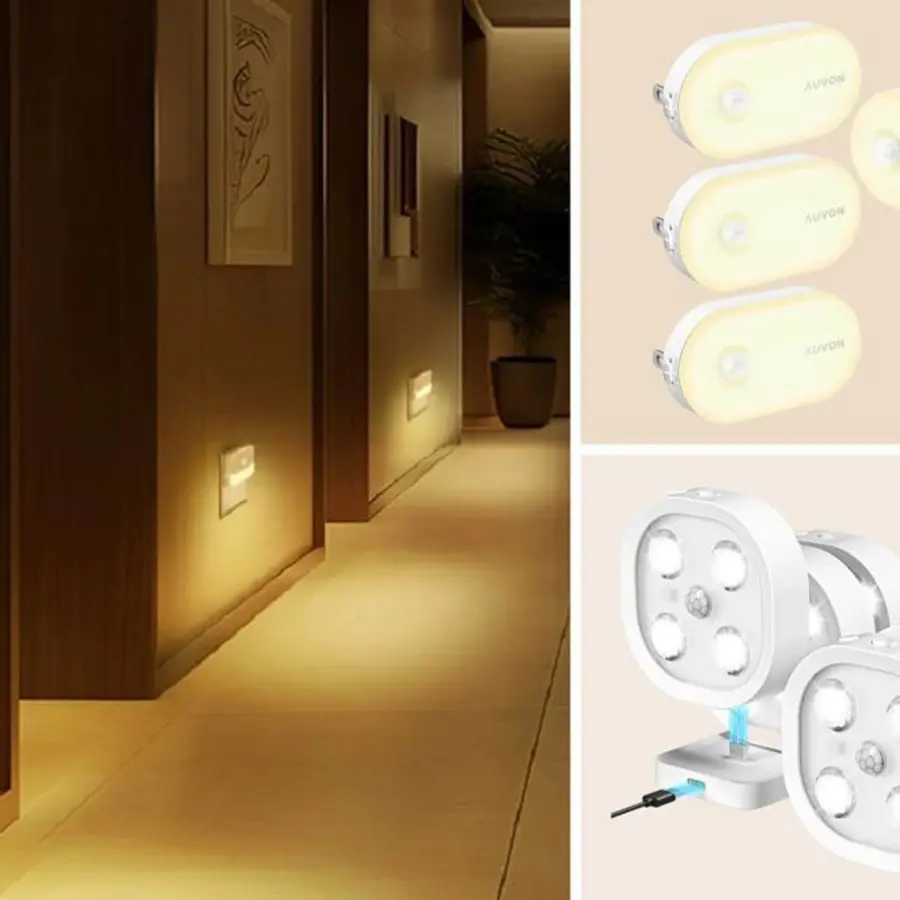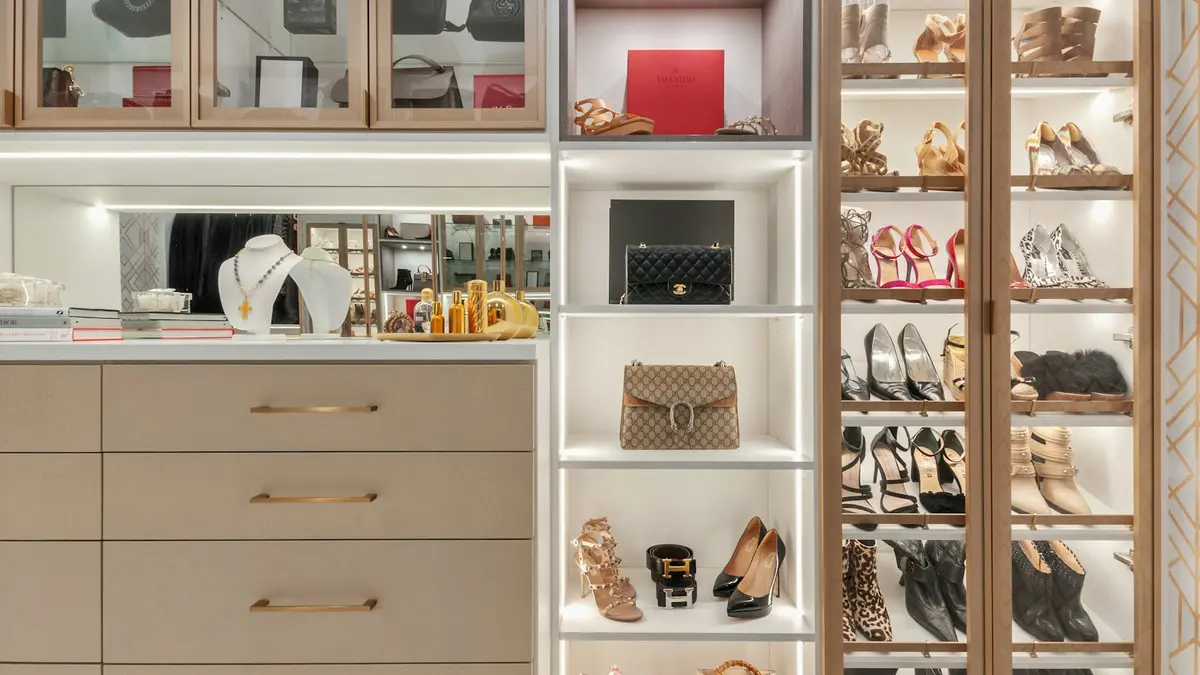
Motion sensor lights for walk in closet spaces work best when treated as a small lighting system rather than a single stick-on fixture. For a closet that feels bright on entry, choose several warm-white, dimmable LED bars or compact fixtures, place them to light the walkway and storage faces, and make sure each sensor can detect a person entering or moving within its zone.
A rechargeable light bar can be a practical no-wiring option, particularly for renters or for closets without an accessible electrical connection. Its limits are equally important: battery-powered fixtures provide localized light, their output can fall as the battery runs down, and every fixture needs to be removed or connected for charging. Plan around those realities before covering the room with adhesive-mounted lights.
Start with the closet layout, not the product listing
The useful question is not simply whether a light is 鈥渂right.鈥?It is where its light will land after it is installed.
In a walk-in closet, hanging clothing, deep shelves, drawers, and tall cabinetry all create shadows. A bar mounted above one doorway may make the floor near the entrance visible while leaving the back wall and the interiors of shelving units dim. Light aimed straight down can also make it difficult to distinguish dark garments hanging close together.
Divide the closet into zones:
- Entry and walking zone: enough general light to enter, move safely, and see the floor.
- Hanging-clothes zone: light directed toward garment fronts and rods.
- Shelving and shoe zone: light that reaches the front of shelves, where labels, colors, and stored items are seen.
- Mirror or dressing zone: even, face-level light where practical, without a harsh point source directly overhead.
For a compact, open walk-in closet, two or three coordinated fixtures may be sufficient. A longer closet, an L-shaped plan, tall wardrobes, or shelves that project into the room can require more separate light positions. Choose a system with matching fixtures instead of expecting one unusually powerful bar to solve every shadow.
Compare usable brightness and beam spread
Look for a stated lumen output, but do not use that number alone to compare fixtures. Lumens describe the total light produced by the fixture; they do not tell you how widely the light is distributed or how much of it reaches clothing and shelves.
A narrow, concentrated beam can look intense directly below the light but leave the edges of a closet dark. A broader diffuser generally gives smoother coverage over a smaller area, although it may look less dramatic when viewed straight on. For closet use, broad and even light is often more useful than a bright hotspot.
When comparing dimmable closet lights no wiring options, check for these details:
| Specification | Why it matters in a walk-in closet | What to look for |
|---|---|---|
| Lumen output | Indicates potential light output | Compare fixtures at their highest setting, but plan for multiple fixtures where needed |
| Light length | Affects how much of a rod or shelf run one fixture can cover | Longer bars for continuous runs; shorter units for individual bays or shelves |
| Diffuser and beam shape | Determines whether light spreads or forms a narrow pool | Frosted diffusers and wide, even distribution for general closet coverage |
| Dimming method | Lets you reduce glare and tailor the room to the time of day | Multiple levels or smooth dimming that remains available in automatic mode |
| Runtime claim | Influences charging frequency | Treat claims as estimates that vary with brightness, sensor settings, and daily use |
Brightness settings are especially useful in a closet shared by more than one person. A high setting may be helpful for sorting clothes or checking colors, while a medium setting can be more comfortable for quick early-morning use. Confirm that the fixture remembers its preferred brightness level after charging; some revert to a default setting.
Choose warm white carefully
For the warm, welcoming result many people want, select a fixture specifically described as warm white rather than assuming every LED bar will look warm. Color temperature is expressed in kelvins: lower values generally appear warmer and more yellow, while higher values appear cooler and whiter.
Warm white can suit wood cabinetry, beige finishes, and a bedroom-adjacent dressing area. However, an extremely warm light can make whites, grays, and dark blues harder to judge accurately. If color matching is important, consider a warm-neutral setting or a fixture with selectable color temperatures, provided the warmer setting still feels comfortable in the room.
Color rendering matters too. It describes how naturally colors appear under a light source. A fixture with better color rendering can make clothing colors and skin tones easier to assess, though product listings do not always provide complete or consistent details. For more context on this specification, see our guide to <a href="/guides/what-is-cri-in-lighting/">what CRI means in lighting</a>.
Pick a sensor that works with your actual movement
Most rechargeable motion sensor closet lighting uses a passive infrared, or PIR, sensor. It detects changes in heat moving across its field of view. That means a sensor may be less reliable when a person stands nearly still while choosing clothes, or when the sensor is hidden behind an open door, tall hamper, or hanging garments.
Check the following before mounting:
Detection direction
A sensor generally responds better to movement crossing in front of it than to movement moving directly toward it. Mounting a bar so the sensor faces the doorway or walkway often works better than aiming it into a dense run of hanging clothes.
Detection range
Manufacturers may state a detection distance, but real coverage changes with mounting height, approach direction, obstacles, room temperature, and the sensor鈥檚 angle. Use stated range as a comparison point, not a guarantee that one fixture will sense activity across the whole room.
Hold time
Hold time is the period the light stays on after it no longer detects motion. A very short timeout saves battery but can be frustrating while you stand at shelves or look through a drawer. A longer timeout feels more natural but consumes more power. If the duration is adjustable, start with a middle setting and adjust after living with the layout.
Daylight mode
Some lights offer an all-day automatic mode and a mode that activates only in darkness. A daylight-only setting can preserve battery life in a closet with a window or an open door, but it may not activate during daytime when the room is still too dim to use comfortably. Choose the setting based on usable light in the closet, not the brightness outside it.
For a wider overview of placement principles, see <a href="/guides/where-to-put-motion-sensor-lights/">where to put motion-sensor lights</a>.
Plan fixture placement before using adhesive
Temporarily position each light with removable tape, or hold it in place while someone walks in and opens drawers. This simple trial can reveal shadows and sensor blind spots before adhesive makes repositioning harder.
Useful positions include:
- On the underside of a shelf above a clothing rail, directed toward garment fronts.
- At the front edge of high shelving, angled down toward shelves and the aisle.
- On a side wall facing across the walkway, where the sensor can see entering movement.
- Inside deep cabinets or shoe compartments, using a separate fixture rather than trying to reach them from across the room.
Avoid mounting a bar where its light shines directly into your eyes on entry. Also avoid placing sensors behind swinging doors, inside heavily packed compartments, or so high that they cannot reliably detect movement below.
Magnetic mounting plates are often easier to live with than fixtures permanently fixed to adhesive. The light can be removed for charging, temporarily repositioned, or replaced without prying the entire mount off the surface.
Treat adhesive as a surface compatibility question
鈥淪tick on鈥?does not mean 鈥渟ticks securely to every surface.鈥?Adhesive can fail on dusty paint, textured walls, unfinished wood, curved molding, fabric-lined cabinetry, and surfaces exposed to heat or humidity changes. It can also pull paint or finish away when removed.
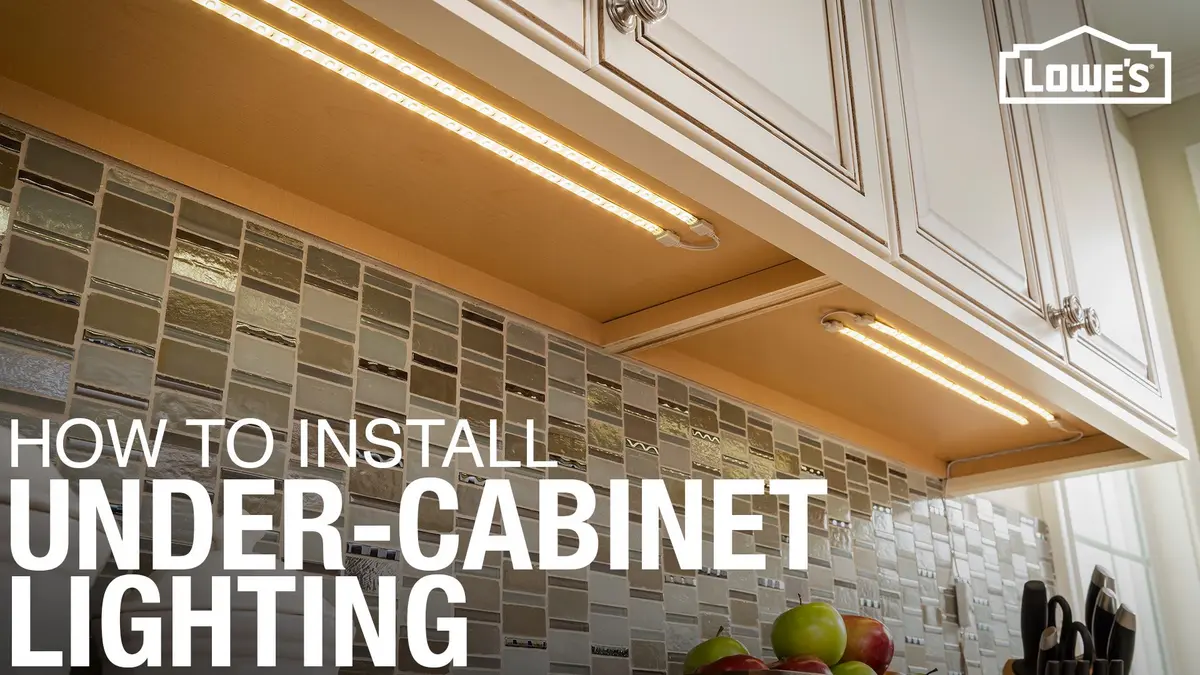
Before installation, clean the mounting area as directed by the fixture maker and allow it to dry fully. Mount on a flat, solid surface whenever possible. If a fixture feels substantial for its adhesive pad, or will be removed frequently for charging, consider whether a small screw-mounted plate is allowed in the space. For a general overview of mounting approaches, read <a href="/guides/under-cabinet-lighting-installation/">our under-cabinet lighting installation guide</a>.
Do not place battery lights where they may be buried under clothing, covered by fabric, or exposed to moisture. Follow the manufacturer鈥檚 instructions for the battery, charger, operating temperature, and intended mounting location.
Make charging part of the selection decision
A rechargeable fixture is only convenient if you can remove and recharge it without dismantling your closet setup. Before buying, identify the charging port type, whether a cable is included, and whether the fixture can charge in place. Also consider whether several fixtures can be charged at once.
Battery life depends heavily on brightness, timeout length, how often the closet is entered, and whether the sensor triggers unnecessarily. A bar used as general closet lighting several times a day will need more frequent charging than a light inside a rarely opened cabinet.
Choose fixtures with a clear low-battery indication if possible. A system with several matching units is easier to maintain when all use the same charging cable and controls. It can also help to charge every unit on a routine schedule rather than waiting for one dark section of the closet to reveal a depleted battery.
Common selection mistakes
Assuming one bar will light the whole closet
One fixture can be useful at a doorway or within a cabinet, but it rarely provides even light for a full walk-in closet. Plan separate lighting for the main aisle and shadowed storage areas.
Choosing only by battery capacity
A larger battery can extend runtime, but it does not correct poor light distribution, weak sensor positioning, or a fixture that is too dim for the space.
Buying warm white without checking dimming behavior
Some lights can be dimmed only in manual mode, while others retain a chosen level in auto mode. Verify this if you want automatic warm, low-level light at night and stronger light for dressing.
Installing before testing sensor coverage
A sensor that works on a countertop may not work from the top of a tall wardrobe or behind a door. Test the entry path, shelving area, and typical standing positions first.
Forgetting access for charging
A light mounted behind a rod, above a high shelf, or under a tightly fitted cabinet may be difficult to remove. A theoretically wire-free installation can become inconvenient if routine charging requires moving clothes or climbing for every fixture.
A practical specification checklist
For a warm, bright, no-wiring walk-in closet, look for a coordinated set of fixtures with:
- Warm-white output or adjustable color temperature with a warm setting.
- Dimming that works in the mode you expect to use most.
- A stated lumen output and a broad, diffused beam rather than a narrow spotlight effect.
- Motion sensing suited to the fixture鈥檚 planned position, with an appropriate hold time.
- Magnetic or otherwise removable mounting for straightforward charging.
- Mounting hardware compatible with the closet鈥檚 actual wall, shelf, or cabinet surface.
- Enough fixtures to cover the entry, walkway, and storage faces independently.
The strongest no-wiring solution is usually modest and deliberate: several well-placed rechargeable lights, each serving a defined area, rather than a single stick-on bar asked to behave like a ceiling fixture. If you find that repeated charging, inconsistent sensor coverage, or adhesive mounting compromises daily use, a professionally planned wired closet-lighting system may be the more durable long-term option.
References
- The Best Closet Lighting. (n.d.). https://shopping.yahoo.com/home-garden/home-improvement/articles/best-closet-lighting-143637470.html
- The Ultimate Guide To The Best Lighting For Closets. (n.d.). https://incrediblehome.ca/the-ultimate-guide-to-the-best-lighting-for-closets
- Motion Sensor Lights For Closets. (n.d.). https://www.amazon.com/motion-sensor-lights-closets/s?k=motion+sensor+lights+for+closets
- The Simplest Way to Install Closet Lighting Without Wiring. (n.d.). https://www.youtube.com/watch?v=A0Ez0nNvJIk&vl=en
- best sensor motion closet lighting? : r/Lighting. (n.d.). https://www.reddit.com/r/Lighting/comments/1lodfzt/best_sensor_motion_closet_lighting
- Closet Lighting Ideas - Brighten Up Your Wardrobe Space. (n.d.). https://www.lowes.com/n/ideas-inspiration/closet-lighting-ideas
- Best Lighting For Walk In Closet: Optimizing for Maximum .... (n.d.). https://www.paclights.com/explore/best-lighting-for-walk-in-closet-optimizing-for-maximum-energy-savings
- Minimalist Closet Lighting. (n.d.). https://www.pinterest.at/ideas/minimalist-closet-lighting/901861029827