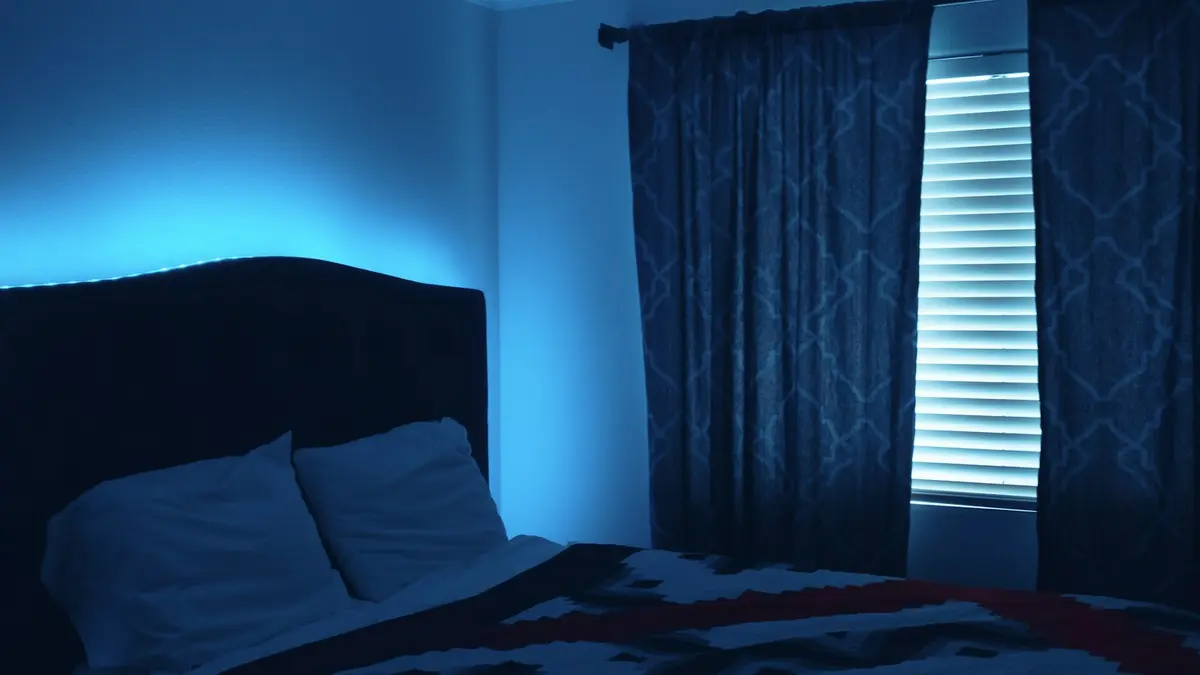
An LED ceiling light glowing when switched off is usually responding to a very small amount of electricity rather than operating at normal brightness. LEDs are sensitive enough that a tiny current from a dimmer, an illuminated switch, a smart control, or wiring effects can create a faint glow in a dark room. A brief fade immediately after switch-off can also come from stored energy in the fixture’s driver.
A persistent glow is not automatically an emergency, but it should not be dismissed if the fixture also flickers, buzzes, smells hot, behaves unpredictably, or seems unusually dim when switched on. Those symptoms can point to an incompatible control, a failing LED driver, or an electrical issue that needs a qualified electrician.
First, identify the kind of glow
The timing and behavior of the light provide useful clues.
| What you see | More likely explanation | Appropriate next step |
|---|---|---|
| A glow that fades within seconds or a few minutes | Stored charge in the LED driver | Usually monitor it; investigate if the behavior changes or becomes more pronounced |
| A steady, faint glow all night | Small ongoing current through a control or circuit | Check the switch and dimmer type; arrange electrical diagnosis if the cause is unclear |
| A repeating flash or pulse after switch-off | Driver charging and discharging from a small current | Check dimmer, smart switch, or illuminated switch compatibility |
| Light is dim, flickery, or slow to start when on | Incompatible dimmer, failing driver, loose connection, or fixture fault | Stop relying on the fixture until the cause is identified; consider an electrician |
| Buzzing, heat, burning odor, discoloration, or tripping breaker | Potential equipment or wiring fault | Turn off power at the breaker if safe to do so and seek prompt professional help |
A true afterglow that vanishes quickly is different from LED ghosting after power off. Ghosting is a continuing faint illumination or periodic flash that can persist as long as the wall control remains off.
Why LEDs can glow when there seems to be no power
Older incandescent lamps needed enough current to heat a filament. Very small stray currents generally produced no visible result. An LED fixture contains electronic components and LEDs that can react to much less energy, especially in a completely dark room.
The fixture is not necessarily receiving full usable power. Instead, a small current may charge part of the driver, weakly energize the LEDs, or produce an occasional pulse. The source can be inside the wall control, in the fixture driver, or in the circuit wiring.
This is why replacing an incandescent lamp with an LED bulb, or replacing an older ceiling fixture with an integrated LED model, can reveal a problem that was previously invisible.
Common causes of an LED light faint glow after switch off
An illuminated wall switch
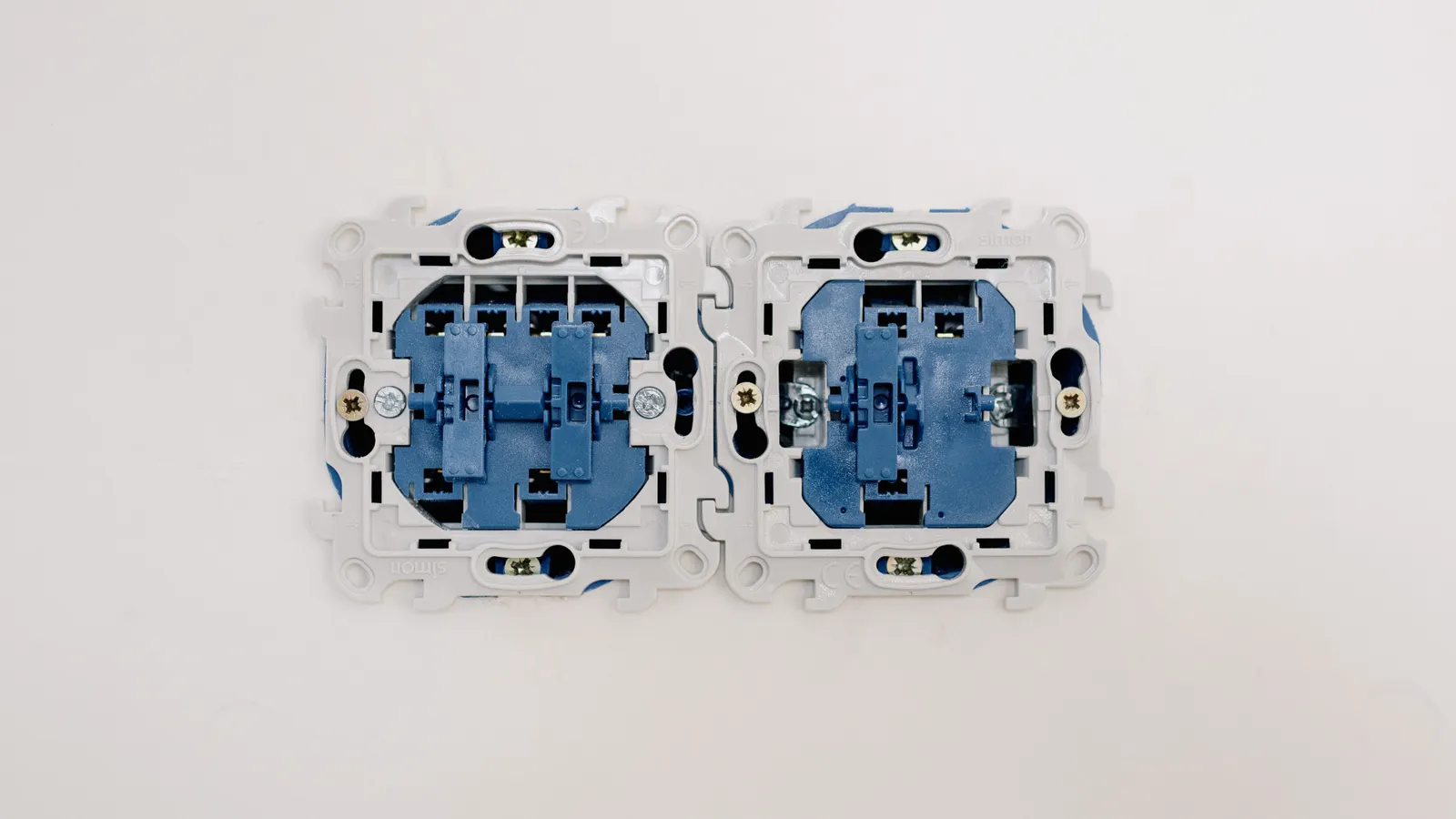
Some switches have a locator light that helps you find the switch in the dark. Others have an indicator that shows the controlled light is on. Depending on the switch design, it may pass a very small amount of current through the lighting circuit when the main switch is off.
That amount may be imperceptible with an older lamp but enough to make an LED ceiling light stays dim or flashes occasionally. If your switch has a small visible light, it is one of the first things to investigate.
Do not remove a switch cover or alter wiring unless you are competent to work safely on electrical equipment and have verified that the circuit is de-energized. A qualified electrician can confirm whether the switch is the source and recommend a suitable replacement or compatible solution.
A dimmer that does not fully turn off
An LED dimmer not fully turning off is a common explanation, particularly with older dimmers installed before LED lighting became common. Many dimmers need a small amount of current to operate their electronics. Some also work poorly with LED drivers outside their intended load range.
The result can be a faint steady glow, a periodic flash, poor low-end dimming, buzzing, or a fixture that appears unusually dim when switched on. A dimmer and fixture can both be labeled dimmable yet still perform poorly together.
Start by confirming whether the fixture is designed for dimming. Then check the dimmer manufacturer’s compatibility guidance for LED loads and the specific fixture or driver where possible. A properly selected LED-rated dimmer often resolves both off-state ghosting and poor on-state performance. For more on related symptoms, see why LEDs can flicker after installing a dimmer.
A smart switch, sensor, timer, or electronic control
Smart switches, occupancy sensors, timers, touch controls, and some fan/light controls may draw a small operating current. Controls that do not have a neutral connection available at the switch location can be especially prone to sending a small current through the light load to power themselves.
That does not mean every smart switch is unsuitable for LEDs. It means the switch, fixture, and any required accessory or bypass component must be compatible. Check the documentation for both devices rather than adding a component based on a generic online recommendation.
If the glow began immediately after installing a smart switch or sensor, that timing is a strong clue. An electrician can determine whether the chosen control is appropriate for the fixture and circuit.
Wiring effects on long or shared runs
Wires running alongside energized conductors can pick up a small induced voltage. This effect is more likely to become visible on longer cable runs or circuits with multiple electronic controls. The resulting energy is normally far too small for ordinary lighting operation, but it may be enough to charge an LED driver intermittently.
Other circuit conditions can produce similar symptoms. For example, a switched conductor may not be isolated as expected, or a control may be installed in a way that does not suit the circuit. Diagnosing these conditions requires proper testing equipment and electrical knowledge; a non-contact voltage tester alone cannot establish the cause.
A failing LED driver or fixture
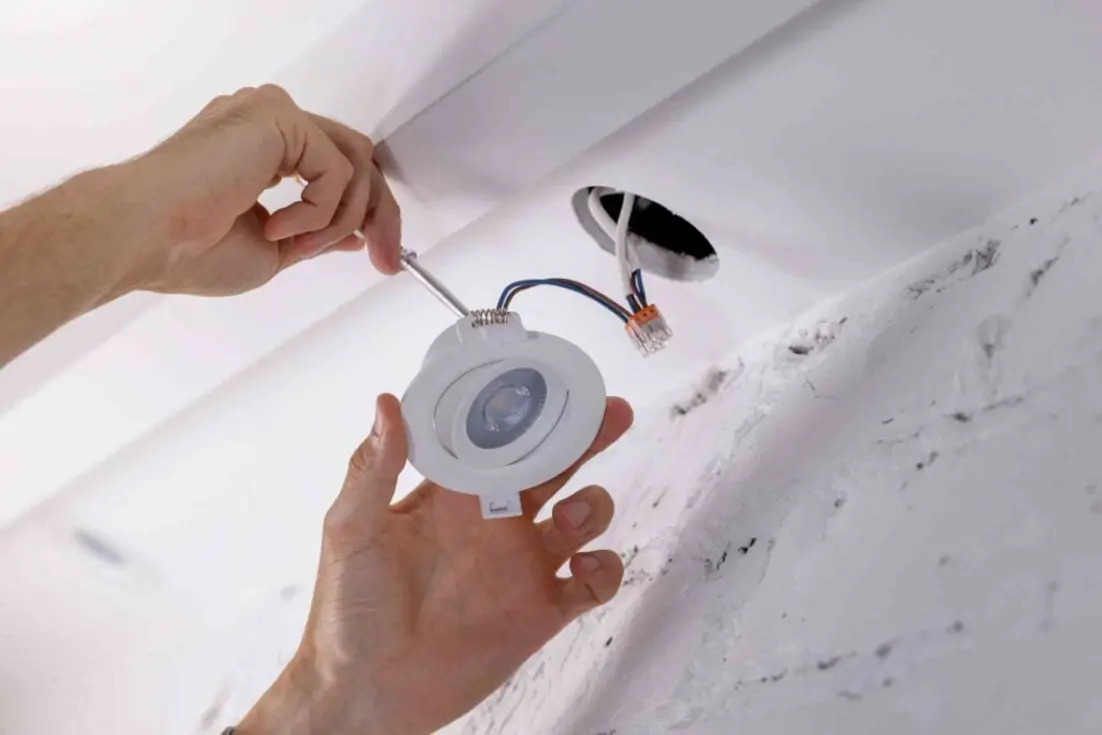
Integrated LED ceiling fixtures include a driver that converts incoming power into the form the LEDs need. Like other electronic components, drivers can fail over time.
A driver becomes more suspect when the glow is accompanied by new flickering, reduced brightness, color changes, delayed startup, random shutoffs, or buzzing. If the same switch works normally with another compatible fixture, the fixture or driver is more likely to be involved.
Some integrated fixtures have replaceable drivers; others are designed to be replaced as a unit. Check the fixture documentation and warranty terms before assuming the entire fitting must be discarded. This distinction is one reason to consider integrated LED versus replaceable-bulb fixtures when planning future lighting.
A safe isolation process
You can narrow down the cause without opening electrical boxes or making wiring changes.
- Observe the pattern. Note whether the glow is steady, fading, or flashing, and whether it began after a new fixture, dimmer, switch, or renovation.
- Check the wall control. Look for a dimmer, illuminated locator light, smart control, timer, motion sensor, or fan/light combination control.
- Test normal operation. With the light on, check whether it reaches expected brightness, dims smoothly if applicable, or makes noise. Do not keep using a fixture that smells hot, crackles, or shows visible damage.
- Compare with another compatible lamp or fixture where practical. If the ceiling fixture takes standard replaceable bulbs, trying one known-compatible LED bulb may help identify whether the issue follows a particular bulb. Do not exceed the fixture’s stated lamp limits.
- Use the breaker as an observation, not a repair. Turning off the relevant breaker should make the light go completely dark. If it does, the glow is being fed from the circuit or control rather than from light stored in the fixture. This does not identify the exact fault or make internal wiring safe to handle.
- Call an electrician for persistent or unclear cases. They can test the circuit, switch, neutral arrangement, and fixture safely and determine whether a control change, driver replacement, or wiring correction is appropriate.
A switch should ordinarily interrupt the correct conductor for the local electrical system, and the fixture should not remain unexpectedly energized when switched off. Because wiring practices and current rules vary by location and installation age, this is a job for a qualified electrician rather than a do-it-yourself wiring experiment. Our guide to why light switches need a neutral wire provides useful background on why modern controls can complicate older switch locations.
When a faint glow is relatively low concern
A faint, stable glow with no heat, noise, flicker, or loss of normal performance is often a compatibility nuisance rather than an immediate hazard. It may be acceptable to schedule a non-urgent switch or dimmer update, particularly if the light is otherwise functioning correctly.
Still, it can be worth correcting. Constant low-level glow can be distracting in bedrooms, can interfere with darkness-sensitive spaces, and may signal that the control and fixture are not an ideal pairing.
When to seek prompt electrical help
Stop troubleshooting at the fixture and arrange professional help promptly if you notice any of the following:
- A burning smell, unusual heat, smoke, discoloration, or melted plastic
- Crackling, arcing sounds, or repeated breaker trips
- A fixture that is significantly dimmer than before when switched on
- Flickering or flashing that affects more than one light on the circuit
- A glow that began after damage, water exposure, electrical work, or a storm
- Loose switches, damaged covers, or signs that wires or terminals may be exposed
- A light that remains substantially illuminated rather than merely faintly glowing
If there is immediate evidence of overheating or arcing, turn off the relevant breaker if you can do so safely and contact an electrician. Do not repeatedly reset a breaker that trips.
The practical fix is usually the control, driver, or circuit—not the LED itself
An LED ceiling light that glows after switch-off is often doing exactly what highly sensitive electronics do when they receive a trace amount of energy. The important task is finding where that energy comes from.
Begin with the simplest explanation: an illuminated switch, dimmer, smart control, or sensor. If the fixture is also dim when on, flickers, or behaves differently than it once did, give more weight to a failing driver or compatibility problem. Avoid improvised wiring changes and generic add-on components. A qualified electrician can identify the actual cause and choose a correction that suits the fixture, the control, and current local requirements.
References
- LED Light Afterglow: Why Does Your LED Stay On After Switching It Off? - LED Light Expert. (n.d.). https://www.ledlightexpert.com/led-light-afterglow-explained
- Why Do Some LED Lights Glow Faintly When Turned Off. (n.d.). https://www.alibaba.com/product-insights/why-do-some-led-lights-glow-faintly-when-turned-off.html
- LED Light Still Glows After Turning Off: Is the Fixture Broken? – goecolighting. (n.d.). https://goecolighting.com/blogs/eclairage-interieur/led-light-still-glows-after-turning-off-is-the-fixture-broken
- Is It Dangerous for LED Lights to Glow When Off? - Engineer Fix. (n.d.). https://engineerfix.com/is-it-dangerous-for-led-lights-to-glow-when-off
- Why Do LED Lights Stay Dimly Lit When Turned Off? - Ledic Lighting. (n.d.). https://www.ledicatedlighting.com/blog/led-lights-dimly-lit-when-turned-off
- Why Do My LED Lights Glow When Switched Off? - Engineer Fix. (n.d.). https://engineerfix.com/why-do-my-led-lights-glow-when-switched-off
- LED light fixture stays on very dim after switched off : r/electrical. (n.d.). https://www.reddit.com/r/electrical/comments/ytusyq/led_light_fixture_stays_on_very_dim_after
- Why do LED lights glow when switched off, and how can I stop it?. (n.d.). https://toolstash.com/answers/why-do-led-lights-glow-when-switched-off-and-how-can-i-stop-it