A wall dimmer labeled for LEDs cannot necessarily dim existing T8 LED tubes. Flickering, flashing, delayed startup, a narrow dimming range, or no dimming at all usually means one part of the system is incompatible: the tube, the fluorescent ballast, the tube鈥檚 internal or external driver, the fixture wiring, or the dimmer鈥檚 control method.
The practical answer is not to replace the dimmer or tubes at random. First identify how the existing tubes are powered. Many T8 LED replacements are intended either to run through a compatible fluorescent ballast or to run directly from the fixture鈥檚 supply after the ballast has been removed or bypassed. Only some versions are designed to dim, and a dimmable version may support only one specific dimming protocol.
Why a T8 LED tube is different from a screw-in LED bulb
A typical household LED bulb combines its light source and driver in one compact unit and is commonly designed for phase-cut wall dimming. A T8 LED tube may instead be part of a more complicated retrofit system.
The tube may use:
- an existing fluorescent ballast;
- direct line power supplied through rewired lampholders;
- an external LED driver; or
- a hybrid arrangement that can operate with a ballast initially and be converted later.
Each arrangement changes what the wall control can do. The word 鈥渄immable鈥?on a product listing is incomplete unless it also states how the tube is dimmed and under what installation conditions.
For example, a direct-wire tube described as dimmable with a forward-phase or TRIAC dimmer is fundamentally different from a tube designed for 0鈥?0V controls. A tube powered by a fluorescent ballast may depend on that ballast鈥檚 approved dimming capability. Installing an LED-compatible wall dimmer does not make a standard electronic ballast into a dimming ballast.
Identify the tube type before changing anything
Turn the lighting circuit off before inspecting the fixture. If the fixture is concealed, difficult to access, damaged, or has unclear wiring, stop and use a qualified electrician.
Look for a label on the tube itself, its packaging, or the fixture. The model number is more useful than a generic description such as 鈥?-foot LED tube.鈥?Search the manufacturer documentation for that exact model and determine which of these broad categories it fits.
| Tube type | How it is powered | What it means for dimming |
|---|---|---|
| Type A / plug-and-play | Through an existing fluorescent ballast | The ballast must be compatible, and it may need to be a dimming ballast. Many installations will not dim from an ordinary wall dimmer. |
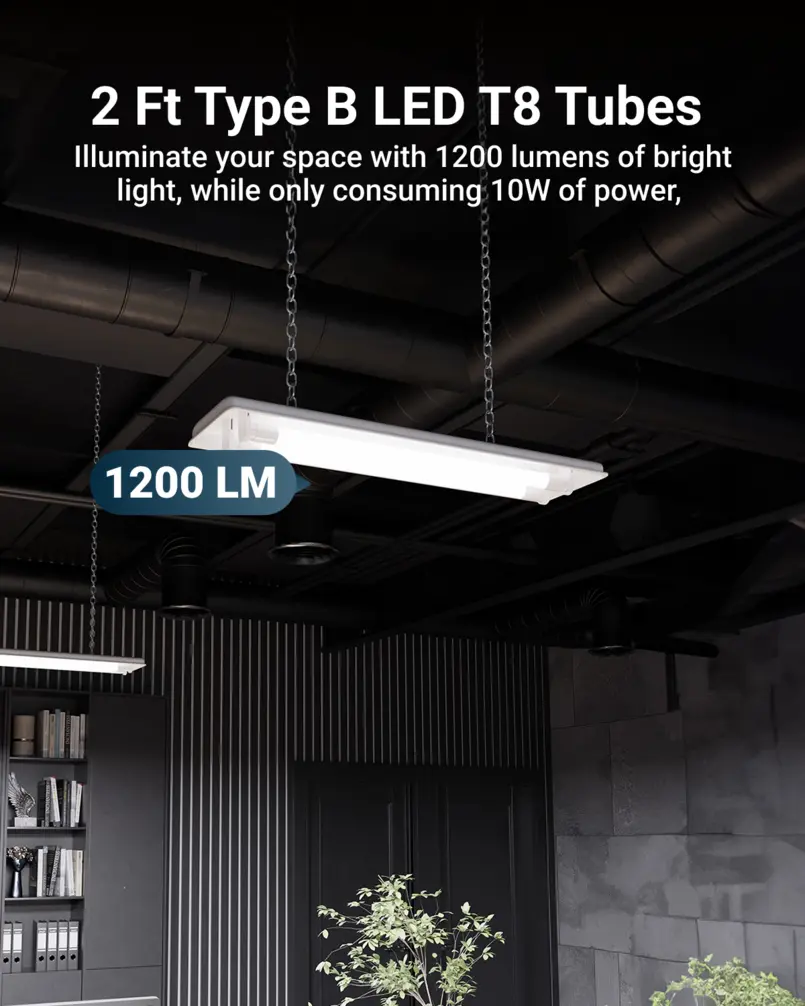
| Type B / ballast bypass / direct wire | Directly from the fixture supply after ballast removal or bypass | Some models support wall-dimmer phase control; many do not. The exact tube documentation matters. |
| Type A/B hybrid | Initially through a ballast or later as direct wire | Dimming behavior can differ substantially between the two modes. |
| Type C / external driver | Through a dedicated LED driver | The driver determines the dimming method, often through a low-voltage control system rather than a standard wall dimmer. |
These names are commonly used, but product documentation should take priority. Manufacturers may use additional terms such as direct-drive, internal-driver, line-voltage, or external-driver tube.
The most common reason: a ballast is still controlling the tubes
A plug-and-play T8 LED tube is made to operate with particular fluorescent ballasts. This makes it convenient for a basic lamp replacement, but it limits control options. If the fixture still contains a non-dimming electronic ballast, a phase-cut wall dimmer ahead of the fixture may produce unstable operation rather than smooth dimming.
Symptoms can include:
- tubes that turn on only above a certain slider setting;
- repeated flashing at low settings;
- a visible pulse or shimmer;
- a brief bright flash when switched on;
- dimming that affects some tubes but not others; or
- a dimmer that buzzes, becomes unusually warm, or resets.
Do not assume the ballast has failed just because the tubes flicker after a dimmer is added. The ballast may be functioning normally in a system it was never designed to dim this way.
If the tubes are Type A, check both the LED tube鈥檚 ballast compatibility list and the ballast label inside the fixture. If either cannot be identified, the safe conclusion is that dimming compatibility is unknown.
Dimming protocol matters more than the dimmer brand
A Lutron LED dimmer, or any other reputable LED-rated dimmer, can still be the wrong control for a T8 retrofit. The issue is not simply whether the dimmer is 鈥渇or LED.鈥?It is whether its output method matches the tube or driver.
Common control approaches include:
Forward-phase or TRIAC dimming
This is a familiar wall-dimmer method. Some ballast-bypass T8 tubes are explicitly rated for forward-phase dimming. Their documentation may list tested dimmers or specify compatible dimmer families.
A tube that supports TRIAC dimming may still flicker if the connected load is below the dimmer鈥檚 supported range, if the dimmer鈥檚 low-end trim is set poorly, or if the fixture contains a mix of tube models.
Reverse-phase dimming
Some LED dimmers use reverse-phase control, which can perform well with certain LED drivers. But compatibility cannot be assumed merely because it is an LED dimmer. A tube intended for forward-phase control may not behave well on reverse-phase control, and vice versa.
0鈥?0V dimming
0鈥?0V is usually a separate control method, not a substitute for a standard phase-cut wall dimmer. Fixtures using it typically require compatible control wiring and a compatible driver or tube system. A standard line-voltage dimmer installed in the existing switch location may not provide the control signal that a 0鈥?0V product expects.
Proprietary, digital, or wireless controls
Some commercial-style linear LED systems use dedicated controls, sensors, or networked drivers. These are not generally interchangeable with a conventional residential wall dimmer.
Check the dimmer鈥檚 load and adjustment settings
Even a correctly matched dimmable tube and dimmer can need adjustment. LED tubes draw much less power than the fluorescent lamps they replace, so an older dimmer may have trouble sensing or controlling the small connected load.
Check the dimmer instructions for:
- a stated minimum LED load;
- whether it supports the dimming method required by the tube;
- a low-end trim or minimum-level adjustment;
- a compatibility list that includes the tube or its driver; and
- limits on the number of LED loads connected.
If every tube flickers at the same point in the dimming range, a low-end trim setting or load issue is plausible. If one tube flickers while others remain steady, swap its position with a known-good tube only after turning power off. If the problem follows the tube, that tube may be defective or a different model. If it stays at the same socket position, the lampholder, wiring, ballast connection, or fixture itself needs inspection.
Do not mix tube types in one fixture
Concealed uplights sometimes contain replacements installed over several years. Tubes can look nearly identical while using different internal electronics. Mixing dimmable and non-dimmable tubes, different wattages, or different driver designs can cause uneven light output and unreliable dimming.
Use matching tube model numbers throughout a dimmed fixture unless the manufacturer documentation specifically permits a mix. Also confirm that every tube is oriented correctly. Some direct-wire tubes are single-ended, meaning power is intended to enter at one marked end; others are double-ended. Incorrect installation can create a fault condition or damage equipment.
Do not alter lampholder wiring based on visual similarity to another fixture or an online diagram. Direct-wire LED tube conversion changes the electrical arrangement inside the fixture. The correct approach depends on the exact tube design, fixture condition, and current local requirements.
A practical decision path
Use this sequence before buying replacement tubes or another dimmer.
- Find the exact tube model number. Confirm whether it is Type A, Type B, hybrid, or Type C, and whether the manufacturer calls it dimmable.
- Identify the current power arrangement. Look for a ballast label in the fixture, but do not touch wiring with power on. If you cannot determine whether a ballast remains, have the fixture assessed professionally.
- Find the dimming method specified for the tube. Look for terms such as forward-phase, TRIAC, reverse-phase, 0鈥?0V, or compatible dimmer list.
- Identify the installed wall control. Record its model number, not just its brand. Check its LED load range and control type.
- Confirm that every tube is the same model and correctly installed. Replace questionable or mismatched tubes before diagnosing more complex issues.
- Adjust the dimmer only if its instructions permit it. Set its minimum level so the tubes remain stable at the lowest useful setting.
- Choose a system-level fix if components do not match. This may mean returning to simple on/off switching, using a compatible tube-and-dimmer combination, or having an electrician convert the fixture to an appropriate direct-wire or driver-based dimming system.
When replacement tubes may solve the problem
Replacing tubes can be reasonable when the fixture is already configured for direct-wire operation and the current tubes are explicitly non-dimmable. In that case, look for tubes that match the existing wiring arrangement and clearly specify compatibility with the intended dimmer type.
For instance, some Type B ballast-bypass tubes are designed for forward-phase dimming with compatible TRIAC dimmers. That does not mean every ballast-bypass tube dims, nor does it mean any TRIAC dimmer will work without adjustment. Verify the lamp manufacturer鈥檚 current instructions and compatibility information for the exact model.
Replacement tubes are less likely to solve the problem when the fixture still relies on a non-dimming fluorescent ballast. In that situation, a compatible dimming system may require a different retrofit approach rather than another plug-and-play tube.
When to call an electrician
Ask a qualified electrician to assess the installation when the fixture needs ballast removal or bypass, when the tube input arrangement is uncertain, or when the wiring has been modified previously. Professional help is also appropriate if there is heat damage, discoloration, a burning smell, buzzing that continues at full brightness, loose lampholders, breaker trips, or intermittent operation unrelated to the dimmer position.
An electrician can determine whether the existing concealed uplight is suitable for conversion and whether a different lighting approach would be more dependable. Current local electrical rules and the tube manufacturer鈥檚 installation instructions should guide any wiring changes.
The bottom line
Dimmable T8 LED tubes work only when the tube, power method, fixture wiring, and control are designed to operate together. A conventional LED wall dimmer may be suitable for certain direct-wire, forward-phase-dimmable tubes, but it is not a universal answer for T8 fixtures.
Start with the tube model number and the presence or absence of a ballast. Once those two facts are clear, you can determine whether a dimmer adjustment, a matched tube-and-dimmer replacement, a professional fixture conversion, or a return to on/off control is the sensible next step.
References
- 4ft T8 Light Bulbs: Your Complete Tube Guide - LED Light Expert. (n.d.). https://www.ledlightexpert.com/t8-bulbs-explained
- T8 LED Tubes: High-quality, energy-efficient lighting solutions. (n.d.). https://lightbulbsurplus.com/t8-led-tubes?_bc_fsnf=1&Color+Temperature=3500K&Dimmable=Yes
- T8 LED Tubes: High-quality, energy-efficient lighting solutions. (n.d.). https://lightbulbsurplus.com/t8-led-tubes?_bc_fsnf=1&Color+Temperature=3500K
- Dimmable T8 Led Tubes Lighting - led-smartlight. (n.d.). https://www.everychina.com/p-z52fc7d4-111052005-dimmable-t8-led-tubes-lighting.html
- Keystone 4 Foot Dimmable LED T8 Tube 5000K Bypass Ballast Replace Fluorescent. (n.d.). https://ledt8bulb.com/led-t8-tubes/dimmable-led-t8-tubes-120v-0-10v-linear-led-dimming/keystone-direct-drive-4-foot-18w-dimmable-t8-led-tube.html
- Keystone 4 Foot Dimmable LED T8 Tube 5000K Bypass Ballast Replace Fluorescent. (n.d.). http://ledt8bulb.com/keystone-direct-drive-4-foot-18w-dimmable-t8-led-tube.html
- Keystone 4 Foot Dimmable LED T8 Tube 5000K Bypass Ballast Replace Fluorescent. (n.d.). https://ledt8bulb.com/keystone-direct-drive-4-foot-18w-dimmable-t8-led-tube.html
- DirectDrive LED T8 Ballast Bypass | T5 | Keystone Tech. (n.d.). https://www.keystonetech.com/all-products/lamps/linear-led-tubes/type-b-ballast-bypass