Yes, a close to ceiling light fixture on a sloped ceiling can sometimes be installed safely and look acceptable—but only when the fixture is designed for that mounting angle or its manufacturer approves a compatible mounting arrangement. A standard flush-mount or semi-flush fixture with a flat canopy is usually a poor candidate, even on a modest slope.
A sloped-ceiling adapter can help some hanging fixtures stay level below an angled ceiling. It does not automatically make a short-canopy fixture fit. The adapter must be compatible with the exact fixture, the canopy still needs to cover the electrical box neatly, and the shade or body needs enough clearance from the ceiling.
Why close-to-ceiling fixtures are difficult on a slope
Most close-to-ceiling lights are built around a simple assumption: the electrical box is in a flat, horizontal ceiling. Their canopy sits flush to that surface, and the fixture body drops straight down from it.
On a sloped ceiling, a fixture with a flat mounting surface sits at an angle instead. This creates several possible problems:
- A visible gap: One side of a flat canopy may touch the ceiling while the opposite side stands away from it.
- An uneven shade position: A glass bowl, drum shade, or broad metal shade may hang at the same angle as the ceiling rather than level with the floor.
- Ceiling interference: The high side of the shade or fixture body may contact the ceiling, even if the canopy can be fastened in place.
- Poor coverage of the box opening: An adapter, spacer, or different bracket can leave part of the ceiling opening or electrical box area exposed unless the canopy is designed to cover it.
- Mounting incompatibility: The supplied bracket, screws, canopy, and hardware may not be intended to work together on an incline.
These are geometry issues as much as electrical ones. A fixture can be electrically connected and still be unsuitable because it cannot sit, hang, or clear the ceiling correctly.
A sloped-ceiling adapter is not a universal fix
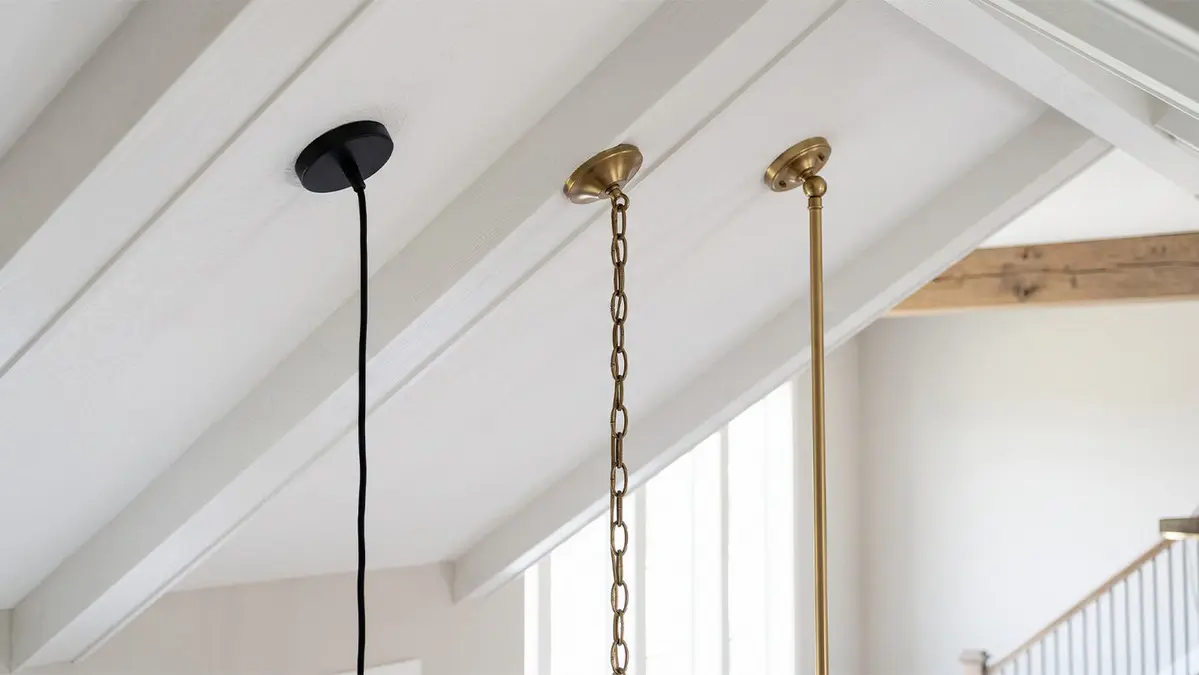
A sloped ceiling light adapter usually provides a pivoting or angled connection between the ceiling and a pendant stem, chain, or cable. Its purpose is generally to let the suspended part of the fixture hang vertically while the canopy covers the angled ceiling.
That arrangement works best when the fixture has enough drop between the canopy and the shade. A pendant with a chain, cable, or compatible downrod has room for the pivoting joint to operate.
A close-to-ceiling fixture often has very little of that room. Its shade may begin immediately below the canopy, leaving no place for an adapter or swivel. Adding an adapter can also lower the fixture, change its proportions, or make the canopy look improvised.
Do not assume that two parts with similar finishes, diameters, or screw patterns are interchangeable. Use an adapter only if the fixture manufacturer identifies it as compatible, or if a qualified electrician and the fixture documentation support the proposed arrangement. Do not bend a rigid stem or alter mounting parts to force an angled installation.
Check these four dimensions before deciding
Measure at the actual electrical-box location, not at the highest or lowest point in the room. Ceiling pitch and available clearance can vary significantly across a vaulted room.
1. The ceiling angle
Use a digital angle gauge, inclinometer, or a phone-based measuring tool as an initial estimate. Then compare that angle with the fixture's stated sloped-ceiling capability, if one is provided.
“Vaulted-ceiling compatible” is useful only if the product information also explains how the fixture mounts and what maximum slope it supports. A fixture made for a high ceiling is not necessarily made for an angled one.
2. The canopy shape and diameter
A round canopy can conceal a small, even gap better than a shallow rectangular canopy, but neither is automatically suitable for a slope. Look at whether the canopy is flexible, deep enough to cover the mounting hardware, or explicitly shaped for an angled ceiling.
Also confirm that it will cover the existing ceiling opening after any box, bracket, or adapter changes. A canopy that barely covered the box on a flat ceiling may no longer do so once it is tilted or spaced down.
3. The fixture's drop below the canopy
The more vertical distance there is between the ceiling and the widest part of the fixture, the more likely a pivoting connection can allow the shade to hang level. A true flush mount has essentially no useful drop. A semi-flush fixture may have enough, but only if its design includes an approved swivel or angled mounting system.
4. Shade and body clearance
Check the clearance around the entire fixture, not just the lowest point. On the uphill side of the slope, the ceiling comes closer to the fixture.
This matters especially for broad drum shades, glass bowls, exposed bulbs near the canopy, and decorative arms that extend upward. If any part presses against the ceiling, stop rather than trimming, bending, or forcing the fixture into place.
Which fixture types usually work best?
The most reliable choice is a fixture specifically described by its manufacturer as suitable for a sloped or vaulted ceiling at your measured angle.
| Fixture type | Suitability on a sloped ceiling | Main limitation |
|---|---|---|
| Standard flush mount | Usually unsuitable | Flat back and minimal clearance make gaps and interference likely. |
| Standard semi-flush mount | Sometimes suitable | Needs documented angled-ceiling compatibility and adequate shade clearance. |
| Pendant on chain or cable | Often suitable | The canopy and suspension connection still need to be approved for the slope. |
| Pendant with compatible swivel stem | Often suitable | Confirm the supported angle and required hardware. |
| Track or directional surface fixture | Sometimes suitable | The fixture may follow the slope, affecting aiming and appearance. |
| Recessed fixture rated for sloped ceilings | Often suitable for general light | Requires a compatible housing or trim and a suitable ceiling cavity. |
A pendant is not automatically the right replacement. In a bedroom, dining room, or living room, its hanging height must still work for circulation, sightlines, furniture placement, and glare control. A fixture that solves the angle but hangs too low is not a successful solution.
Can you change the electrical box instead?
A sloped ceiling electrical box may be installed on the same plane as the ceiling, but changing the box alone does not make a flat-backed fixture level. The fixture canopy will still meet an angled surface unless its mounting system accounts for that angle.
There are situations where a different box, brace, mounting plate, or support arrangement may be appropriate. Those changes should be evaluated carefully because the box and ceiling structure must support the fixture's weight and because existing wiring, framing, insulation, and ceiling finish can affect the work.
If the fixture is heavy, the box moves, the mounting screws do not engage securely, or the ceiling opening needs alteration, use a qualified electrician. Local requirements and the fixture instructions may affect what box and support arrangement are acceptable.
A practical decision process
Before buying an adapter or attempting installation, work through this sequence:
- Find the exact fixture instructions. Look for explicit language about sloped, angled, or vaulted ceilings.
- Measure the pitch at the electrical box. Compare it with the fixture's stated limit, not a general claim about similar fixtures.
- Inspect the canopy and suspension. Determine whether the fixture has an approved swivel, joint, chain, or adapter connection.
- Mock up the clearance. Use the fixture dimensions to check the uphill side of the shade and body against the ceiling.
- Confirm box coverage. Make sure the proposed canopy will conceal the opening and mounting hardware cleanly.
- Verify support and wiring conditions. Have an electrician assess the existing box and mounting location when there is any uncertainty.
When replacement is the better answer
Replacing the fixture is usually more sensible than adapting it when it is a true flush mount, has a very shallow canopy, or uses a wide shade close to the ceiling. An adapter may turn a simple installation into a visibly awkward one without resolving clearance problems.
For a gently sloped ceiling, a compact pendant with an approved swivel canopy may provide a clean result while keeping the light centered and level. For broader ambient lighting, sloped-ceiling recessed fixtures or carefully aimed surface fixtures may be more practical. If you are planning several lights, the placement principles in our guide to <a href="/guides/recessed-lighting-layout/">recessed lighting layout</a> can help you avoid uneven room coverage.
The key point is simple: a sloped-ceiling adapter addresses the hanging angle of certain fixtures, not every limitation of a close-to-ceiling design. Confirm the manufacturer-approved mounting method, canopy coverage, shade clearance, and electrical-box support before proceeding.
References
- A Practical Guide to Sloped-Ceiling Pendant Lights | Radilum Blog. (n.d.). https://radilum.com/blogs/news/can-you-hang-a-chandelier-on-a-sloped-ceiling
- Our Best Tips For Hanging Pendant Lights On A Vaulted or Sloped Ceiling (Complete Guide) — TruBuild Construction. (n.d.). https://trubuildconstruction.com/reviews/hanging-pendant-lights-vaulted-sloped-ceiling
- Sloped Ceiling Lighting: Fixtures, Adaptors & Rules That Work – Southern Lights Electric. (n.d.). https://www.southernlightselectric.com/blogs/journal/sloped-ceiling-lighting
- SCA Sloped Ceiling Adapter - INI. (n.d.). https://www.genlyte.com/api/assets/v1/file/Signify/content/fa5a393af9ce4671901eae2f01140364/SCA_Sloped_Ceiling_Adapter___Installation_Instructions_EN.pdf
- Sloped Ceiling Lighting: Pitch, Canopy & Clearance. (n.d.). https://severnlighting.com/blogs/news/the-45-degree-problem-how-to-light-a-room-that-slopes
- Moving a Light Fixture | Ask This Old House. (n.d.). https://www.youtube.com/watch?v=FwCp0KLGwP0
- How To Install Recessed Lighting on Sloped Ceilings | The Home Depot. (n.d.). https://www.youtube.com/watch?v=bTeHXnNIpL4
- Can adapter work for sloped ceiling light fixture?. (n.d.). https://www.facebook.com/groups/homedesign/posts/2092563958133113