When side sconces will not fit, the most dependable approach is to separate two jobs: use a dedicated light at or around the mirror for faces, and use ceiling light for the rest of the room. A recessed downlight over the vanity can make the countertop bright, but it usually lights the top of the head and brow more strongly than the front of the face. That is why a small bathroom can feel well lit while shaving, makeup, skincare, and contact-lens tasks remain awkward.
For small bathroom vanity lighting without side sconces, the usual first choice is a broad, diffused fixture above the mirror or a properly designed lighted mirror. Either can provide more frontal light than a ceiling downlight alone. The best layout depends on whether there is usable wall area above the mirror, whether the mirror can be resized, and where electrical connections can realistically go.
Treat the mirror as a task area, not just wall decor
Vanity lighting has a more precise purpose than general bathroom illumination. It should make facial features easy to see without strong dark areas under the brow, nose, chin, and eyes. Side sconces do this well because they bring light toward the face from both sides. When that placement is unavailable, the goal is not to imitate it perfectly with a ceiling fixture. It is to add the best available forward-facing, diffuse light.
Ceiling lights still matter. They help someone enter the bathroom, use the toilet, shower, find towels, and clean. But they are ambient light, even when they happen to be close to the vanity.
A useful compact-bathroom plan often has these layers:
- Mirror task light: an above-mirror bar, integrated lighted mirror, or another fixture that sends softened light toward the face.
- Ambient light: a ceiling fixture or recessed downlight arrangement that lights the room generally.
- Optional low-level light: a dimmable night light, toe-kick light, or low-output fixture for nighttime use, where appropriate.
Keeping the mirror light on a separate control from the ambient lighting makes the room more flexible. Bright task light can be used when needed without making every late-night bathroom visit feel overly bright.
Why downlights over the bathroom vanity often create shadows
Downlights over bathroom vanity areas are useful for general illumination and can reduce darkness at the counter. Their limitation is direction. A light source in the ceiling shines mainly downward, while a person looking into the mirror needs light arriving from in front of them.
When a downlight is behind the person standing at the sink, their head can block some of its light. When it is directly above the person, the brow ridge, nose, and chin can cast shadows downward across the face. Moving the downlight slightly can improve countertop coverage or reduce a harsh shadow, but it cannot turn an overhead source into true face lighting.
This does not mean downlights over a bathroom vanity are always a mistake. They can be part of the ambient plan, especially in a compact room with low visual clutter. The mistake is expecting them to do all the work at the mirror.
Best alternatives when side sconces will not fit
1. A wide, diffused light above the mirror
An above-mirror vanity light is often the simplest alternative when there is wall space between the top of the mirror and the ceiling. Look for a fixture that is broad enough to spread light across the mirror rather than concentrating it at one point. A diffused lens or shade is generally more comfortable to look toward than exposed point sources.
The fixture should light the user, not merely throw a bright strip onto the top portion of the glass. Its mounting height, projection, diffuser design, and the mirror's position all affect the result. A very shallow fixture can look tidy but may provide less forward reach; a deeper fixture may light the face better but can be more visible in the mirror and may create glare.
An above-mirror light is especially practical when:
- the mirror is not tight to the ceiling;
- the vanity is on a wall where adding a connection above the mirror is feasible;
- a simple, conventional mirror is preferred over an integrated unit;
- the room needs a visually quiet fixture with a small footprint.
2. An illuminated mirror
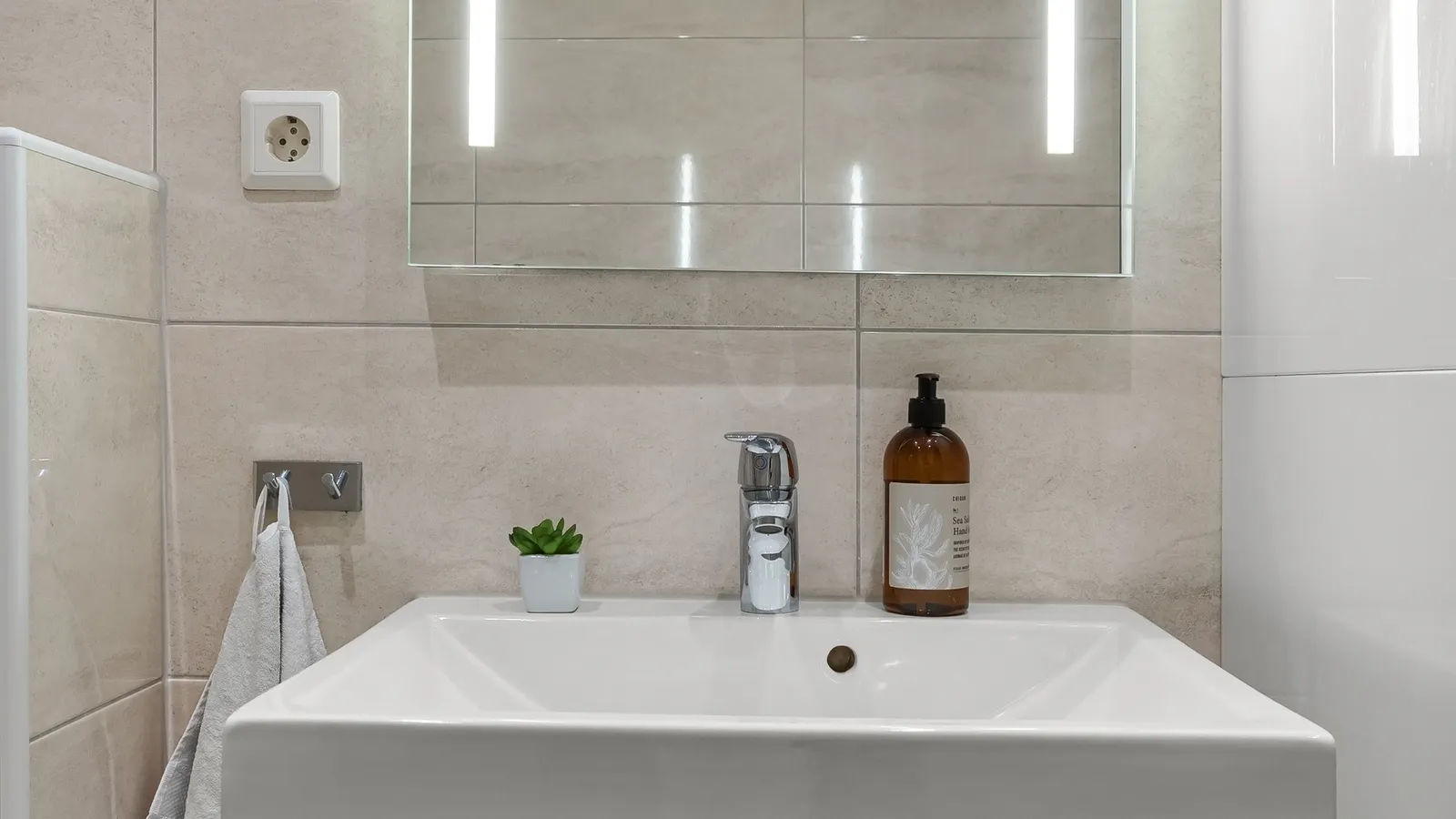
A lighted mirror can solve both the mirror and fixture-placement problem. Perimeter-lit designs can distribute light closer to the face than a ceiling downlight, while avoiding a separate fixture above or beside the glass. This can be a strong option in narrow bathrooms where a conventional light bar would crowd the upper wall.
Not every illuminated mirror performs the same way. Some create a soft decorative halo on the wall but provide limited useful light at the face. Others have a more visible, forward-facing illuminated border that is better suited to grooming. Before choosing one, look at photographs or documentation that show the lit edge from the user's position, not only a front elevation with the bathroom lights off.
Consider whether the mirror's light can be dimmed, how its controls will work, and whether the light is intended to be the primary task source or a supplement. If its output feels gentle rather than functional, retain separate ambient lighting and consider another task-light source if the layout permits.
3. A shallow-fronted fixture near the mirror
In some layouts, the available wall area is above the mirror but not enough for a conventional vanity bar. A slim fixture mounted very close to the mirror's top edge may still work, provided it does not interfere with the mirror, cabinet door, or ceiling clearance.
This is a detail to resolve early. A mirror that is slightly shorter, or that starts a little lower, can create enough space for a more effective fixture. In a small bathroom, changing the mirror size by a modest amount may improve lighting more than adding another recessed ceiling light.
4. A pendant only in carefully planned layouts
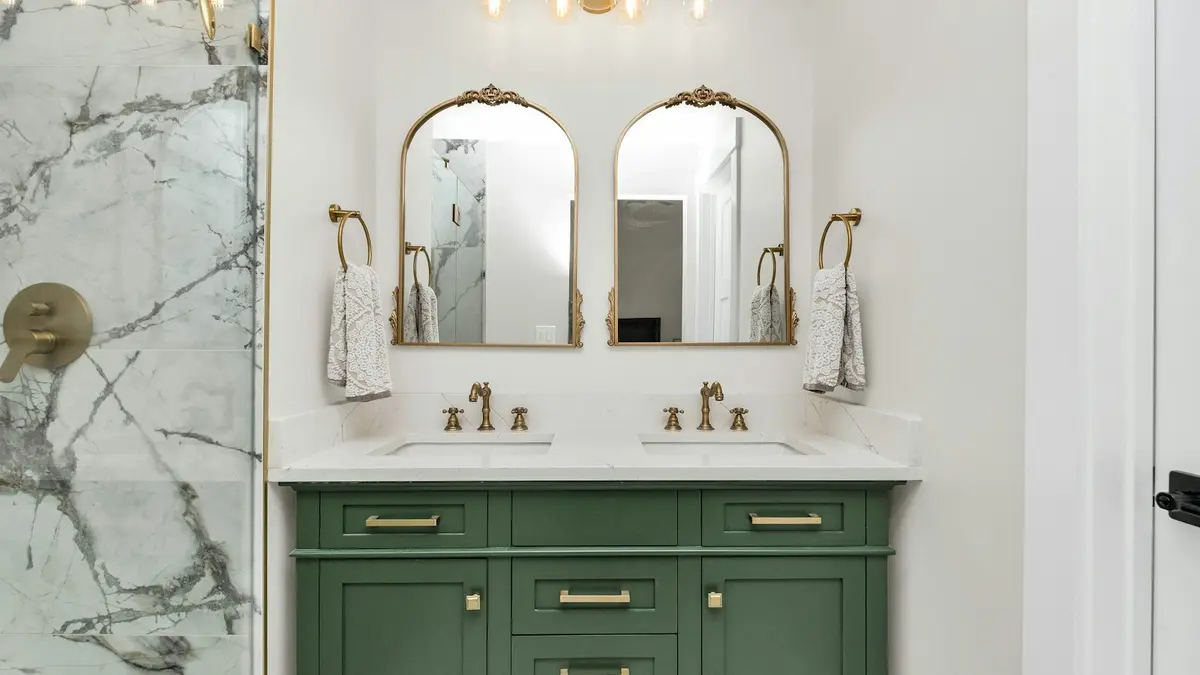
A pendant near a vanity can be visually appealing, but it is usually not the easiest solution for face lighting. A downward-oriented pendant remains primarily an overhead source and may cast shadows similar to a downlight. It can also obstruct the mirror view or create glare, depending on its height and shade.
Use a pendant as an ambient or decorative layer only after confirming it will not conflict with the mirror and that a separate mirror task-light strategy remains in place. It is not an automatic substitute for a sconce.
How to test facial-shadow direction before electrical work
Do this test before finalizing ceiling cutouts, tile, mirror dimensions, or wiring locations. A temporary test is more useful than trying to predict the result from a floor plan.
- Mark the planned mirror and sink position. Painter's tape can show the mirror edges and the approximate standing position at the vanity.
- Stand where the user will actually stand. Face the proposed mirror location rather than looking across the room.
- Use a movable lamp or temporary light source. Hold or place it where a proposed fixture would be: above the mirror, at ceiling level, or slightly forward of the mirror plane where feasible.
- Look for directional shadows. Check under the brow, nose, cheekbones, and chin. Also look for glare in the mirror and bright reflections that make the source hard to ignore.
- Test more than one height and position. A change in location can alter whether light reaches the front of the face or mostly the counter.
- Test with the ambient light on and off. This reveals whether the mirror light can work independently and whether the ceiling lighting is filling the room without overpowering the task light.
A phone flashlight is useful for understanding shadow direction, but it is much smaller and harsher than a diffused fixture. Use it as a rough directional test, not as a simulation of the final appearance.
Choose light quality for real mirror use
Brightness is only one part of good vanity lighting. A glaring, uneven source can be less useful than a softer source that reaches the face well.
For a mirror light, prioritize these qualities:
- Diffuse illumination: A lens, shade, or illuminated surface helps avoid harsh points of light reflected in the mirror.
- Good color rendering: Better color rendering can make skin, makeup, towels, and finishes easier to judge. Read more in our guide to what CRI means in lighting.
- A color temperature that works with the room: Match the task light reasonably closely to the bathroom's other lighting. A noticeably different light color at the mirror can make the room feel inconsistent and complicate color-sensitive grooming.
- Dimming: Dimming is helpful because the required light level changes between detailed grooming, daytime use, and nighttime visits.
- Low glare at eye level: Stand in front of the mirror conceptually when selecting the fixture. A source may look attractive in a listing image but become distracting when reflected directly toward the user.
Common compact-bathroom lighting mistakes
Relying on a single recessed light
One recessed light may be enough to navigate a tiny bathroom, but it is rarely enough for comfortable mirror tasks. It also creates a single-direction lighting pattern, which makes shadows more apparent.
Centering every light on the room instead of the user
A room-centered ceiling layout can be sensible for ambient light, but the vanity user does not stand in the middle of the room. Plan the mirror task light around the face position first, then coordinate the ambient fixtures around circulation, showering, and cleaning.
Letting the mirror fill all available wall space
A large mirror can make a small bathroom feel more open. However, if it leaves no room for a task fixture and is not itself illuminated, it can limit the lighting plan. Decide on mirror size and lighting together.
Adding more overhead lights to solve a directional problem
More downlights can make the room brighter without improving facial modeling. If the issue is shadow under the brow and chin, adding a frontal or perimeter source is usually more effective than adding another overhead source.
Ignoring moisture, fixture suitability, and installation constraints
Bathroom fixture selection and electrical work require more than visual planning. Requirements can vary with the fixture's location, the bathroom layout, local rules, and the product's intended location rating. Confirm current local requirements and the fixture documentation, and use a qualified electrician for electrical planning and installation. For a general explanation of location ratings, see IP ratings for lights.
A practical layout for most small bathrooms
If there is any space above the mirror, start with a broad, diffused above-mirror light on its own dimmer or control. Add ceiling lighting for ambient coverage, but do not depend on it for grooming. If upper-wall space is unavailable, evaluate an illuminated mirror with a forward-facing lit perimeter rather than relying on backlit glow alone.
Where the ceiling plan is already set, test the proposed downlight location at the actual vanity position before construction is complete. If the result places the face in shadow, it is usually better to revise the mirror-light strategy early than to try to correct the problem after tile, cabinetry, and wiring are finished.
A compact bathroom does not need side sconces to have usable mirror lighting. It does need at least one source that is planned for the person at the mirror, not only for the ceiling and floor.
References
- 8 Small Bathroom Lighting Ideas to Brighten Any Space. (n.d.). https://www.claxy.com/blog/small-bathroom-lighting-ideas
- Best Bathroom Vanity Lighting: Placement, Brightness & Style - The Edit by Lumens. (n.d.). https://the-edit.lumens.com/the-guides/bathroom-vanity-lighting-buyers-guide
- Bathroom lighting ideas without sconces or over vanity .... (n.d.). https://www.facebook.com/groups/homedesign/posts/2406547240068115
- Top 10 Modern Bathroom Vanity Lights (For Perfect Grooming). (n.d.). https://rhealighting.com/modern-bathroom-vanity-lighting-grooming
- Small Bathroom Lighting Ideas SA: Wall Sconce & Vanity .... (n.d.). https://lighting.co.za/blogs/lighting-ideas/small-bathroom-lighting-ideas-sa-wall-sconce-vanity-guide
- Bathroom Vanity Lights on Side of Mirror: A Pro Guide – Golden Lighting. (n.d.). https://goldenlighting.com/blogs/the-golden-edit/bathroom-vanity-lights-on-side-of-mirror-a-pro-guide
- Bathroom Vanity Lighting: Light a Face, Not a Ceiling. (n.d.). https://goldenlighting.com/blogs/the-golden-edit/bathroom-vanity-lighting-how-to-light-a-face-not-a-ceiling
- Will a pendant light over a bathroom vanity cast shadows? | Houzz Forum. (n.d.). https://www.houzz.com/discussions/6436550/will-a-pendant-light-over-a-bathroom-vanity-cast-shadows