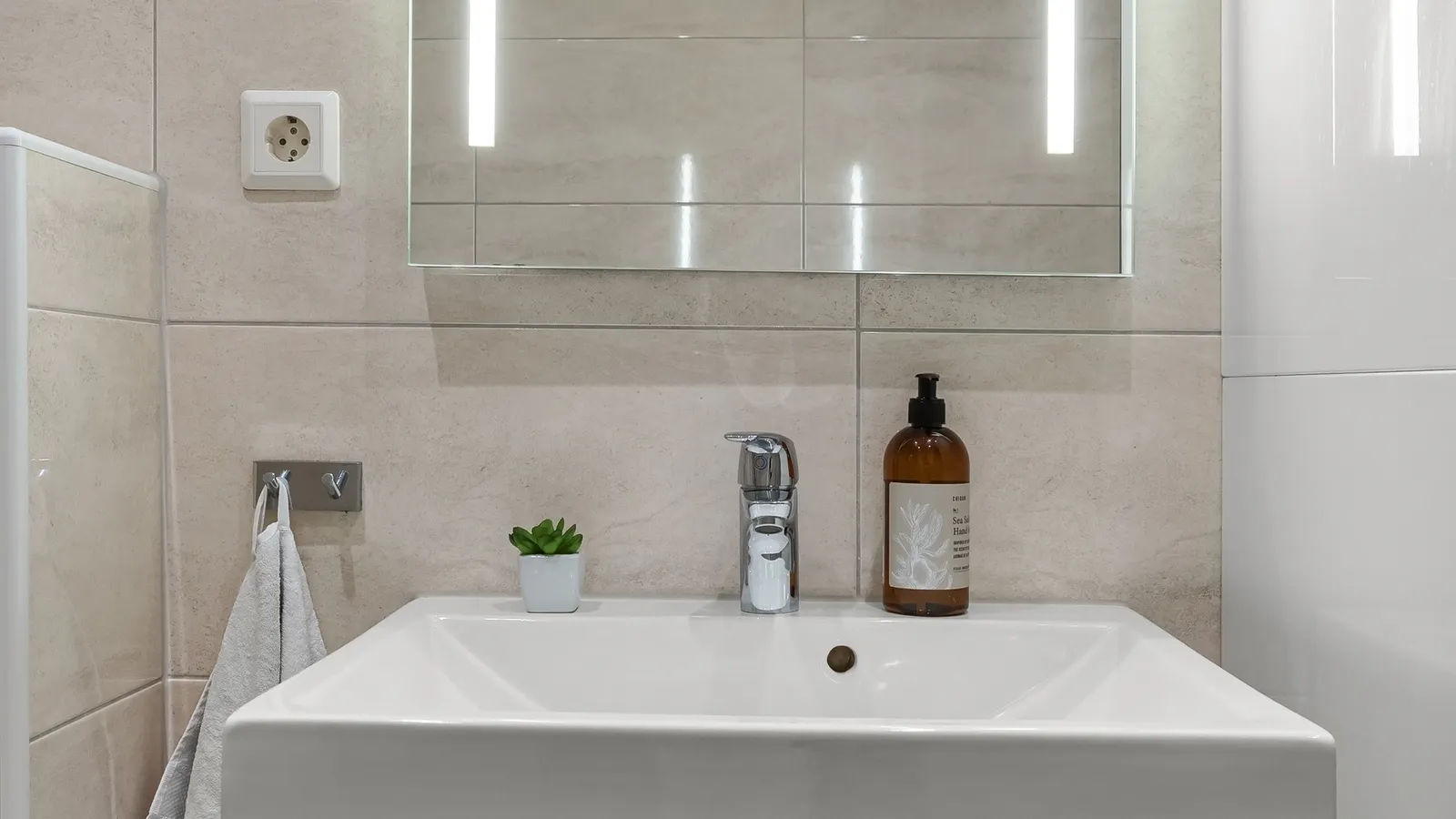
Hotel-style bathroom lighting is less about decorative fixtures and more about making the room easy to use at every hour. For an overnight guest, the biggest improvements are usually clear lighting at the mirror, a comfortable general light for the whole room, and a dim, low-glare path for nighttime visits.
If the budget is limited, improve the mirror area first. A bright ceiling fixture may make a bathroom look generally illuminated, but it often leaves shadows under the eyes, nose, and chin. Better fixture placement鈥攏ot simply a higher-output lamp鈥攗sually makes the bathroom feel more polished and more useful.
Start with the guest experience
A hotel bathroom works because a guest can enter an unfamiliar room and immediately understand it. They can find the switch, see the towels, use the mirror, locate toiletries, and return during the night without being hit by harsh light.
Use these questions to assess your current bathroom:
- Can someone see their face clearly at the mirror?
- Is there enough general light to find towels, toilet paper, and toiletries?
- Does the room feel harsh when used late at night?
- Can a guest identify which switch controls which light?
- Are there dark corners near the shower, toilet, or storage?
- Does the light make skin, makeup, towels, and finishes look reasonably natural?
The goal is not to make every surface equally bright. It is to provide the right light where a person needs it, with controls that suit morning routines, evening wind-down, and middle-of-the-night visits.
Build bathroom lighting in layers
The most convincing hotel-style bathroom lighting uses several modest layers rather than one dominant ceiling fixture. The layers can be simple, and not every bathroom needs a full renovation.
1. Mirror lighting: the highest-value upgrade
Bathroom mirror lighting is the practical centerpiece of the room. Guests use it to wash, shave, apply makeup, insert contact lenses, style hair, and check their appearance before leaving. A fixture centered above the mirror can be helpful, but it should not be the only source lighting the face.
The most useful arrangement places light on both sides of the mirror, roughly around face level. Vertical sconces, slim light bars, or a mirror with illuminated sides can create more even front-and-side light. This reduces the downward shadows that occur when all illumination comes from above.
If there is no room for side fixtures, a wide, diffused fixture above the mirror is usually a better compromise than a small point-like light. Choose a fixture that spreads light across the vanity rather than concentrating it in one bright spot. A ceiling light near the vanity can add fill, but it should not replace dedicated mirror lighting.
Before changing placement, check the mirror size, medicine cabinet door clearance, and whether the new fixture would reflect uncomfortably in the mirror. A compact guest bathroom often benefits from a tall, narrow sconce shape because it distributes light over more of the face without taking much horizontal wall space.
2. General light: make the full room readable
General lighting helps a guest orient themselves when they first enter. It should reveal the room clearly enough to use the toilet, shower, storage, and towels without creating a flat or glaring atmosphere.
A central ceiling fixture, recessed fixtures, or a combination of both can provide this layer. In a small bathroom, one well-positioned ceiling fixture may be adequate as general light when it is paired with good mirror lighting. In a larger room, the shower, toilet area, and vanity may need more deliberate coverage.
Avoid treating a recessed fixture directly above the mirror as vanity lighting. It can brighten the counter, but it tends to cast light straight down over the face. Think of ceiling light as room illumination and mirror fixtures as grooming illumination.
For shower and tub areas, fixture suitability matters. Bathroom zones can involve moisture exposure and local electrical rules that vary by location and installation details. Verify current requirements with a qualified electrician or local authority before selecting or installing fittings in or near wet areas.
3. Night guidance: make late visits less disruptive
Bathroom night light ideas do not need to be elaborate. The useful version is low, indirect, and easy to find without waking someone fully or flooding the adjacent bedroom with light.
Good options include:
- A plug-in night light placed where it does not obstruct an outlet or walkway.
- A low-mounted light near the vanity base or along a toe kick.
- A small motion-sensing light outside the bathroom door or near the toilet area.
- A dimmable general-light setting that guests can use instead of full brightness.
Keep nighttime light warm and subdued. A bright, cool-toned light can feel startling at 2 a.m., particularly when the guest has just come from a dark bedroom. The aim is safe orientation: enough light to see the floor, door, and fixtures, without making the bathroom feel like a fully lit daytime space.
Do not place a night light where it shines directly into the eyes from bed, reflects strongly in a mirror, or creates a bright point in the guest's line of sight. Indirect light aimed down toward the floor is generally more comfortable.
4. Soft accent light: optional, but effective
Accent light is not essential, but it can add the calm finish associated with a good hotel bath. It may come from a softly glowing mirror edge, an under-vanity light, a small wall sconce, or a decorative fixture that complements the general lighting.
The useful test is whether the accent light contributes to comfort without competing with the mirror light. A decorative pendant that produces glare, for example, may look interesting but does little for a guest trying to see clearly at the vanity.
Choose a comfortable color appearance
Warm bathroom lighting usually suits a guest bath because it feels less clinical in the evening and tends to work well with towels, wood finishes, warm metals, and softer wall colors. Many homes use light around the warm-white to neutral-white range for bathrooms, often near 2700K to 3000K. The best choice depends on the surrounding rooms and the look of the bathroom finishes.
A guest bathroom does not have to match the bedroom exactly, but the transition should not feel jarring. If the guest room is warmly lit and the bathroom is much cooler and bluer, the contrast can make the bathroom feel more utilitarian than relaxing.
Color rendering also matters. A light source with good color rendering can make skin tones, cosmetics, towels, and paint colors easier to judge. For a vanity fixture, prioritize even, diffused light and credible color appearance over a decorative fixture with an exposed, glaring lamp. For more context, see our guide to what CRI means in lighting.
Use controls that guests can understand
A hotel-style room should not require instructions. Ideally, a guest can operate the main lighting from a familiar switch location and tell which control does what.
Separate controls are helpful when possible:
| Lighting layer | Useful control approach |
|---|---|
| Mirror lighting | A dedicated switch, often paired with the general light for daytime use |
| General ceiling light | A clearly labeled or intuitive wall switch |
| Night guidance | Motion sensor, always-on low light, or separate low-level switch |
| Accent lighting | Separate dimmer or control if it is likely to be used independently |
Dimming is particularly valuable in a guest bathroom because the same fixtures serve different needs. Full brightness can support grooming and cleaning, while a lower setting can make late-night use more comfortable. Confirm dimmer compatibility with the lamp, driver, or integrated fixture before installation.
If switches are confusing, a small, discreet label can be more hospitable than a decorative but unclear multi-gang switch plate. Labels such as 鈥淢irror,鈥?鈥淐eiling,鈥?and 鈥淣ight鈥?are simple and useful.
A budget-first improvement sequence
You do not need to replace every fixture to make a guest bathroom feel significantly better. Work from the highest practical impact downward.
First: improve the mirror light
Replace a small overhead vanity bar, if necessary, with a wider diffused fixture, or add side lighting if the wall layout allows. This is the change guests are most likely to notice when getting ready.
If replacing fixtures is not currently possible, evaluate the existing lamp color, glare, and light distribution. A compatible lamp with a warmer, better-rendering appearance may improve the experience, though it cannot solve poor fixture placement.
Second: add or refine nighttime guidance
A modest night light, toe-kick light, or motion-sensing low light is often inexpensive and useful immediately. Test it from the guest bed and from the bathroom door. The right level should reveal the route without making the bedroom feel illuminated.
Third: improve controls
Add dimming where feasible, clarify switches, and avoid forcing a guest to turn on every light at once. This change can make existing fixtures feel more versatile without changing the room's appearance.
Fourth: address dark areas and visual clutter
If the shower, linen storage, or toilet area feels gloomy, consider whether a small addition to the general-light layer would solve the problem. Also remove unnecessary glare: exposed bare lamps, highly reflective shades, and fixtures that reflect directly in the mirror can make a bathroom feel less restful even when it is bright enough.
Common mistakes that make a bathroom feel less guest-ready
Relying on one ceiling fixture
One ceiling light can make the room visible but rarely makes the mirror comfortable to use. It also gives guests no low-level option at night.
Installing a bright light directly over the mirror
Over-mirror lighting is not inherently wrong, but a narrow or undiffused fixture can create hard shadows and glare. Side lighting or a broader source usually produces a more useful result.
Choosing brightness before placement
When a vanity is poorly lit, increasing lamp output may make the counter brighter while leaving the face shadowed. Fix the direction and distribution of light first.
Mixing noticeably different light colors
A warm mirror fixture, a cool ceiling lamp, and a bluish night light can make a small bathroom feel visually unsettled. Use a coordinated color appearance unless there is a specific reason not to.
Forgetting the shower and wet-area conditions
A standard-looking fixture is not automatically appropriate for every bathroom location. Have a qualified electrician confirm the suitable fixture type, placement, switching, and current local requirements before work begins.
A simple guest bathroom lighting plan
For many modest guest bathrooms, a complete plan can be as straightforward as this:
- Put the best light at the mirror, preferably from both sides or from a broad, diffused source.
- Keep a comfortable ceiling light for full-room visibility.
- Add a low-level night light that guides rather than dazzles.
- Use coordinated warm-to-neutral light appearance throughout the room.
- Give the main and nighttime lighting clear, intuitive controls.
This approach creates the useful part of hotel style: a bathroom that feels calm, legible, and considerate of the person using it. Expensive tile and decorative hardware can enhance the result, but they cannot compensate for a mirror that casts shadows or a nighttime visit that requires full daylight brightness.
For a more cohesive overnight space, pair this plan with the lighting approach in our guide to guest bedroom lighting ideas.
References
- Hotel Bathroom Lighting | Warehouse-Lighting.com. (n.d.). https://www.warehouse-lighting.com/blogs/lighting-application-suggestions/hotel-bathroom-lighting
- Hotel Bathroom Lighting | Warehouse-Lighting.com. (n.d.). https://warehouse-lighting.com/blogs/lighting-application-suggestions/hotel-bathroom-lighting
- Hotel Bathroom Lighting Design. (n.d.). https://www.pinterest.com/ideas/hotel-bathroom-lighting-design/895508381251
- Bathroom Lighting Requirements: Codes, Safety & Design. (n.d.). https://ajlongelectric.com/blog/bathroom-lighting-requirements-guide
- Bathroom Mirror and Lighting Ideas to Transform Your Space in 2026 - Varikattheritage. (n.d.). https://varikattheritage.com/bathroom-mirror-and-lighting-ideas-to-transform-your-space-in-2026
- Recessed Lighting in Bathrooms: Placement, Wet Rating & Code Tips 鈥?Amicolight. (n.d.). https://amicolight.com/blogs/news/recessed-lighting-in-bathrooms-placement-wet-rating-code-tips
- How to Choose Bathroom Vanity Lighting: A Pro Guide. (n.d.). https://usabuildersdepot.com/blogs/news/modern-bathroom-vanity-lighting
- Bathroom Vanity Light Placement: Side, Top, and What .... (n.d.). https://bullrunkitchenandbath.com/bathroom-vanity-light-placement-side-top-and-what-works


