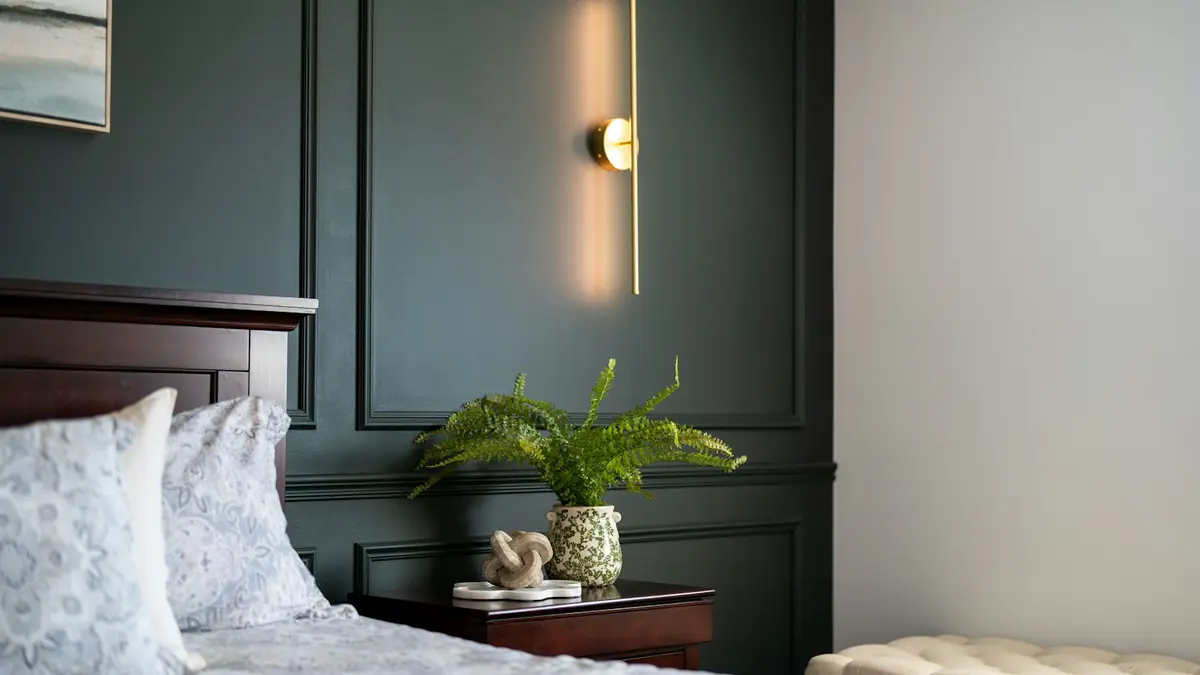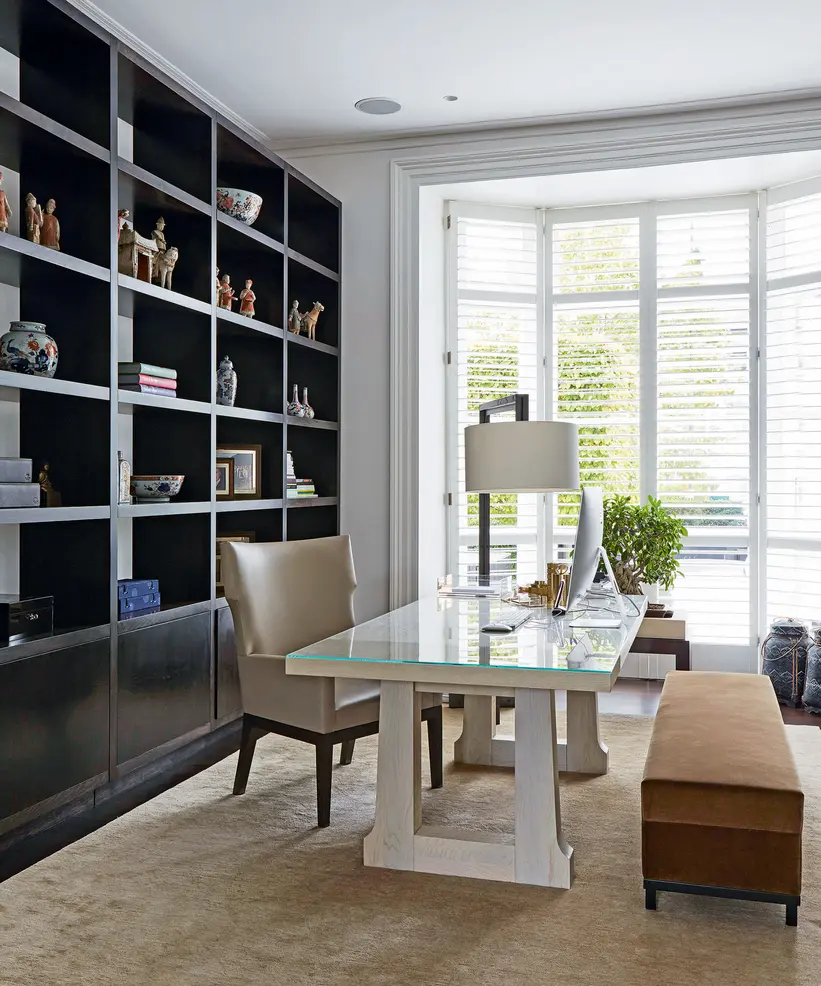
For most bedroom home offices, plan for two different lighting levels rather than one large bulb: modest, controllable ambient light for the room and about 300 to 500 lux on the desk for ordinary computer, writing, and paperwork tasks. In a small bedroom, that often means roughly 1,000 to 2,000 lumens of dimmable general lighting plus a separate adjustable desk lamp. The exact total depends on room size, fixture type, wall colors, and how much of the bulb’s light actually reaches the desk.
An 1100-lumen bulb can be adequate as gentle bedroom lighting, but it is rarely a complete solution for a study room. Its lumen rating describes light leaving the bulb, not the illumination arriving on your desktop. A ceiling fixture spreads light over the floor, walls, bed, and circulation area; it may also cast your own shadow across the work surface. The practical answer is usually to add task lighting, not simply to replace every bulb with a brighter one.
Lumens and lux answer different questions
Lumens measure the total quantity of visible light emitted by a lamp or fixture. Lux measures illuminance: the light that lands on a surface. One lux equals one lumen per square meter, but that relationship is straightforward only when all light is directed evenly onto that square meter.
For a bedroom office, the important surface is usually the desk. General home-office guidance commonly places ordinary desk work at roughly 300 to 500 lux at the work surface. Fine detail work, such as drawing, sewing, examining small parts, or reading dense printed material, may need more localized light.
A bedroom has a different purpose after work. Low, comfortable general lighting is usually preferable for winding down, moving around safely, and getting ready for bed. Rather than trying to make the entire room as bright as a desk, light the desk more strongly and keep the rest of the room adjustable.
This is why a single ceiling bulb produces disappointing results: it is being asked to create both a calm bedroom and a well-lit work area from one location.
Is an 1100-lumen bulb enough for a study room?
It can be enough for part of the job, but usually not all of it.
An 1100-lumen bulb in a central ceiling fixture may provide reasonable orientation light in a small bedroom. It can make the bed, storage, and floor visible. Yet the actual lux at a desk may be much lower than the bulb rating suggests, especially when the desk is against a wall, under a shelf, or outside the fixture’s strongest beam.
Several factors reduce useful light at the desk:
- The bulb distributes light in many directions rather than directly onto the desktop.
- A shade, globe, recessed trim, or ceiling fan may absorb or block some output.
- The desk may be several feet from the fixture.
- Dark paint, dark furniture, and heavy curtains absorb more reflected light.
- A person seated at the desk can shade paper or a keyboard.
- A bright overhead source may create screen reflections without adequately lighting documents.
Adding another 1100-lumen ceiling bulb may help if the room is broadly dim. But if the main complaint is a dark work surface, an adjustable desk lamp is usually the more targeted improvement.
Start with a simple lumen estimate for the room
A quick starting calculation is:
Room area in square meters × target lux = estimated lumens reaching the area
If you measure in feet, convert square feet to square meters by dividing by 10.76. For a rough shortcut, you can also use foot-candles: one foot-candle is approximately 10.8 lux.
For example, consider a small bedroom that is 100 square feet, or about 9.3 square meters.
- At 100 lux for soft general room light: 9.3 × 100 = about 930 lumens reaching the room surfaces.
- At 150 lux for brighter general light: 9.3 × 150 = about 1,400 lumens reaching the room surfaces.
- At 400 lux across the entire room: 9.3 × 400 = about 3,700 lumens reaching room surfaces.
That last figure explains why office-level targets can look unrealistic when applied to a whole bedroom. It assumes the entire floor area should receive desk-level illumination. In a bedroom office, it usually should not.
The calculation is an estimate, not a shopping list. Fixture efficiency, beam direction, ceiling height, surface colors, and furniture placement mean installed lamps must often emit more lumens than the calculated amount reaching the useful surface. Treat the result as a planning range and leave room for adjustment with dimmers or multiple light sources.
A more practical plan: ambient light plus a desk lamp
A small room works better when the light is divided by function.
1. Use controllable ambient light for the bedroom
Aim for enough general lighting to navigate, dress, clean, and make the room feel open. In many small bedrooms, around 1,000 to 2,000 installed lumens from all ambient sources is a reasonable starting range, provided the lighting is dimmable or otherwise controllable.
This might come from a ceiling fixture, a floor lamp, wall lighting, or a combination. The goal is even background light rather than one glaring bright point. If the ceiling fixture has an opaque shade that sends most light downward, adding a lamp that throws some light onto the wall or ceiling can make the room feel brighter without making the bed area harsh.
2. Put the stronger light at the desk
Use a desk lamp with an adjustable head or arm so it can place light on paper and the keyboard area. A task lamp rated around 500 to 1,000 lumens gives useful adjustment range, although the relevant result is the lux it delivers at the desk, not the number on the box.
Place the lamp to one side of the work surface rather than directly in front of the monitor. Right-handed writers often prefer the lamp on the left to reduce hand shadows; left-handed writers often prefer it on the right. For computer-focused work, aim the lamp down toward the desk rather than toward the screen.
A broad, diffused lamp head is often more comfortable for general desk work than a small exposed point source. The lamp should light the task without creating a bright reflected patch in the monitor, glossy desk surface, or eyeglasses.
3. Make the two layers independently controllable
Separate control is what allows one room to serve two purposes. During the day, use ambient light and task light together. In the evening, lower the room lighting and keep only the desk area bright enough for the task. When work ends, turn off or dim the desk lamp without leaving the whole room overly bright.
A dimmable ceiling light, a lamp with multiple output levels, or a plug-in dimmer compatible with the lamp can help. Confirm that both the lamp and bulb are rated for the control method before using a dimmer.
How to check whether the desk is bright enough
The most reliable check is a lux meter placed flat on the desk where you read or write. Dedicated meters are available, and phone apps can provide a rough indication, though their accuracy varies by device and app.
Measure with the lighting in the arrangement you actually use: curtains closed if you work after dark, monitor on if screen glare is a concern, and task lamp positioned normally. For typical home-office work, a reading around 300 to 500 lux across the main work area is a sensible target. The center of the desk may be bright while the paper area at the side remains dim, so take several readings if possible.
Do not pursue a number at the expense of comfort. If the desk measures adequately but you squint because of reflections, sharp shadows, or a bare bright bulb in your line of sight, reposition or diffuse the source rather than simply adding output.
Color temperature and color rendering matter too
Brightness is only one part of bedroom desk lighting. For daytime study, many people find neutral white light around 3500K to 4000K clear and comfortable. Warm white lighting around 2700K to 3000K is often more relaxing in the evening. A tunable fixture or separate desk and ambient lights can make those preferences easier to accommodate.
Look for good color rendering if you read printed materials, draw, work with fabrics, or choose clothing in the room. A CRI of 90 or higher is a useful target where accurate color appearance matters. For ordinary computer work, glare control and desk illuminance are usually more consequential than a small difference in CRI.
For a fuller discussion of this specification, see our guide to what CRI means in lighting.
Common bedroom office lighting mistakes
Treating a bulb’s lumen rating as desk brightness
An 1100-lumen bulb does not create 1100 lux at a desk. Distance, direction, fixture losses, and room layout determine the light that arrives there.
Making the whole bedroom office-bright
Lighting an entire bedroom to 300 or 500 lux can feel clinical at night and wastes the advantage of localized task lighting. Keep the high level where work is performed.
Using only a desk lamp in an otherwise dark room
A very bright desk surrounded by darkness can be tiring and can make screen contrast feel severe. Keep some low-level ambient light on in the room, particularly for extended computer work.
Ignoring glare
A brighter lamp is not automatically better. Avoid exposed lamps within your direct line of sight, and check screens from your normal seated position. Repositioning a lamp a few inches can make a substantial difference.
Choosing one fixed setting for all hours
A bedroom office benefits from flexibility. Use dimming, separate switches, or multiple lamps so the room can shift from work mode to rest mode.
A simple target for most small bedroom offices
If you need a practical starting point, use this approach:
- Provide roughly 1,000 to 2,000 lumens of dimmable ambient lighting for the small bedroom.
- Add an adjustable desk lamp in the approximate 500- to 1,000-lumen range.
- Arrange the lamp and ceiling light to achieve about 300 to 500 lux over the main desk area.
- Keep enough background light on to prevent the desk from becoming an isolated bright pool.
- Adjust output and placement based on glare, shadows, and your actual tasks.
This layered setup is generally more useful than trying to solve a bedroom office with one high-lumen ceiling bulb. It gives the desk the illumination it needs while preserving a lower, more restful lighting level for the rest of the room. For additional layout guidance, see our home office lighting guide.
References
- Home lighting guide and recommeded light levels. (n.d.). https://www.ledrise.eu/blog/home-lighting-guide-lr
- How Many Lumens Do You Need? Room Lighting Guide. (n.d.). https://www.vaxlamp.com/blogs/lighting/how-many-lumens-room-guide
- How Many Lumens (or Lux) Are Required for a Standard Office Desk?. (n.d.). https://guocio.com/blog/how-many-lumens-lux-required-for-office-desk
- How the hell do you reach the recommended LUX level?. (n.d.). https://www.reddit.com/r/Lighting/comments/1q6t29c/how_the_hell_do_you_reach_the_recommended_lux
- How to Light a Home Office | Office Lighting Ideas at Lumens. (n.d.). https://the-edit.lumens.com/the-guides/how-to-light-a-home-office
- How many lumens do I need? Room-by-room calculator & guide – Modern Lights. (n.d.). https://modernlights.com/blogs/news/how-many-lumens-do-i-need
- How Much Light Does My Room Need? Lumens Calculator Guide – Seus Lighting. (n.d.). https://www.seuslighting.com/blogs/p/how-much-light-does-my-room-need
- Lux Levels for Every Room – UK Lighting Design Standards & Guide | Future House Store. (n.d.). https://futurehousestore.co.uk/news/lux-levels-lighting-standards-guide