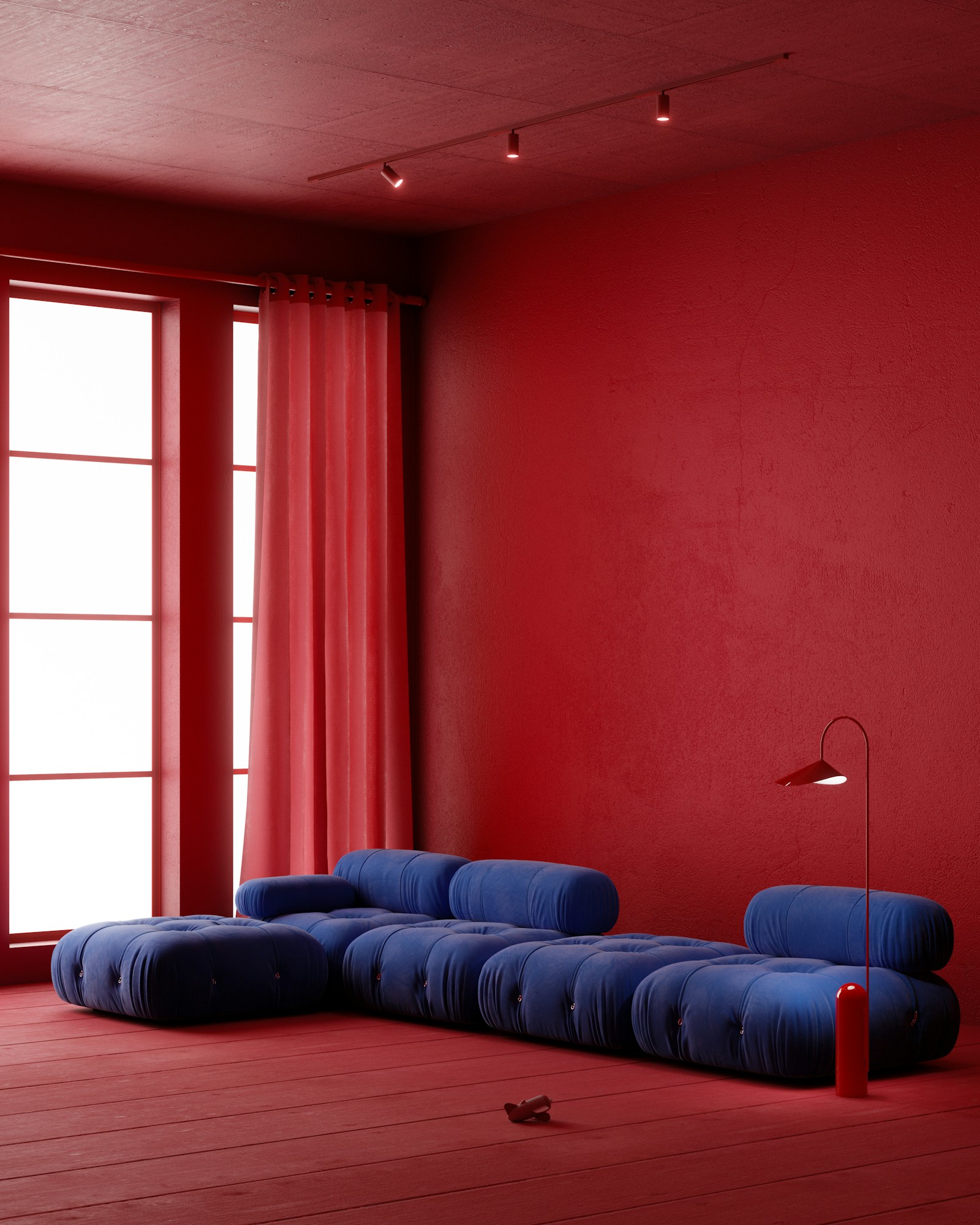
Red walls and a blue sofa can work very well together, but they need light that reveals their depth without making either color dominate. Start with warm-neutral, well-rendered light: for most living rooms, bulbs around 2700K to 3000K with a CRI of 90 or above are a strong baseline. Then use several diffused light sources rather than relying on one bright ceiling fixture.
The goal is not to make the red and blue match exactly. It is to give both surfaces enough even illumination that the red reads as rich rather than muddy and the blue retains its character rather than turning gray or nearly black. Once that lighting baseline is in place, smaller additions such as wood, cream, muted blush, charcoal, or aged brass can help the room feel connected.
Start With Light Quality, Not New Decor
When a room has saturated wall color, a bold rug, and strong upholstery, changes in light quality are often more noticeable than changes in accessories. A red wall absorbs and reflects light differently from a pale neutral wall, while a blue sofa can look dramatically different under warm and cool lamps.
A useful starting specification is:
| Lighting quality | Practical choice for this room | Why it helps |
|---|---|---|
| Color temperature | 2700K to 3000K | Keeps the room comfortable while avoiding an overly yellow cast or a stark blue-white effect. |
| Color rendering | CRI 90+ where possible | Helps reds, blues, wood, skin tones, and textiles appear more natural and distinct. |
| Dimming | Dimmable lamps and compatible controls | Lets the room feel calm at night without losing usable light for reading or hosting. |
| Shade diffusion | Fabric, parchment, frosted glass, or other diffusing shades | Softens shadows and reduces harsh hotspots on saturated surfaces. |
| Light distribution | Multiple moderate sources | Gives the walls, sofa, and rug a more even visual presence. |
Color temperature describes whether white light appears warmer or cooler. Lower color temperatures tend to look more yellow or amber; higher temperatures tend to look whiter or bluer. In a red-and-blue room, extremes can pull the palette apart. Very warm light can overemphasize the warmth in red walls and make some blues seem duller. Cool white light can make blue upholstery more pronounced while causing red paint to look sharper, flatter, or less inviting.
For most evening living rooms, 2700K is the softer choice. Move toward 3000K if the room is naturally dark, heavily colored, or used for active tasks such as reading, crafts, or working at a sofa bed. The exact result still depends on the paint, fabric, daylight, and other finishes, so test one lamp before changing every bulb.
Choose High Color Rendering for Red Paint and Blue Upholstery
Good color rendering matters more in a room with strong colors than it does in an all-neutral room. A low-quality light source may make a red wall look brownish, overly orange, or flat. It can also make a blue sofa lose the subtle differences that keep it from looking like a single dark block.
Look for a CRI of 90 or higher for the lamps that do most of the room's visual work, especially table lamps near the sofa, floor lamps near seating, and ceiling fixtures that illuminate the walls. CRI is not a complete description of color quality, but it is a practical first filter when comparing ordinary household lamps.
For more detail on what the rating means and what it does not tell you, see our guide to what CRI means in lighting.
Do not judge a bulb only by the package photo or by how bright it looks in a store. Put one in the room and view it at the time you normally use the space. Look at the red wall, the sofa fabric, the rug, and skin tones together. If one surface looks much more vivid while the others look drained, the problem may be the bulb's color quality, color temperature, or both.
Use Layered Light to Stop the Colors From Competing
A single overhead fixture often creates the least flattering result in a saturated living room. It can leave upper walls bright, seating dim, and corners visually disconnected. Strong downlight can also create sharp shadows that make a sofa bed, rug, and surrounding furniture appear like separate objects rather than one arrangement.
Build the room around three light layers.
1. Ambient light for overall balance
Ambient light gives the room a comfortable starting level. This may come from a ceiling fixture, a floor lamp with an uplight component, wall sconces, or a combination of these.
The important point is distribution. If the ceiling fixture directs all of its light downward, add another source that sends some light outward or upward. Light reflected from a pale ceiling softens contrast and helps prevent the red walls from becoming a dark perimeter around a bright center.
If the ceiling is white, warm white, or a light neutral, it can be useful as a reflector. Avoid aiming an intense bare bulb directly at it, however. The result can feel glaring even if the rest of the room remains dim.
2. Task light at the sofa
A blue sofa bed needs usable local light, particularly if it is used for reading, conversation, or occasional overnight guests. Place a floor lamp beside or just behind one end of the sofa, or use a table lamp on a nearby side table.
Choose a shade that conceals the bare light source at normal seated eye level. A large fabric shade, frosted globe, or well-shielded reading lamp is generally easier to live with than an exposed clear bulb. Clear bulbs can create bright points of glare and hard reflections on smooth painted walls.
For reading, use an adjustable lamp if possible, but direct its beam toward the book or lap area rather than across the red wall. The wall should receive soft spill light, not a concentrated spotlight.
3. Accent light for wall depth and visual connection
Accent lighting can make red walls feel deliberate and dimensional. Use it sparingly: a small lamp on a console, a picture light, a shaded wall sconce, or a gentle upward wash from a floor lamp can be enough.
Avoid placing a narrow, powerful spotlight too close to a red wall unless highlighting art or a specific architectural feature. Strong scallops of light can emphasize paint texture, create uneven patches of red, and make the wall compete with the sofa.
If the room has tall walls, sconces can help distribute light at a more comfortable height. Our guide to wall sconces for tall living room walls explains the placement questions to consider before adding them.
Match the Lamp Shade to the Room's Color Strategy
Lamp shades influence the room's color balance almost as much as the bulb. Their material, lining, and color determine whether they diffuse light broadly or send it into narrow, contrasting pools.
For a room with red walls and a blue sofa, start with shades in one of these directions:
- Warm white, ivory, or oatmeal: Softens the room and creates a bridge between warm red walls and cool blue upholstery.
- Natural linen or pale woven material: Adds texture and warmth without introducing another strong color.
- Muted clay, tobacco, or soft terracotta: Can relate to red walls, but should be noticeably quieter than the paint.
- Deep blue or red shades: Use only when the lamp is meant to be a deliberate color statement. These shades tint the emitted light and can make the room feel heavier at night.
A white-lined shade usually produces more useful light than a dark-lined shade. That matters beside a sofa, where you may need enough illumination for reading without turning on every lamp. Dark shades can still work as decorative objects, but they often need a second nearby source to make the seating area functional.
Give Red Walls Some Light, but Not All the Light
How to light red walls depends partly on their depth and finish. Deep matte red can absorb enough light that a room feels smaller at night. Glossier red may reflect bright points from lamps and windows. In either case, broad, indirect illumination is usually more helpful than aggressive direct lighting.
Aim for gentle overlap between light sources. For example, a ceiling fixture may provide general light, while a table lamp softly brightens one portion of the wall and a floor lamp supports the far side of the seating area. The room should not have one brilliantly lit wall next to a nearly black corner.
Check the room after dark with curtains closed. Daylight can conceal unevenness that becomes obvious in the evening. If one red wall looks much darker than the others, add a diffused source nearby rather than replacing every existing fixture with brighter bulbs.
Keep the Blue Sofa From Looking Isolated
A blue sofa can seem disconnected when it is the only cool-toned element in a room dominated by red, warm wood, and amber light. Lighting cannot change the color relationship completely, but it can prevent the sofa from appearing visually separate.
First, make sure some ambient light reaches the sofa back and arms. A sofa lit only from above may look like a dark blue shape against a brighter wall. A nearby lamp with a translucent shade can reveal its texture and soften the contrast.
Then repeat blue in small, restrained ways. This could be a blue detail in artwork, a muted blue-gray throw, a ceramic object, or a pattern in the rug. The repeated color does not need to match the sofa exactly. A less saturated blue, navy, slate, or blue-gray often creates a more relaxed connection than several identical bright-blue accents.
Use neutrals and materials as bridges rather than adding more competing colors. Cream, mushroom, charcoal, black, walnut, oak, natural linen, and aged brass can all create visual pauses between the red wall and blue upholstery.
Put Lighting on Separate Controls
A bold room benefits from different lighting scenes. If every fixture turns on at once, the room can become bright but visually flat. If only one lamp is used, it may become moody but impractical.
Set up at least two or three controllable groups where possible:
- General room lighting
- Sofa-side reading or task lighting
- Wall, artwork, or background accent lighting
Dimmers are particularly useful because saturated surfaces often look better under moderate, layered illumination than under maximum output. Before using a dimmer with an LED bulb, confirm that the bulb and control are intended to work together. Compatibility problems can cause flicker, limited dimming range, or buzzing.
If you are changing hardwired controls or fixtures, verify local electrical requirements and use a qualified electrician when the work is beyond a simple bulb or plug-in lamp change.
Common Mistakes With Living Room Lighting for Bold Colors
Using cool daylight bulbs throughout
Bulbs labeled daylight are often much cooler than most living rooms need. They can make the blue sofa stand out sharply while making red walls feel harsher or less comfortable at night. Reserve cooler light for situations where it suits the room's function and appearance after testing.
Trying to solve dim corners with one stronger bulb
A higher-output central bulb may brighten the floor but still leave walls and seating uneven. Add a lamp closer to the dark area instead. More locations usually work better than one more-intense location.
Choosing exposed bulbs for every decorative fixture
Exposed bulbs can look appealing when switched off, but they may cause glare when viewed from the sofa. In a color-rich room, glare also creates distracting bright points that pull attention away from the walls, rug, and upholstery.
Adding colored LED strips to correct the palette
Red, blue, purple, or color-changing LEDs can be useful for occasional atmosphere, but they are rarely the best everyday solution for showing red paint and blue fabric accurately. Establish good white-light layers first. Treat colored lighting as an optional separate scene, not as the room's main illumination.
Changing all bulbs before testing one area
Paint and upholstery respond differently to light from one home to another. Test a candidate bulb in the lamp closest to the sofa and wall before standardizing the rest of the room. Compare it in daylight, early evening, and full darkness.
A Simple Plan for This Room
If the room currently feels disconnected, make changes in this order:
- Replace the most-used bulbs with matching 2700K or 3000K, high-CRI lamps.
- Add or improve one shaded task lamp at the blue sofa.
- Add a soft source that gives the red wall gentle side or upward light.
- Put the main light and accent sources on separate controls or use plug-in dimmers where suitable.
- Only then add small bridging details in neutral materials and repeated blue or red tones.
This approach lets the red walls remain confident and the blue sofa remain distinct without asking either color to disappear. The most cohesive result usually comes from warm-neutral, high-quality light, softly diffused shades, and enough separate light sources to make every major surface part of the same evening scene.
For a reminder that identical color-temperature bulbs can still appear different in real rooms and photographs, see why 3000K lighting looks different in photos.
References
- Red and Blue Lighting Ideas. (n.d.). https://www.pinterest.com/ideas/red-and-blue-lighting-ideas/924031871642
- Saturated Colors - Woodgrain. (n.d.). https://woodgrain.com/saturated-colors
- How to decorate a room with red walls without it looking too .... (n.d.). https://www.facebook.com/groups/homedesign/posts/1574631299926384
- How to Decorate with Red WITHOUT It Looking Cheap or Intense. (n.d.). https://www.youtube.com/watch?v=D3ylSRQp8fY
- Guide to Correlated Color Temperature (CCT) & Color Rendering Index (CRI). (n.d.). https://info.regencysupply.com/guide-to-correlated-color-temperature-cct-color-rendering-index-cri
- Guide to Correlated Color Temperature (CCT) & Color Rendering Index (CRI). (n.d.). https://info.regencylighting.com/guide-to-correlated-color-temperature-cct-color-rendering-index-cri
- The Designer Guide To Using Primary Colors In Interior Design | LUXE Interiors + Design. (n.d.). https://luxesource.com/architecture-design/primary-colors-in-interior-design
- What other colour match light blue walls other than white .... (n.d.). https://www.reddit.com/r/interiordecorating/comments/1j0zlxj/what_other_colour_match_light_blue_walls_other