Bathroom lighting under chin shadows are usually a placement problem, not a color-rendering problem. A bright ceiling fixture or a vanity bar mounted high above the mirror sends most of its light downward. The brow, nose, jaw, and chin then block that light, leaving darker areas beneath them.
The most reliable improvement is to put diffuse light on both sides of the mirror, near face height, while retaining separate ceiling lighting for general room illumination. Symmetrical side lighting fills shadows from opposite directions, making shaving, makeup, skincare, and other close mirror tasks easier without depending on a harshly bright overhead fixture.
Why under-chin shadows happen
A face is not a flat surface. Its features interrupt light and create small shadows according to the direction of the source. When the main vanity light is above the face, shadows fall downward:
- Brows darken the eye sockets.
- The nose shades the upper lip and one side of the face.
- The jaw casts a shadow onto the neck.
- The chin and lower jaw can make the area beneath the chin look unusually dark.
More brightness does not necessarily solve this. Raising the output of one overhead fixture can make the bathroom brighter overall, yet the direction of the shadows remains nearly the same. It can also increase reflected glare in the mirror.
The opposite problem can happen with lighting installed below the mirror or near the countertop. Upward light can create unnatural shadows above the nose, chin, and cheekbones. It may be useful as a low-level night light, but it is not a replacement for practical face lighting.
High CRI helps color, not shadow direction
A high color rendering index, commonly called CRI, can help colors and skin tones appear more natural under electric light. That matters when selecting makeup, shaving, or checking skin tone. But CRI does not change where the fixture is located or how light reaches the face.
A high-CRI lamp above the mirror can still create deep shadows below the chin. Conversely, a reasonably good-quality lamp in a well-positioned, diffused pair of side sconces can make the face appear much more evenly lit.
Think of these as separate decisions:
| Lighting question | What it affects | What to prioritize |
|---|---|---|
| Where does the light come from? | Facial shadows and glare | Position and symmetry |
| How broad is the emitting surface? | Shadow softness | Diffusion and fixture design |
| How much light is available? | Task visibility | Appropriate output and dimming |
| How faithfully are colors shown? | Skin tone and cosmetic color judgment | Good color rendering |
For more on the last point, see our guide to what CRI means in lighting.
Use balanced side lighting at the mirror
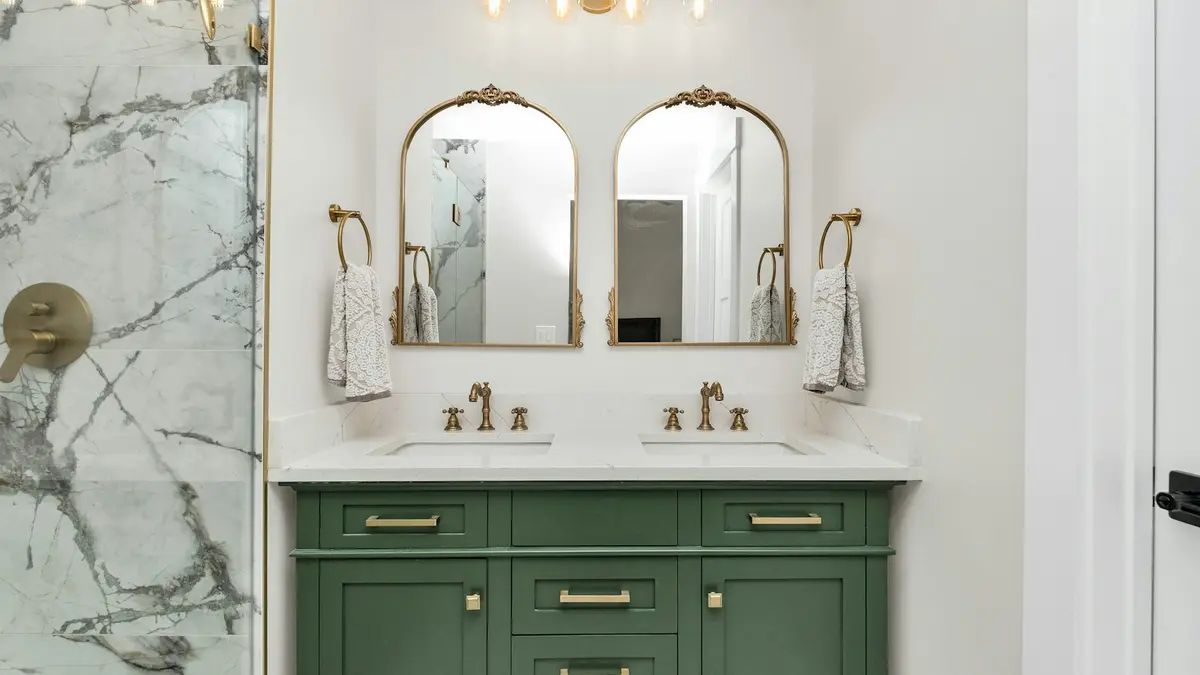
For most bathroom vanities, the strongest starting point is a matching pair of vertical sconces, one on each side of the mirror. This arrangement directs light across the face from left and right rather than relying on a single downward path.
The goal is not to eliminate every facial contour. A completely shadowless face can look flat and may be difficult to achieve in an ordinary bathroom. The goal is to prevent one strong source from making the underside of the chin, nose, and brow appear disproportionately dark.
Place sconces around face height
Mount side fixtures so their useful glowing area overlaps the height of the user’s face rather than sitting entirely above it. A tall vertical fixture is often helpful because it illuminates from roughly forehead level toward the jaw and neck, even when people in the household differ in height.
Exact mounting height depends on the mirror, sink, ceiling height, and primary users. Before final installation, it is worth temporarily holding a sample fixture or portable light near the proposed location and checking the reflection from normal standing distance. Look specifically at the eye sockets, upper lip, jawline, and area below the chin.
Keep the pair symmetrical
One side light is better than only a ceiling light, but it creates a new one-sided shadow pattern. Matching fixtures placed at similar heights on both sides provide more even illumination and a more balanced reflection.
Symmetry also matters when the sink or mirror is off-center. If the mirror is centered on the vanity, center the lighting around the mirror. If the vanity serves more than one person or has two sinks, plan the lighting around where faces will actually be positioned, not only around a decorative ceiling fixture.
Choose diffusion over exposed points of light
The size and shielding of the light source affect how sharp the shadows appear. A small, clear bulb acts more like a point source and tends to create crisp-edged shadows. A fixture with a frosted lens, opal glass, or another broad diffusing surface spreads the light over a larger area and softens transitions between light and shade.
This does not mean every fixture must be fully opaque. A decorative fixture can still work if the bulbs are well shielded from direct view and the source is distributed along enough of the fixture’s height. The practical question is whether the fixture creates a comfortable, broad glow at the face or a few intensely bright points reflected in the mirror.
Avoid choosing a vanity fixture solely because its lamp output is high. A very bright exposed lamp near eye level can create discomfort and mirror glare even if it reduces some shadows.
If you need an above-mirror bar
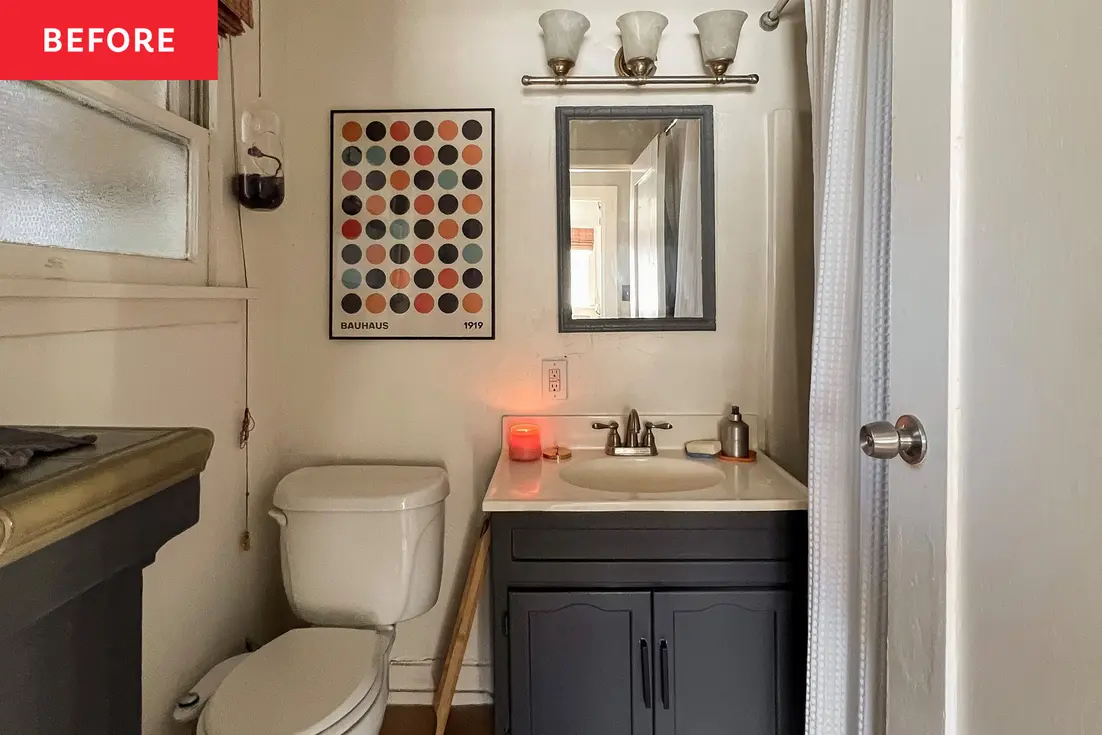
An above-mirror bar is common because it works with many existing electrical boxes and leaves the sides of the mirror clear. It can be a reasonable compromise where there is no wall space for sconces, but it should be treated as a compromise rather than equivalent to two-sided face lighting.
To get a better result from an above-mirror fixture:
- Choose a fixture with a broad, diffused light-emitting area rather than a single small lamp.
- Use a longer fixture that distributes light across the mirror width, rather than concentrating it at the center.
- Mount it close enough to the mirror area that it lights the user, not just the upper wall and ceiling.
- Pair it with gentle ambient lighting so the vanity light does not have to do all the work.
- Use a compatible dimmer where appropriate, allowing the light level to be adjusted for daytime and nighttime use.
Even a well-designed bar remains above the face, so some under-chin and under-eye shading is likely. Adding side lighting later, or using illuminated mirror edges designed to light the face, can improve the result if the wall and electrical layout allow it.
Control contrast in the rest of the bathroom
Facial shadows look harsher when the mirror area is surrounded by much brighter or much darker surfaces. A bright recessed downlight directly behind the person can make the reflected face appear comparatively dim. Very dark finishes around a small mirror can also reduce the amount of reflected light in the vanity zone.
Use ambient lighting to make the room comfortable, but do not expect it to replace dedicated vanity lighting. Ceiling fixtures are valuable for entering, cleaning, bathing, and navigating the room. Vanity fixtures should be selected and positioned for the more specific job of lighting the face.
A separate control for vanity and ambient light is useful because these tasks do not always need the same level of brightness. It also gives you a way to assess whether the mirror lighting works on its own rather than being masked by a very bright ceiling fixture.
Common fixes that do not fully solve the problem
Replacing bulbs but keeping the same fixture
A better bulb may improve color, flicker behavior, or brightness, but it cannot substantially alter a fixture’s direction. If the source remains high above the mirror, the basic downward shadow pattern remains.
Adding more recessed ceiling lights over the vanity
More ceiling lights can improve general brightness, but lights directly over the user still tend to shade the eyes, nose, and chin. Recessed fixtures can support the overall room layer; they are not usually the primary answer for flattering bathroom vanity lighting.
Relying on light from the mirror alone
A small integrated mirror light may be too narrow, too dim, or positioned too high to light the lower face evenly. Some illuminated mirrors work well, especially when they have broad lighted edges on both sides, but assess the actual glowing area and direction rather than assuming all lit mirrors provide effective task lighting.
Installing lights too far from the mirror
Wall lights placed far out to either side may brighten the room without putting enough usable light on the face. They can also create more side-heavy modeling. Keep the fixtures close enough to the mirror zone to serve the person standing at it, while leaving appropriate clearance for mirror size, doors, cabinets, and everyday movement.
A practical planning checklist
Before buying or relocating fixtures, stand at the vanity and answer these questions:
- Is the main light on the face coming from above, below, one side, or both sides?
- Can you see the fixture or bare lamp as a distracting bright reflection in the mirror?
- Are both sides of the face similarly illuminated?
- Does the light reach the lower face and neck, not only the forehead and countertop?
- Is the source diffused enough to soften shadow edges?
- Can vanity lighting and ceiling lighting be controlled separately?
If the answer to the first question is “mostly above,” prioritize adding or planning symmetrical side illumination. If side sconces are not possible, improve the above-mirror fixture’s width and diffusion, then use ambient light to lower contrast.
Bathroom electrical work involves moisture exposure, fixture suitability, wall conditions, and local requirements. Verify the current rules that apply to your location and fixture location, and use a qualified electrician for new wiring, relocated junction boxes, or any work you are not equipped to assess safely. For constrained layouts, our guide to small bathroom vanity lighting without side sconces covers alternatives when a sconce pair will not fit.
References
- Bathroom Lighting Without Shadows and Glare. (n.d.). https://homeworlddesign.com/bathroom-lighting
- Vanity Lights Beside the Mirror: Height and Spacing Guide – Golden Lighting. (n.d.). https://goldenlighting.com/blogs/the-golden-edit/bathroom-vanity-lights-on-side-of-mirror-a-pro-guide
- Bathroom Lights: Mistakes That Cause Shadows & Fix Them All. | Niori. (n.d.). https://niori.co.uk/blogs/lighting-design-tips/bathroom-lights-mistakes-avoid-harsh-shadows
- Bathroom Vanity Lighting That Flatters Every Skin Tone - Lightopia. (n.d.). https://www.lightopia.com/bathroom-vanity-lighting-cri
- Best Bathroom Vanity Lighting: Specs That Flatter Your Face – Golden Lighting. (n.d.). https://goldenlighting.com/blogs/the-golden-edit/best-lighting-for-bathroom-vanity-buyers-guide
- Bathroom Vanity Lighting: Light a Face, Not a Ceiling – Golden Lighting. (n.d.). https://goldenlighting.com/blogs/the-golden-edit/bathroom-vanity-lighting-how-to-light-a-face-not-a-ceiling
- Bathroom Lighting Guide: Vanity Lights & Safety | Lightopia. (n.d.). https://www.lightopia.com/bathroom-lighting-guide
- Top 10 Modern Bathroom Vanity Lights (For Perfect Grooming). (n.d.). https://rhealighting.com/modern-bathroom-vanity-lighting-grooming