A 3000K LED strip and a 3000K recessed fixture can both be accurately labeled yet still look different when switched on together. One may look faintly green or yellow-green, while the other looks rosier, cleaner, or more neutral. This is why same color temperature LEDs look different: correlated color temperature (CCT) is only one part of a light source’s color.
The most common missing specification is Duv, which describes a source’s green-to-magenta tint relative to the blackbody locus—the path associated with familiar warm-to-cool white light. LED manufacturing tolerances, different phosphor mixtures, driver behavior, dimming, and the surfaces around the lights can all make a mismatch more obvious. High CRI is useful, but it does not guarantee that two white LEDs will match.
CCT is a category, not an exact color point
CCT is expressed in kelvins: 2700K, 3000K, 3500K, 4000K, and so on. It is an efficient shorthand for whether white light generally reads warm or cool. But it reduces a complex spectrum and chromaticity position to one number.
A constant CCT is not one unique visible white. The U.S. Department of Energy notes that two sources with the same CCT can look greenish or pinkish relative to one another because a CCT corresponds to a line of possible chromaticity positions, rather than one point. It also notes that nominal labels such as 2700K and 3000K cover ranges of actual CCT and tint values under ANSI guidance. DOE’s LED color characteristics fact sheet illustrates this limitation directly.
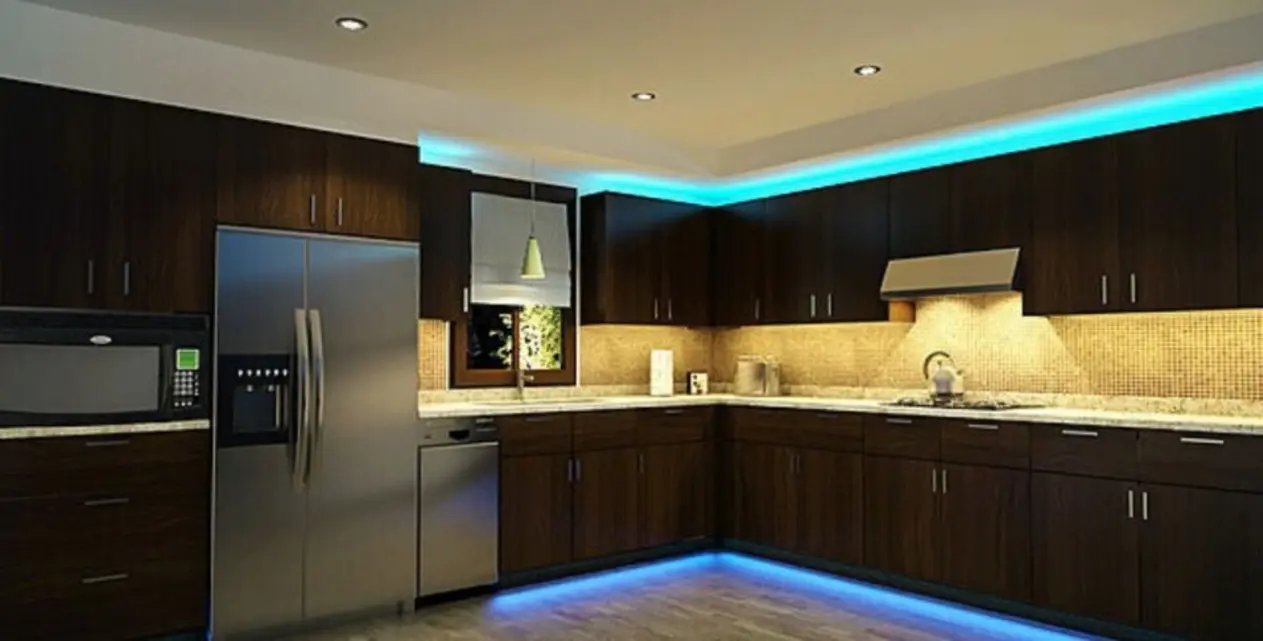
That means “3000K” is a useful starting point, but not a complete matching specification. It is especially inadequate when lights are close together: under-cabinet strips beside recessed downlights, cove strips near wall washers, or multiple integrated fixtures across one open-plan room.
Duv explains the green or pink difference
Duv is the distance of a light source from the blackbody locus at its CCT. In practical terms:
- Positive Duv tends to look greener or yellow-green.
- Negative Duv tends to look pinker or slightly magenta.
- Duv near zero is often described as more neutral relative to the blackbody locus.
Neither direction is automatically defective. A modest negative Duv can look pleasant in some residential settings, while a positive Duv may be less objectionable when seen alone. The problem is relative difference. Put a slightly green 3000K strip next to a slightly pink 3000K downlight, and the contrast can make both seem wrong.
A specific combination of CCT and Duv identifies a much more precise chromaticity location than CCT alone. As this overview of chromaticity and Duv explains, a description such as “3000K, Duv +0.0007” is substantially more meaningful for matching than “3000K” by itself.
LED binning controls how much one unit can vary from another
Individual LEDs do not emerge from production at precisely the same color point or output. Manufacturers measure and sort them into groups, called bins, with similar color characteristics. Tighter sorting generally gives more consistent color from one LED package, reel, bulb, or fixture to another.
The ANSI/NEMA chromaticity standard provides common color regions for nominal white LED products. It helps create a shared language for manufacturing and specification, but it does not mean every product marked with the same CCT will match every other product—or even look identical across different production batches. The ANSI/NEMA technical bulletin on LED binning explains that binning is based on chromaticity regions rather than a single, exact color.
For a homeowner, the practical distinction is this:
| Product information | What it can tell you about matching |
|---|---|
| 3000K only | General warmth, but little about tint consistency |
| 3000K and CRI | General warmth plus color-rendering information, but still little about tint matching |
| CCT and Duv | Much better indication of the intended white-light tint |
| Chromaticity coordinates or SDCM tolerance | More detailed information about color consistency and allowed variation |
| Same product family and production batch | Often the safest practical route when exact specifications are unavailable |
You may also see SDCM, sometimes described using MacAdam steps. It is a color-consistency tolerance that captures more than just green-magenta shift. Lower tolerances generally mean a tighter color grouping. It is most useful when comparing products that state the metric clearly and on a comparable basis.
High CRI does not mean the whites will match
CRI indicates how faithfully a light source renders a set of test colors compared with a reference source of similar CCT. It is about color rendering, not whether the source lands on the same white tint as another lamp.
So a high-CRI 3000K LED strip can still look pinker, greener, warmer, or cooler than a high-CRI 3000K recessed fixture. Two high-CRI sources may also render wood, paint, food, textiles, and skin somewhat differently because their spectral power distributions differ.
This is not necessarily a failure of either light. CRI is a valuable specification, particularly where material and skin appearance matter, but it should not be used as a proxy for chromaticity matching. For a fuller explanation of what it does and does not measure, see What Is CRI in Lighting?.
Why strips and fixtures often mismatch
LED strips are especially prone to visible comparison because they create a continuous illuminated line close to cabinets, backsplashes, ceilings, or walls. A recessed fixture may be several feet away and illuminate the same surfaces from a different angle. Even a small tint difference becomes easy to notice.
Common reasons include:
Different LED packages and phosphors
A strip maker and a fixture maker may use different LED packages, phosphor formulations, and chromaticity targets. Both can legitimately call the result 3000K.
Different product batches
A replacement reel bought months later may come from a different production run. If the manufacturer does not tightly control color bins across batches, it may not match an earlier reel. This matters when extending under-cabinet lighting or repairing one section of cove lighting.
Dimming behavior
At low output, a fixture’s electronics and LED mix can look somewhat different from its full-output appearance. Warm-dim products are designed to shift warmer as they dim, so they should not be expected to match a standard fixed-CCT strip at every dimming level. Inconsistent dimming controls or incompatible drivers can add visible instability or unevenness as well.
If an installed strip changes color noticeably as it dims, review the driver, controller, and dimming method before assuming the LEDs alone are responsible. Our guide to under-cabinet LED strips that change color when dimmed covers that troubleshooting path.
Surface color and viewing conditions
White paint is not neutral in every light. A cool gray wall may emphasize a pink tint, while warm cream cabinetry can make a greenish source look yellower. Glossy backsplashes, polished stone, and satin paint can intensify the comparison by reflecting the source color directly.
Daylight further complicates the judgment. A strip may appear acceptable at night but noticeably different in the daytime when window light mixes with it. The eye also adapts to a single source over time; mismatches become most obvious when the lights are adjacent and operating together.
How to buy lights that have a better chance of matching
When matching LED strip lights and fixtures matters, use this workflow before permanent installation.
- Choose the CCT first, but treat it as the broad target. Decide whether the room needs 2700K, 3000K, 3500K, or another general white-light range. Do not expect the number alone to settle the match.
- Use one manufacturer and product family where possible. This does not guarantee a match, but it can reduce variables because the maker may use related chromaticity targets and tighter internal controls.
- Ask for Duv, chromaticity coordinates, or SDCM information. A supplier may not publish these details for consumer products, but a clear answer is useful. If the lights will meet visually in the same room, avoid relying only on “warm white” or “3000K high CRI.”
- Buy enough strip from one order for the complete run. Do not assume a later reel will be identical. Keep a labeled offcut from the installed batch for comparison if future repairs are likely.
- Test all light sources together before final mounting. Place the strip temporarily where it will be installed, energize the nearby fixtures, and view the result after dark. Test at the dimming levels you actually expect to use.
- Judge the actual room surfaces. Look at cabinet faces, backsplash material, wall paint, counters, upholstery, and skin tones—not only the LED dots or diffuser. A source that looks neutral in open air can read differently on a particular finish.
- Compare from normal viewing positions. Stand at the kitchen entry, sit on the living-room sofa, and view the lights from the angles where the mismatch would matter. Do not make the decision solely while standing directly under one fixture.
- Keep returns and installation flexible until you are satisfied. Test before cutting strips, closing channels, or permanently fastening fixtures. Tint differences are easier to solve before installation than after it.
What to do when installed lights already look mismatched
First, make sure you are comparing them at the same dimming level and without strong daylight changing one area more than another. Then isolate the sources: turn on the strip alone, then the fixtures alone, then both together. This helps separate a true source mismatch from reflected color or mixed daylight.
If the strip is visibly greener or pinker, the practical fixes are usually to replace it with a better-matched product, replace the neighboring lamps or fixtures as a group, or reduce direct side-by-side comparison through placement and shielding. A diffuser can soften visible LED points, but it cannot correct the strip’s underlying chromaticity.
Avoid trying to solve a tint mismatch by selecting a substantially different CCT. Choosing 2700K to compensate for a greenish 3000K strip may create a new blue-yellow mismatch rather than a convincing match. A product with a more suitable Duv and tighter color consistency is the more direct solution.
The useful specification to remember
Color temperature answers, “How warm or cool is this white light in broad terms?” It does not answer, “Will this 3000K LED look identical to that 3000K LED?”
For close visual matches, look beyond CCT to Duv, chromaticity tolerance, binning, product batch, and real-room testing. High CRI remains important for how colors appear under the light, but it is a separate question from whether adjacent white light looks consistently neutral. In kitchens and living rooms, where strips, downlights, and decorative fixtures often operate together, that distinction prevents many disappointing purchases.
References
- What Is DUV in LED Lighting and Why It Matters for Your Projects. (n.d.). https://www.commercial-lighting.net/what-is-duv
- Chromaticity: The Science Behind the Color of LED Light – naturaLED. (n.d.). https://naturaled.com/chromaticity-the-science-behind-the-color-of-led-light
- LED Color Characteristics. (n.d.). https://www.energy.gov/sites/prod/files/2016/08/f33/led-color-characteristics-factsheet.pdf
- Going beyond the 20th century color space to evaluate LED color consistency. (n.d.). https://opg.optica.org/abstract.cfm?uri=oe-31-23-38666
- Color consistency in lighting products | Waveform Lighting. (n.d.). https://www.waveformlighting.com/tech/color-consistency-in-lighting-products
- LED Light Color Consistency - GREEN CREATIVE - Your Partner for Professional Lighting Solutions. (n.d.). https://greencreative.com/lighting-academy/lighting-guide/led-light-color-consistency
- Everything Explained About LED Binning & Color Consistency – Clear Lighting | Custom LED Neon Flex Lighting. (n.d.). https://clearlighting.com/everything-explained-about-led-binning
- ANSI/NEMA LED Binning Standard. (n.d.). https://orf.od.nih.gov/TechnicalResources/Documents/Technical%20Bulletins/19TB/ANSI%20NEMA%20LED%20Binning%20Standard%20November%202019-Technical%20Bulletin_508.pdf